
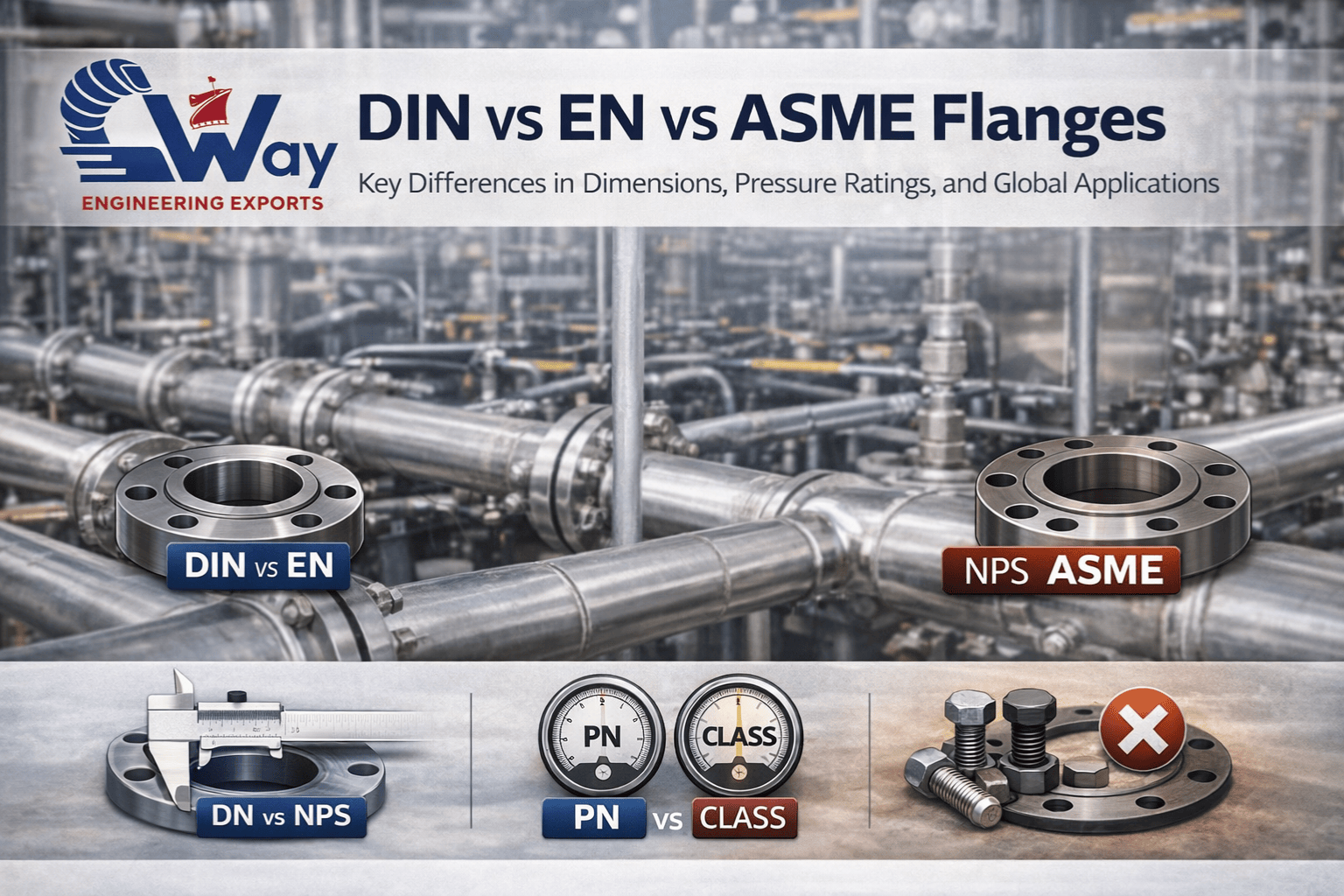
DIN vs EN vs ASME Flanges: Key Differences in Dimensions, Pressure Ratings, and Global Applications
If you’ve ever worked on an international piping project, you already know this truth the hard way:
a flange is never just a flange.
On paper, DIN, EN, and ASME flanges all do the same job-connect pipes, valves, pumps, and equipment. But in reality, mixing or misunderstanding these standards is one of the most common reasons for leakage, bolt mismatch, installation delays, and costly rework on site.
So let’s slow things down and clear the confusion once and for all. In this guide, I’ll walk you through the real engineering differences between DIN, EN, and ASME flanges not textbook theory, but what actually matters when you’re designing, procuring, or installing piping systems across Europe, North America, the Middle East, and beyond.
DIN vs EN vs ASME flanges are among the most commonly used piping standards in global industrial projects. Engineers working across Europe, the Middle East, and North America frequently encounter compatibility challenges when selecting between DIN, EN 1092-1, and ASME B16.5 flange standards. Understanding the dimensional differences, pressure ratings, and bolt patterns is critical to prevent leakage, installation delays, and costly project rework
DIN vs EN vs ASME Flanges: What Are the Key Differences?
Flanges are not interchangeable across standards. Even when nominal sizes look equivalent, differences in DN vs NPS sizing, PN vs Class pressure ratings, bolt circle diameter, flange thickness, and allowable bolt load can make two flanges completely incompatible.
Using the wrong standard can result in:
- Bolt hole misalignment
- Uneven gasket compression
- Leakage during pressure testing or thermal cycling
- Inspection rejection by consultants or end users
For global projects, selecting the correct flange standard upfront ensures compliance, leak-free performance, and smooth installation.
Now imagine what happens when someone assumes PN16 = Class 150 or DN100 = 4 inch without checking bolt patterns. That’s how flanges arrive on site, fit almost,but not quite and suddenly the project timeline slips.
Understanding flange standards isn’t optional anymore. It’s a risk-management skill.
Overview of DIN, EN, and ASME Flange Standards
Before we compare them, let’s understand where each standard comes from and why it exists.
DIN Flanges – The Traditional German Standard
DIN standards originated in Germany and dominated European piping systems for decades. Many older plants still use DIN-designated flanges such as DIN 2576 or DIN 2633.
DIN flanges are:
- Dimensionally precise
- Based on PN (Pressure Nominal) ratings
- Still common in legacy European installations
However, DIN standards were eventually harmonized into EN standards.
EN Flanges – The Unified European Standard
EN flanges, mainly EN 1092-1, replaced most DIN flange standards to create one common European system.
EN flanges:
- Use DN (Nominal Diameter) and PN ratings
- Are mandatory for many European public and industrial projects
- Provide consistency across EU member countries
If you’re working in Europe today water, district heating, food processing, or utilities – EN flanges are the default choice.
ASME Flanges – The Global Industrial Workhorse
Flanges manufactured according to ASME B16.5 and ASME B16.47 standards (commonly known as ANSI flanges) dominate oil & gas, petrochemical, chemical, and power industries worldwide.
Defined mainly by ASME B16.5 and ASME B16.47, they:
- Use NPS (Nominal Pipe Size) instead of DN
- Use pressure Classes instead of PN
- Are widely accepted in USA, Canada, Middle East, Africa and offshore projects
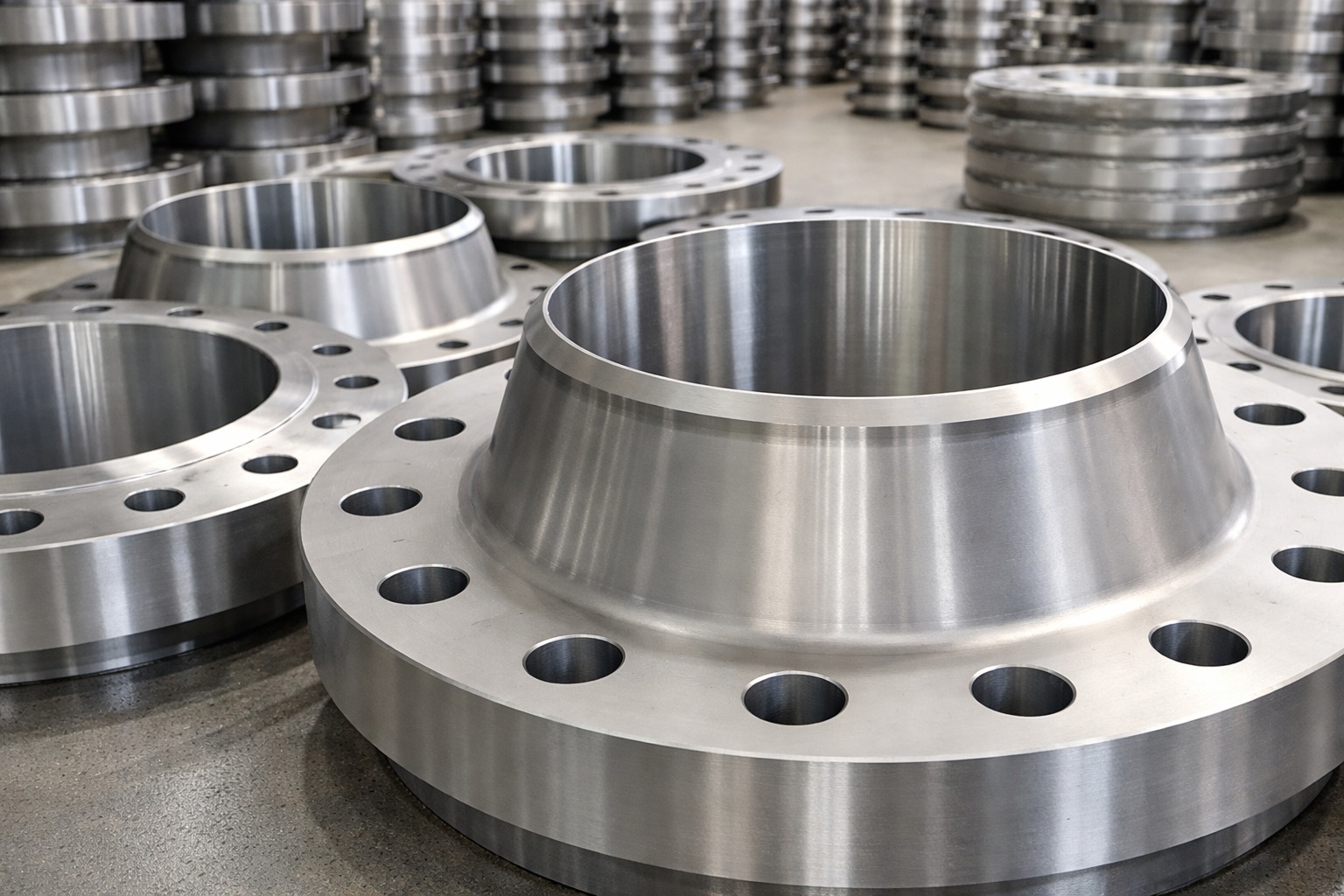
Flanges designed according to ASME pressure class standards are generally heavier, thicker, and designed for higher bolt preload, making them suitable for severe service.
DN vs NPS: Why Size Numbers Can Mislead You
This is one of the most dangerous assumptions engineers make.
- DIN & EN use DN (Nominal Diameter)
- ASME uses NPS (Nominal Pipe Size)
DN100 and NPS 4” look similar, and the pipe OD may be close, but the flanges are not interchangeable.
Differences include:
- Bolt circle diameter
- Number of bolts
- Bolt size
- Flange thickness
I’ve seen projects where flanges “almost fit,” leading teams to force alignment. That almost always ends in gasket failure later.
Rule of thumb:
DN and NPS are reference sizes-not dimensional guarantees.
PN vs Class: Pressure Ratings Explained Properly
PN Ratings (DIN & EN)
PN ratings represent a nominal pressure capacity at 20°C. As operating temperature increases, allowable pressure decreases and must be derated separately.
PN stands for Pressure Nominal, such as:
- PN6
- PN10
- PN16
- PN25
- PN40
PN ratings do not include built-in temperature-pressure tables.
ASME Pressure Classes
ASME pressure classes are temperature-dependent by design. Allowable pressure is defined through pressure–temperature rating tables, based on material grade.
ASME uses pressure classes:
- Class 150
- Class 300
- Class 600
- Class 900
- Class 1500
- Class 2500
ASME flanges maintain higher bolt preload and thicker cross-sections, improving gasket seating stress.
The Dangerous Myth
Many people assume:
- PN16 = Class 150
- PN40 = Class 300
This is only roughly true at ambient temperature, and even then:
- Bolt loads differ
- Flange thickness differs
- Safety margins differ
Never convert PN to Class without engineering validation.
Bolt Pattern and Thickness Differences: Where Leaks Are Born
Even when sizes and pressure ratings look close, bolt patterns kill interchangeability.
Key differences:
- EN flanges often use fewer but larger bolts
- ASME flanges often use more bolts with different spacing
- Flange thickness increases significantly in ASME higher classes
When mixed:
- Bolts won’t align
- Uneven gasket compression occurs
- Leakage appears during pressure testing or thermal cycling
This is one of the most common failure points in mixed-standard projects.
Important:
A flange that “almost fits” is more dangerous than one that doesn’t fit at all.
Flange Design Behavior Under Load
Bolt Load and Gasket Seating Stress
ASME flanges are designed to accept higher bolt preload, which improves gasket seating stress and resistance to pressure fluctuations.
EN flanges, while efficient for their intended applications, may reach bolt yield limits earlier, especially under cyclic thermal conditions.
Many leakage incidents are caused not by gasket failure, but by insufficient or uneven bolt load due to incompatible flange standards.
Thermal Cycling and Fatigue Performance
- Weld neck flanges perform better under cyclic loads due to smooth stress transition
- Slip-on flanges are more sensitive to fatigue and vibration
- ASME systems prefer weld neck flanges for chemical and petrochemical service
This is why chemical plants and refineries avoid slip-on flanges in critical lines.
Material Standards: EN vs ASTM
This is another area where confusion causes procurement errors.
Common EN Materials
- P245GH – carbon steel
- 1.4301 – equivalent to 304
- 1.4404 – equivalent to 316L
Common ASTM Materials
- ASTM A105 – carbon steel
- ASTM A182 F304 / F316 / F316L – stainless steel
While these materials are chemically similar, they are not interchangeable by name. Certification, heat treatment, and testing requirements differ.
For regulated projects, always match:
- Standard
- Material specification
- Certification (EN 10204 vs ASTM MTR)
DIN / EN vs ANSI / ASME Flange Standards Comparison
| Parameter | DIN / EN Flanges | ANSI / ASME Flanges |
| Governing Standard | DIN, EN 1092-1 | ASME B16.5 / ASME B16.47 |
| Primary Usage Region | Europe | USA, Canada, Middle East, Global EPC |
| Size Designation | DN (Nominal Diameter) | NPS (Nominal Pipe Size – inches) |
| Common Size Range | DN 10 to DN 4000 | ½” to 60” |
| Pressure Rating System | PN (PN6, PN10, PN16, PN25, PN40, etc.) | Class (150, 300, 600, 900, 1500, 2500) |
| Pressure Rating Basis | Rated at 20°C | Pressure varies with temperature |
| Typical Industries | Water, HVAC, district heating, food | Oil & gas, chemical, petrochemical, power |
| Flange Thickness | Generally thinner | Generally thicker and heavier |
| Bolt Pattern Philosophy | Fewer bolts, larger diameter | More bolts, higher bolt preload |
| Interchangeability | Limited with ASME | Not interchangeable with DIN/EN |
| Preferred for High Pressure | Limited (PN40 and above) | Strongly preferred (Class 300+) |
Why Standard Compliance Is Critical for Leak-Free Performance
Flanges fail not because steel is weak-but because systems are mismatched.
Real-World Insight: How ASME Standards Solved a Chemical Plant Leakage Problem
The practical impact of flange standard selection became evident in a recently completed chemical plant project involving corrosive service lines. The pipeline system had been experiencing recurring leakage at multiple flange joints, despite repeated gasket replacements and bolt re-tightening during maintenance shutdowns.
A detailed engineering investigation revealed that the root cause was not the gasket material itself, but a combination of:
- Inappropriate flange type selection
- Inconsistent fabrication quality
- Insufficient rigidity of the existing flange joints under thermal cycling
To address the issue permanently, the system was upgraded to ASME B16.5 forged stainless steel flanges, specifically weld neck flanges manufactured from ASTM A182 F316L.
Once installed with correct bolt torque, proper gasket selection, and alignment practices, the pipeline achieved stable, leak-free operation,
You can read the full technical breakdown here:
How ASME B16.5 Forged Stainless Steel Flanges Eliminated Leakage Issues in a Corrosive Chemical Plant Pipeline
How to Choose the Right Flange Standard
A Checklist Before Ordering Flanges:
- Verify DN vs NPS requirement
- Operating pressure and temperature
- Thermal cycling or vibration
- Confirm bolt size, bolt count, and BCD
- Match material standard (EN vs ASTM)
- Request MTC and compliance documents
One project. One standard. That’s the safest rule.
DN vs NPS Conversion Table (Reference Only)
| DN (Nominal Diameter) | NPS (Nominal Pipe Size) | Approx. Pipe OD (mm) | Approx. Pipe OD (inch) |
| DN 10 | ⅜” | 17.2 | 0.675 |
| DN 15 | ½” | 21.3 | 0.840 |
| DN 20 | ¾” | 26.9 | 1.050 |
| DN 25 | 1” | 33.7 | 1.315 |
| DN 32 | 1¼” | 42.4 | 1.660 |
| DN 40 | 1½” | 48.3 | 1.900 |
| DN 50 | 2” | 60.3 | 2.375 |
| DN 65 | 2½” | 73.0 | 2.875 |
| DN 80 | 3” | 88.9 | 3.500 |
| DN 100 | 4” | 114.3 | 4.500 |
| DN 125 | 5” | 141.3 | 5.563 |
| DN 150 | 6” | 168.3 | 6.625 |
| DN 200 | 8” | 219.1 | 8.625 |
| DN 250 | 10” | 273.0 | 10.750 |
| DN 300 | 12” | 323.9 | 12.750 |
| DN 350 | 14” | 355.6 | 14.000 |
| DN 400 | 16” | 406.4 | 16.000 |
| DN 450 | 18” | 457.2 | 18.000 |
| DN 500 | 20” | 508.0 | 20.000 |
| DN 600 | 24” | 609.6 | 24.000 |
| DN 700 | 28” | 711.2 | 28.000 |
| DN 800 | 32” | 812.8 | 32.000 |
| DN 900 | 36” | 914.4 | 36.000 |
| DN 1000 | 40” | 1016.0 | 40.000 |
| DN 1200 | 48” | 1219.2 | 48.000 |
Choose Standards Early, Avoid Problems Later
DIN, EN, and ASME flanges all have their place. Problems arise only when they’re mixed without understanding.
If your project is European-EN is your friend.
If it’s oil, gas, or chemical-ASME is usually the safer choice.
If it’s global-engineering discipline matters more than habit.
Get the standard right early, and everything downstream becomes easier.
Ensure leak-free performance and global compliance, connect with our engineering team to select the right DIN, EN, or ASME flanges for your project.
Disclaimer
ASME is a registered trademark of the American Society of Mechanical Engineers. The term is used here only to reference internationally recognized engineering standards such as ASME B16.5 and ASME B16.47. Our company is not affiliated with or certified by ASME unless explicitly stated.