


ASME B16.9 Pipe Fittings Dimensions Chart (Complete Guide)
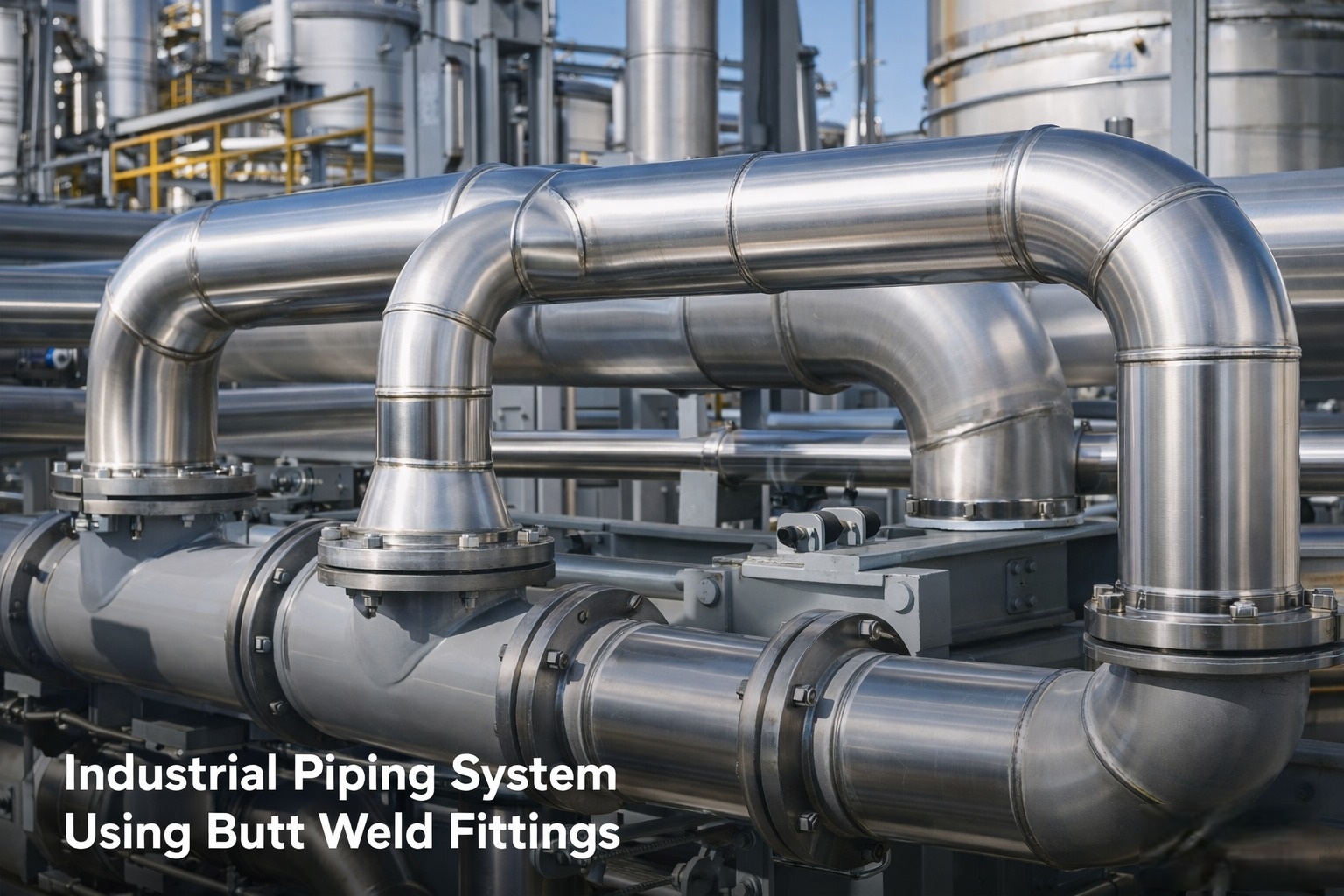
In industrial piping systems, pipe fittings play a critical role in directing flow, connecting pipelines, and adapting pipe sizes. Among the many standards governing pipe fittings worldwide, ASME B16.9 is one of the most widely used standards for factory-made wrought butt weld pipe fittings.
ASME B16.9 pipe fitting dimension charts – including elbow radius dimensions, reducer lengths, and tee center-to-end measurements – help engineers and procurement specialists design pipelines and select the correct fittings for industrial projects.
This technical guide provides a complete overview of ASME B16.9 pipe fittings, including types of fittings, dimension charts, materials, manufacturing processes, and inspection requirements. The objective is to give piping engineers and procurement teams a practical reference when specifying or purchasing butt weld fittings for industrial pipelines.
What is ASME B16.9?
ASME B16.9 is a standard published by the American Society of Mechanical Engineers (ASME) that specifies the dimensions, tolerances, pressure ratings, testing, marking, and manufacturing requirements for factory-made wrought steel butt weld fittings in sizes ranging from NPS ½ through NPS 48.
Unlike forged fittings covered under ASME B16.11, ASME B16.9 fittings are typically manufactured from seamless or welded pipes and steel plates, providing a smooth internal flow profile and high structural strength. These characteristics make them suitable for high-pressure and high-temperature industrial piping systems.
Butt weld fittings manufactured according to ASME B16.9 are designed to be welded directly to pipes, creating a strong and leak-proof connection that ensures long-term reliability in demanding applications.
The standard covers fittings manufactured from carbon steel, stainless steel, and alloy steel materials and is compatible with pipes manufactured according to ASME B36.10 and ASME B36.19 standards.
The high-performance alloys including:
- Austenitic Stainless Steel: ASTM A403 WP304/304L, WP316/316L.
- Duplex & Super Duplex: ASTM A815 UNS S31803, S32750/S32760 (for extreme saline and acidic environments).
Industries Using ASME B16.9 Pipe Fittings
ASME B16.9 pipe fittings are widely used across many industrial sectors, including:
- Oil & Gas
- Petrochemical Plants
- Chemical Processing Industries
- Power Generation Plants
- Water Treatment Facilities
- Offshore Platforms
- LNG and Cryogenic Pipelines
These industries rely on ASME B16.9 fittings because they provide excellent mechanical strength, corrosion resistance, and long service life in critical piping systems.
Compatible Pipe Standards
ASME B16.9 fittings are designed to be compatible with pipes manufactured according to the following standards:
- ASME B36.10 – Welded and Seamless Carbon Steel Pipes
- ASME B36.19 – Stainless Steel Pipes
This compatibility ensures that the pipe outer diameter and fitting dimensions match precisely, allowing reliable welding and proper alignment during pipeline installation.
Types of Pipe Fittings Covered Under ASME B16.9
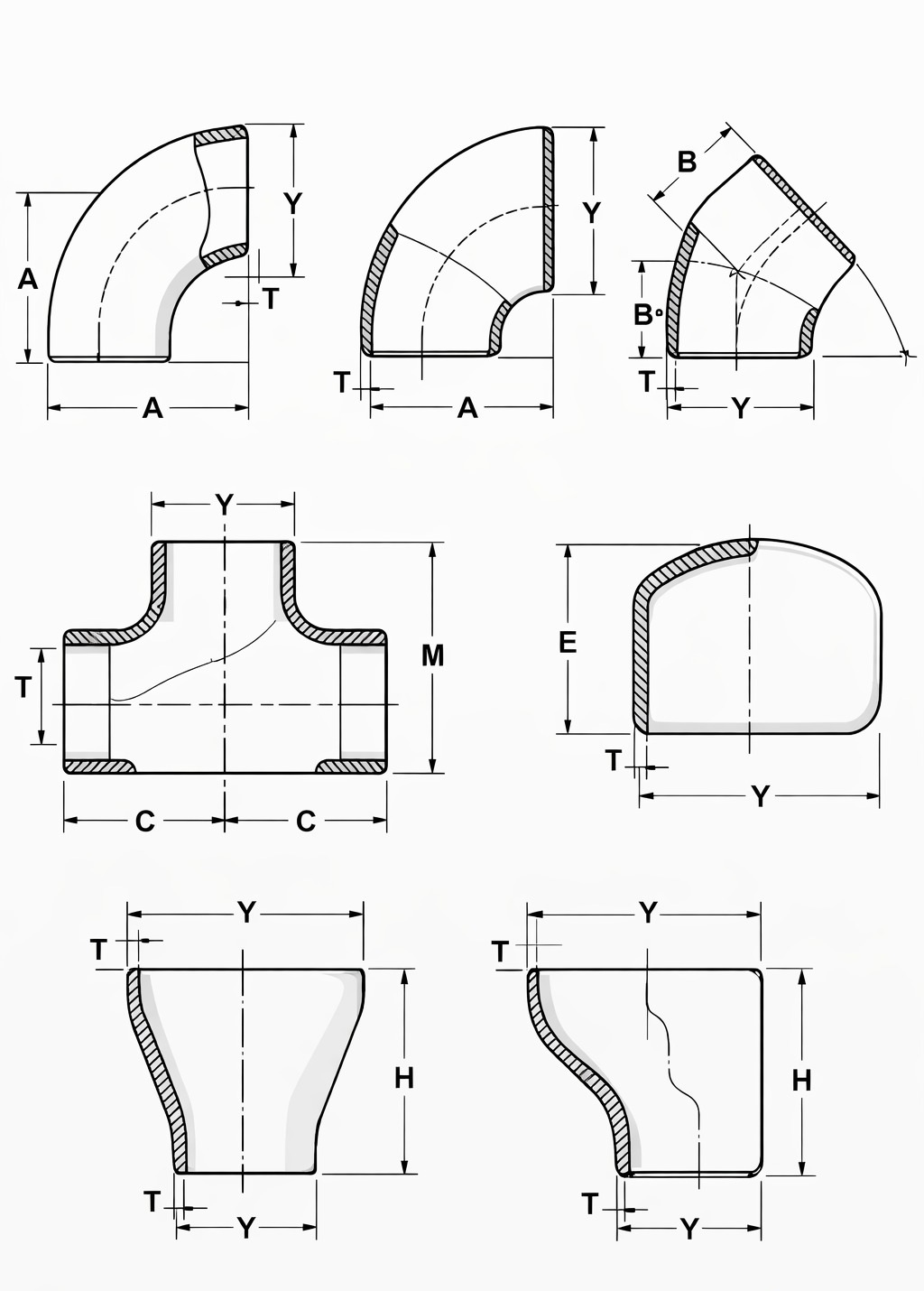
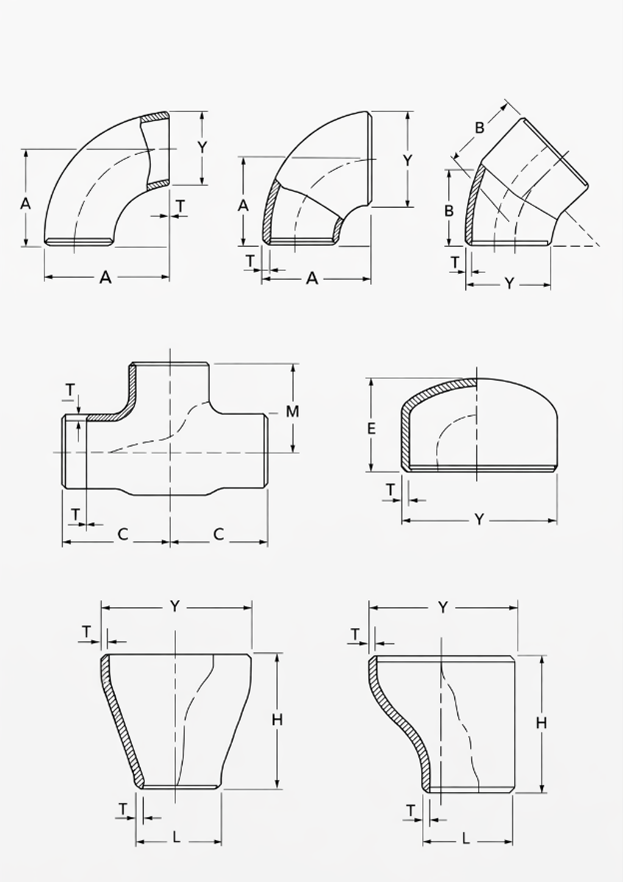
The ASME B16.9 standard includes a wide range of butt weld pipe fittings, which are used to change flow direction, branch pipelines, or connect different pipe diameters.
- 90° Long Radius Elbow Pipe Fitting
A long radius elbow (LR elbow) has a centerline radius equal to 1.5 times the nominal pipe diameter (1.5D). It is widely used in process piping because it reduces pressure loss and improves flow efficiency.
These long radius elbow dimensions are widely used in oil & gas pipelines and process piping systems because they minimize turbulence and pressure drop.
- 45° Elbow Pipe Fitting
A 45-degree elbow changes the direction of flow by 45 degrees and is commonly used where a smaller change in direction is required.
- Short Radius Elbow Pipe Fitting
A short radius elbow (SR elbow) has a radius equal to 1D. These fittings are typically used in applications where space is limited.
- Equal Tee Pipe Fitting
An equal tee allows the pipeline to branch at 90 degrees while maintaining the same pipe diameter in all directions.
- Reducing Tee Pipe Fitting
A reducing tee is used when the branch pipe has a smaller diameter than the main pipeline.
- Concentric Reducer Pipe Fitting
A concentric reducer is used to connect pipes of different diameters while keeping the centerline of the pipeline aligned.
- Eccentric Reducer Pipe Fitting
An eccentric reducer connects pipes of different diameters but keeps one side flat, commonly used in pump suction pipelines.
A pipe cap is used to close the end of a pipeline permanently.
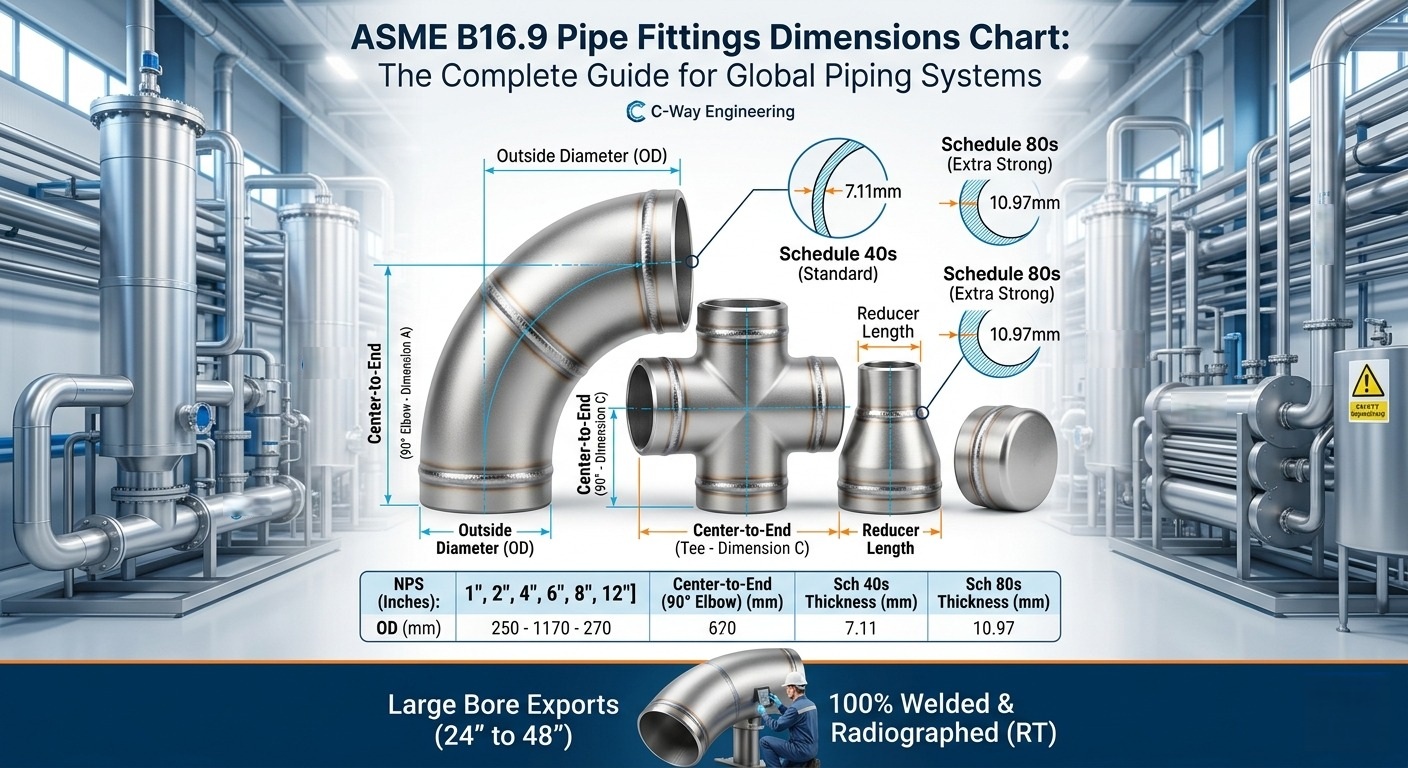
ASME B16.9 Pipe Fittings Dimension & Weight Charts
Below are commonly referenced dimension tables for butt weld pipe fittings, used by piping engineers during design and installation.
-
ASME B16.9 Butt Weld Elbow Dimensions &Weight (Long Radius, Short Radius & 45° Elbow)
| NPS | OD (mm) | A LR 90° | B SR 90° | C 45° | Weight LR 90° (kg) | Weight SR 90° (kg) | Weight 45° (kg) |
| 1/2 | 21.3 | 38 | 25 | 16 | 0.05 | 0.04 | 0.03 |
| 3/4 | 26.7 | 38 | 25 | 19 | 0.07 | 0.06 | 0.04 |
| 1 | 33.4 | 38 | 25 | 22 | 0.11 | 0.09 | 0.06 |
| 1½ | 48.3 | 57 | 38 | 29 | 0.20 | 0.16 | 0.11 |
| 2 | 60.3 | 76 | 51 | 38 | 0.34 | 0.28 | 0.18 |
| 3 | 88.9 | 114 | 76 | 57 | 0.80 | 0.65 | 0.45 |
| 4 | 114.3 | 152 | 102 | 76 | 1.40 | 1.10 | 0.80 |
| 5 | 141.3 | 190 | 127 | 95 | 2.20 | 1.70 | 1.20 |
| 6 | 168.3 | 229 | 152 | 114 | 3.20 | 2.60 | 1.80 |
| 8 | 219.1 | 305 | 203 | 152 | 6.30 | 5.00 | 3.40 |
| 10 | 273 | 381 | 254 | 190 | 10.5 | 8.20 | 5.80 |
| 12 | 323.9 | 457 | 305 | 229 | 15.5 | 12.5 | 8.60 |
| 14 | 355.6 | 533 | 356 | 267 | 21 | 17 | 12 |
| 16 | 406.4 | 610 | 406 | 305 | 28 | 23 | 16 |
| 18 | 457 | 686 | 457 | 343 | 36 | 29 | 21 |
| 20 | 508 | 762 | 508 | 381 | 45 | 37 | 26 |
| 24 | 610 | 914 | 610 | 457 | 68 | 55 | 39 |
| 30 | 762 | 1143 | 762 | 572 | 110 | 90 | 63 |
| 36 | 914 | 1372 | 914 | 686 | 165 | 135 | 95 |
| 42 | 1067 | 1600 | 1067 | 800 | 230 | 190 | 135 |
| 48 | 1219 | 1829 | 1219 | 914 | 310 | 255 | 180 |
Where:
A = Center to End (Long Radius)
B = Center to End (Short Radius)
C = Center to End (45° Elbow)
-
Tee Dimensions &Weight (Equal Tee)
| NPS | OD (mm) | H Run | H Branch | Approx Weight (kg) |
| 1/2 | 21.3 | 16 | 16 | 0.07 |
| 3/4 | 26.7 | 19 | 19 | 0.10 |
| 1 | 33.4 | 22 | 22 | 0.15 |
| 1½ | 48.3 | 29 | 29 | 0.32 |
| 2 | 60.3 | 38 | 38 | 0.50 |
| 3 | 88.9 | 51 | 51 | 1.20 |
| 4 | 114.3 | 64 | 64 | 2.20 |
| 5 | 141.3 | 79 | 79 | 3.50 |
| 6 | 168.3 | 95 | 95 | 5.20 |
| 8 | 219.1 | 127 | 127 | 10 |
| 10 | 273 | 159 | 159 | 16 |
| 12 | 323.9 | 190 | 190 | 24 |
| 14 | 355.6 | 222 | 222 | 33 |
| 16 | 406.4 | 254 | 254 | 44 |
| 18 | 457 | 286 | 286 | 56 |
| 20 | 508 | 318 | 318 | 70 |
| 24 | 610 | 381 | 381 | 105 |
| 30 | 762 | 470 | 470 | 170 |
| 36 | 914 | 559 | 559 | 260 |
| 42 | 1067 | 660 | 660 | 360 |
| 48 | 1219 | 711 | 711 | 480 |
-
Reducer Dimensions &Weight (Concentric / Eccentric)
| Large NPS | Small NPS | F Length (mm) | Approx Weight (kg) |
| 2 | 1 | 76 | 0.45 |
| 3 | 2 | 89 | 0.90 |
| 4 | 3 | 102 | 1.50 |
| 5 | 4 | 127 | 2.40 |
| 6 | 5 | 140 | 3.40 |
| 8 | 6 | 178 | 6.20 |
| 10 | 8 | 216 | 9.80 |
| 12 | 10 | 254 | 14 |
| 14 | 12 | 279 | 18 |
| 16 | 14 | 305 | 23 |
| 18 | 16 | 330 | 29 |
| 20 | 18 | 356 | 36 |
| 24 | 20 | 406 | 55 |
| 30 | 24 | 457 | 90 |
| 36 | 30 | 508 | 140 |
| 42 | 36 | 559 | 200 |
| 48 | 42 | 610 | 270 |
Where:
F = Overall length of reducer.
-
Pipe Cap Dimensions &Weight
| NPS | OD (mm) | Length E (mm) | Approx Weight (kg) |
| 1/2 | 21.3 | 25 | 0.04 |
| 3/4 | 26.7 | 25 | 0.06 |
| 1 | 33.4 | 25 | 0.09 |
| 1½ | 48.3 | 38 | 0.18 |
| 2 | 60.3 | 38 | 0.30 |
| 3 | 88.9 | 51 | 0.70 |
| 4 | 114.3 | 64 | 1.30 |
| 5 | 141.3 | 76 | 2.00 |
| 6 | 168.3 | 89 | 3.00 |
| 8 | 219.1 | 102 | 5.80 |
| 10 | 273 | 127 | 9.50 |
| 12 | 323.9 | 152 | 14 |
| 14 | 355.6 | 165 | 19 |
| 16 | 406.4 | 178 | 26 |
| 18 | 457 | 203 | 34 |
| 20 | 508 | 229 | 43 |
| 24 | 610 | 254 | 65 |
| 30 | 762 | 305 | 105 |
| 36 | 914 | 343 | 160 |
| 42 | 1067 | 381 | 220 |
| 48 | 1219 | 406 | 300 |
Pipe Schedule Chart (SCH 10, SCH 20, SCH 40, SCH 60, SCH 80)
Quick Reference Chart – Pipe Wall Thickness (Schedules)
The following quick reference chart shows common pipe wall thickness values (Schedules) in millimeters based on ASME B36.10 and ASME B36.19 standards. These schedules determine the pressure capacity of pipes and corresponding ASME B16.9 butt weld fittings.
(Based on ASME B36.10 / B36.19 Standards)
| NPS | OD (mm) | SCH 10 (mm) | SCH 20 (mm) | SCH 40 (mm) | SCH 60 (mm) | SCH 80 (mm) |
| 1/2 | 21.3 | 2.11 | 2.41 | 2.77 | 2.77 | 3.73 |
| 3/4 | 26.7 | 2.11 | 2.41 | 2.87 | 2.87 | 3.91 |
| 1 | 33.4 | 2.77 | 2.90 | 3.38 | 3.38 | 4.55 |
| 1½ | 48.3 | 2.77 | 3.18 | 3.68 | 3.68 | 5.08 |
| 2 | 60.3 | 2.77 | 3.56 | 3.91 | 3.91 | 5.54 |
| 3 | 88.9 | 3.05 | 3.96 | 5.49 | 5.49 | 7.62 |
| 4 | 114.3 | 3.05 | 4.50 | 6.02 | 7.11 | 8.56 |
| 6 | 168.3 | 3.40 | 5.54 | 7.11 | 8.74 | 10.97 |
| 8 | 219.1 | 3.76 | 6.35 | 8.18 | 10.31 | 12.70 |
| 10 | 273.0 | 4.19 | 6.35 | 9.27 | 12.70 | 15.09 |
| 12 | 323.9 | 4.57 | 6.35 | 10.31 | 14.27 | 17.48 |
| 14 | 355.6 | 6.35 | 7.92 | 11.13 | 15.88 | 19.05 |
| 16 | 406.4 | 6.35 | 7.92 | 12.70 | 17.48 | 21.44 |
| 18 | 457.2 | 6.35 | 9.53 | 14.27 | 19.05 | 23.83 |
| 20 | 508.0 | 6.35 | 9.53 | 15.09 | 20.62 | 26.19 |
| 24 | 609.6 | 6.35 | 9.53 | 17.48 | 24.61 | 30.96 |
| 30 | 762.0 | 6.35 | 9.53 | 19.05 | 28.58 | 34.93 |
| 36 | 914.4 | 6.35 | 9.53 | 23.83 | 31.75 | 39.67 |
| 42 | 1066.8 | 6.35 | 9.53 | 25.40 | 34.93 | 44.45 |
| 48 | 1219.2 | 6.35 | 9.53 | 27.79 | 39.67 | 47.63 |
Values are nominal wall thicknesses.
Common Material Grades for ASME B16.9 Pipe Fittings
ASME B16.9 fittings are manufactured using several ASTM material specifications, depending on the application.
Carbon Steel
- ASTM A234 WPB
- ASTM A420 WPL6 (low temperature service)
Stainless Steel
- ASTM A403 WP304
- ASTM A403 WP304L
- ASTM A403 WP316
- ASTM A403 WP316L
Alloy Steel
- ASTM A234 WP11
- ASTM A234 WP22
- ASTM A234 WP91
Stainless steel pipe fittings, especially 304 and 316 grades, are widely used in corrosive environments such as chemical plants, food processing, and pharmaceutical industries.
Manufacturing Process of Butt Weld Pipe Fittings
High-quality ASME B16.9 fittings are manufactured using controlled processes to ensure dimensional accuracy and mechanical strength.
Typical manufacturing steps include:
- Raw Material Selection
Pipes or plates are selected based on ASTM material specifications. - Hot Forming / Cold Forming
Elbows and reducers are shaped using hydraulic presses or mandrel bending machines. - Welding
Larger fittings may be fabricated by welding formed segments. - Heat Treatment
Heat treatment improves mechanical properties and relieves residual stress. - Machining and Finishing
Ends are prepared for butt welding with precise bevel angles.
Quality Testing and Inspection
Reliable manufacturers perform several quality assurance tests to ensure fittings meet ASME and ASTM requirements.
Common inspection methods include:
PMI (Positive Material Identification)
Verifies the chemical composition of the material.
Hydrostatic Testing
Checks for leaks and structural integrity.
Ultrasonic Testing
Detects internal defects.
Radiographic Testing
Ensures weld integrity in fabricated fittings.
Dimensional Inspection
Verifies compliance with ASME B16.9 dimension standards.
These tests are essential for oil & gas and petrochemical applications, where pipeline reliability is critical.
Why ASME B16.9 Butt Weld Fittings Are Preferred
Engineers prefer butt weld pipe fittings for several reasons:
- Strong welded connection
- Excellent pressure handling capability
- Smooth internal surface
- Reduced leakage risk
- Suitable for high temperature service
These characteristics make them ideal for critical industrial pipelines.
Choosing a Reliable Pipe Fittings Manufacturer
When sourcing ASME B16.9 pipe fittings, procurement engineers should verify:
- Compliance with ASME and ASTM standards
- Material traceability
- Third-party inspection reports
- Dimensional accuracy
- Manufacturing certifications
Selecting a reliable manufacturer ensures long service life and pipeline safety.
Conclusion
The ASME B16.9 standard plays a crucial role in ensuring the quality, reliability, and dimensional consistency of butt weld pipe fittings used in industrial piping systems.
By understanding elbow dimensions, reducer sizes, tee center-to-end measurements, and material specifications, engineers and procurement teams can confidently select the right fittings for their projects.
Whether the application involves oil & gas pipelines, chemical processing plants, or power generation facilities, ASME B16.9 fittings provide a robust and standardized solution for high-performance piping systems.
If you are looking for high-quality ASME B16.9 pipe fittings, including stainless steel elbows, tees, reducers, and caps, our engineering team at C-Way Engineering Exports can help.
We manufacture and supply precision-engineered pipe fittings, valves, and flanges that comply with ASME, ASTM, DIN, and international standards.
Our products are widely used in oil & gas, chemical plants, water treatment facilities, and power generation projects worldwide.
“At C-Way Exports, we provide ultrasonic thickness testing (UT) as part of our standard quality control process to ensure every fitting meets the minimum wall thickness requirements of ASME B16.9.”


