


Root Cause Analysis of a Jammed Gate Valve Wedge and Replacement Solution
Industrial gate valves are critical isolation devices used in refineries, petrochemical plants, power stations, chemical processing facilities, water treatment plants, and other demanding industrial applications. A properly designed and manufactured gate valve can provide reliable shut-off for decades when correctly selected, installed, and maintained.
However, one of the most common maintenance issues reported by plant engineers is a gate valve stem fracture caused by a jammed gate valve wedge. This type of gate valve failure often occurs after long shutdown periods when corrosion products, scale, coke deposits, or process debris prevent the wedge from moving freely.
If operators continue applying excessive operating torque, the stem may continue transmitting force while the wedge remains locked, eventually causing the stem or stem-to-wedge connection to fail.
This case study explains a common refinery failure scenario, examines the root cause analysis, and demonstrates why the customer selected a complete gate valve replacement to restore reliable plant operation.
Note: This case study represents a common industrial gate valve failure mechanism observed across process industries. It is intended to share engineering knowledge and best practices for gate valve troubleshooting, maintenance, and replacement.
A gate valve stem fracture is usually the result of excessive operating torque applied to a jammed gate valve wedge rather than a defect in the stem itself. In this refinery case study, prolonged valve inactivity allowed corrosion and deposits to seize the wedge, causing the stem to fracture during startup. Replacing the valve with a precision-manufactured API-standard gate valve restored reliable operation and reduced the risk of future failures.
Common Causes
- Corrosion around the wedge
- Long shutdown periods
- Excessive operating torque
- Lack of preventive maintenance
- Process deposits or scale buildup
Project Overview
| Parameter | Description |
| Industry | Petroleum Refinery |
| Application | Main Hydrocarbon Isolation Line |
| Valve Type | Rising Stem Wedge Gate Valve |
| Valve Size | 16 Inch |
| Pressure Rating | ASME Class 300 |
| Operation | Manual Gear Operated |
| Service | High Temperature Hydrocarbon |
| Customer Requirement | Immediate Gate Valve Replacement |
Customer Challenge
During a scheduled refinery turnaround, a critical rising stem gate valve remained in the fully closed position for several months.
When plant startup commenced, operators attempted to reopen the valve. The valve required unusually high operating torque and failed to open despite continuous gearbox operation.
Additional force was applied in an attempt to free the valve.
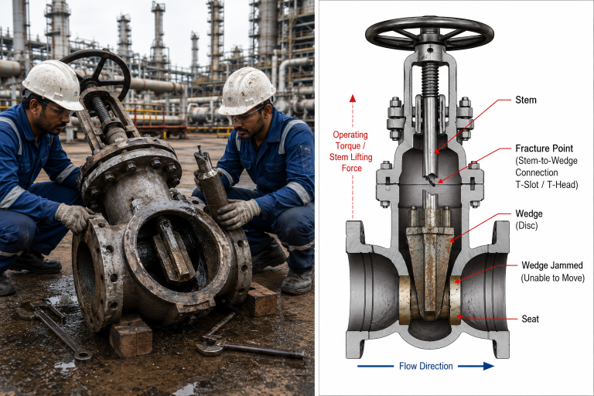
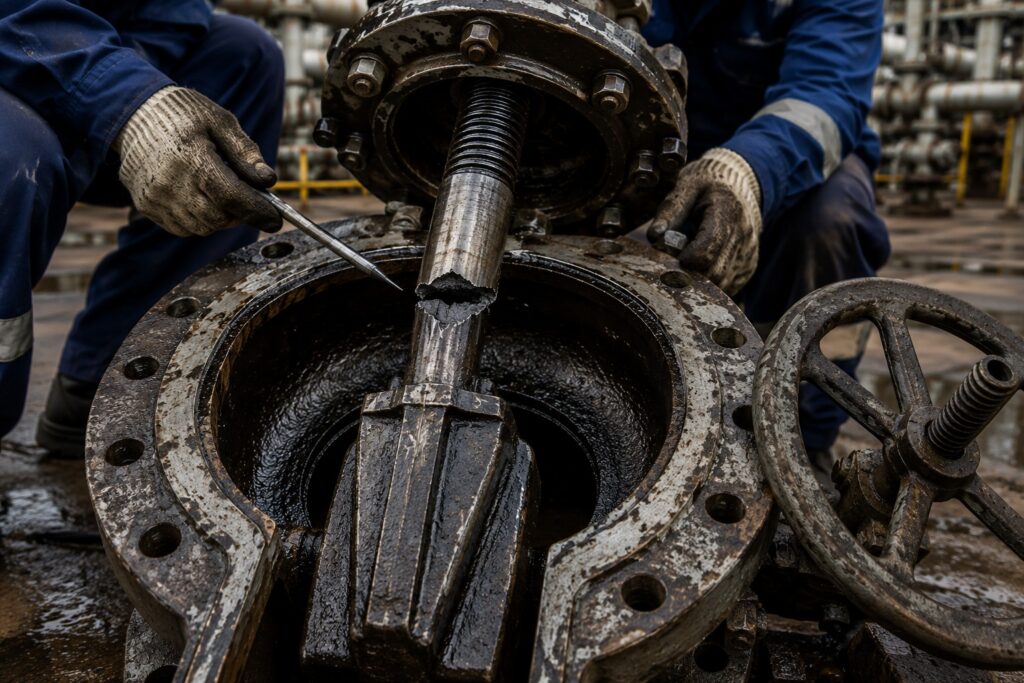
Soon afterward, the handwheel rotated freely without lifting the wedge. The refinery’s maintenance team removed the valve from service and confirmed that the stem had fractured after the wedge became jammed inside the valve body.
Because the valve was installed on a critical hydrocarbon isolation line, the refinery required an immediate replacement gate valve to avoid further delays in commissioning.
The customer contacted C-Way Engineering Exports to manufacture and supply a new gate valve matching the required size, pressure rating, material specification, and project documentation.
Why Do Gate Valve Stems Fail?
Although stem fracture appears to be the main failure, it is usually the final stage of a mechanical problem inside the valve. In most industrial applications, the stem fails because the wedge becomes stuck due to corrosion, deposits, scale, or prolonged inactivity. When excessive torque is applied to force the valve open, the stem absorbs the load until it exceeds its design strength, resulting in fracture.
Understanding the actual failure mechanism helps maintenance teams prevent repeat failures and improve long-term plant reliability.
Root Cause Analysis – Why Did the Gate Valve Stem Fracture?
Although the fractured stem was the visible failure, engineering analysis indicates that it was not the original problem.
The most probable failure sequence was:
Step 1 – Extended Valve Inactivity
The valve remained closed throughout the refinery shutdown.
Step 2 – Wedge Seizure
Process deposits, corrosion products, or contaminants accumulated around the wedge and guide surfaces, preventing normal movement.
Step 3 – Excessive Operating Torque
During startup, increasing torque was applied in an attempt to open the valve.
Step 4 – Mechanical Overload
The stem continued transmitting force while the wedge remained stationary.
Step 5 – Stem Fracture
The mechanical load exceeded the strength of the stem-to-wedge connection, resulting in stem fracture and leaving the valve permanently in the closed position.
This sequence represents one of the most common industrial gate valve failure mechanisms encountered in refineries and process plants.
Common Causes of Gate Valve Failure
The customer’s reported failure is consistent with several well-known industry conditions:
- Extended shutdown without valve exercising
- Corrosion products restricting wedge movement
- Coke or scale deposits around the wedge
- High operating torque during startup
- Excessive force applied to a seized gate valve
- Lack of inspection before plant recommissioning
- Delayed preventive maintenance
Understanding these conditions is essential for effective gate valve maintenance and long-term reliability.
Failure Mechanism
A wedge gate valve is designed so that the stem lifts the wedge vertically away from the seating surfaces.
When the wedge becomes mechanically locked, continued torque no longer produces upward movement. Instead, the mechanical load is concentrated within the stem and stem-to-wedge connection.
If operators continue applying force, one of several failures may occur:
- Stem fracture
- Stem thread damage
- T-slot failure
- Wedge distortion
- Gearbox damage
Because the stem is the primary load-transmitting component, it frequently becomes the weakest link once operating torque exceeds the design load.
Selecting the Replacement Gate Valve
Considering the critical service conditions and the customer’s startup schedule, replacement of the complete valve was selected as the most reliable engineering solution.
After evaluating several replacement options, the refinery selected C-Way Engineering Exports because the project required a valve manufactured to the original specification, complete material traceability, pressure testing, and delivery within the planned shutdown schedule. Selecting a replacement valve with the appropriate pressure class, material grade, and wedge configuration helps minimize future maintenance issues and improves long-term reliability in demanding industrial applications
C-Way Engineering Exports manufactured and supplied a new industrial gate valve in accordance with the required project specifications.
The supplied valve included:
- Precision-machined stem and wedge assembly
- Accurate guide alignment
- Suitable body and trim materials
- Precision-machined seating surfaces
- Manual gear operation
- Complete Material Test Certificates (MTC)
- Hydrostatic shell testing
- Seat leakage testing
- Functional operation testing
- Dimensional inspection before dispatch
The replacement valve was delivered within the required project schedule and installed by the refinery’s maintenance team, allowing the affected process line to return to service.
How to Prevent Gate Valve Stem Fracture
Although every application is unique, the following engineering practices significantly reduce the likelihood of gate valve stem failure.
1. Select the Correct Industrial Gate Valve
Choose the valve according to:
- Process fluid
- Operating temperature
- Pressure class
- Corrosion potential
- Solid content
- Frequency of operation
Proper valve selection improves long-term reliability. Choosing the correct valve design, body material, and wedge configuration plays an important role in preventing premature failures throughout the valve’s service life.
2. Purchase Quality-Manufactured Gate Valves
Selecting the correct valve design is equally important for long-term reliability. The differences between Rising Stem and Non-Rising Stem Gate Valves can significantly affect maintenance accessibility, operating safety, and installation requirements. Reliable performance begins with precision manufacturing.
Important quality considerations include:
- Accurate stem machining
- Precision wedge alignment
- Controlled machining tolerances
- Suitable stem materials
- Quality seating surfaces
- Comprehensive pressure testing
- Functional testing before shipment
3. Exercise Gate Valves Periodically
Isolation valves that remain closed for long periods should be operated according to the plant’s preventive maintenance program whenever operating conditions permit.
Regular operation helps prevent wedge seizure.
4. Never Force a Stuck Gate Valve
If a valve requires unusually high operating torque, investigate the cause before applying additional force.
Attempting to force a seized valve can lead to:
- Stem fracture
- Wedge damage
- Gear operator failure
- Seat damage
- Extended plant downtime
5. Inspect Critical Isolation Valves Before Startup
Before restarting the plant after an extended shutdown, verify that critical gate valves operate smoothly.
Early inspection helps prevent unexpected failures during commissioning.
Repair vs Replacement: Which Is Better?
When a gate valve stem fractures, engineers must decide whether to repair the existing valve or replace it entirely. The right decision depends on the extent of internal damage, downtime requirements, and lifecycle cost.
| Repair | Replacement |
|---|---|
| Suitable for minor internal damage | Recommended for critical refinery service |
| Lower initial cost | Higher long-term reliability |
| Longer maintenance time | Faster plant recommissioning |
| May require spare parts | New valve supplied with MTC and testing |
| Not ideal for severely damaged wedges | Best option for high-pressure applications |
For critical hydrocarbon service, replacing the complete gate valve is often the safer and more reliable engineering solution.
Results
Following installation of the replacement gate valve, the refinery successfully:
- Restored reliable isolation on the hydrocarbon process line
- Completed plant startup with minimal additional delay
- Improved confidence in long-term valve performance
- Reduced the risk of repeat failures associated with the damaged valve
- Returned the process unit to normal operation using a fully tested replacement valve
Key Takeaways: Preventing Gate Valve Stem Fracture in Industrial Applications
This case study demonstrates that a gate valve stem fracture is often the result of an underlying mechanical issue rather than a manufacturing defect. In many industrial applications, prolonged valve inactivity, corrosion buildup, process deposits, or a jammed gate valve wedge can significantly increase operating torque, placing excessive stress on the stem assembly.
By understanding the complete failure sequence, plant engineers and maintenance teams can implement preventive strategies that improve equipment reliability, reduce unplanned downtime, and extend the service life of industrial gate valves used in refineries, petrochemical plants, power stations, and process industries.
Key engineering lessons from this project include:
- Never force a gate valve that requires unusually high operating torque, as this may indicate a seized wedge or internal obstruction.
- Exercise critical isolation valves periodically during scheduled maintenance to help prevent corrosion, scale buildup, and wedge seizure.
- Inspect gate valves thoroughly before restarting process units after extended shutdowns or plant turnarounds.
- Select gate valves with the correct pressure class, material grade, and wedge design based on the operating pressure, temperature, and process media.
- Choose industrial gate valves manufactured to recognized standards such as API 600 and API 598, with certified materials, precision machining, and comprehensive testing.
- Purchase valves from experienced manufacturers that provide complete documentation, including Material Test Certificates (MTC), hydrostatic test reports, and quality inspection records, to ensure long-term operational reliability.
Conclusion
A gate valve stem fracture is rarely an isolated event. In most cases, it is the final result of a jammed gate valve wedge, excessive operating torque, and prolonged valve inactivity.
Understanding these common gate valve failure mechanisms enables plant engineers to improve maintenance planning, startup procedures, and valve selection while minimizing unplanned downtime.
When replacement becomes the preferred engineering solution, selecting a high-quality industrial gate valve manufactured to the required specifications helps restore reliable operation in critical process applications.
C-Way Engineering Exports manufactures industrial gate valves for refineries, petrochemical plants, power stations, water treatment facilities, Marine applications and other demanding industries. Every valve is produced with precision manufacturing, stringent quality control, and comprehensive testing to meet customer specifications and support long-term operational reliability.
Frequently Asked Questions
1. Why does a gate valve stem fracture?
2. What causes a gate valve to jam?
3. Should a gate valve be repaired or replaced after stem fracture?
4. How can gate valve stem failure be prevented?
5. What are the warning signs before a gate valve fails?
6. How do you choose the right replacement gate valve?
7. How can high operating torque in a gate valve be prevented?
8. Why is it important to choose a gate valve supplier carefully?
9. Can a jammed gate valve be opened safely?
10. What causes high operating torque in a gate valve?
11. What is wedge seizure in a gate valve?


