


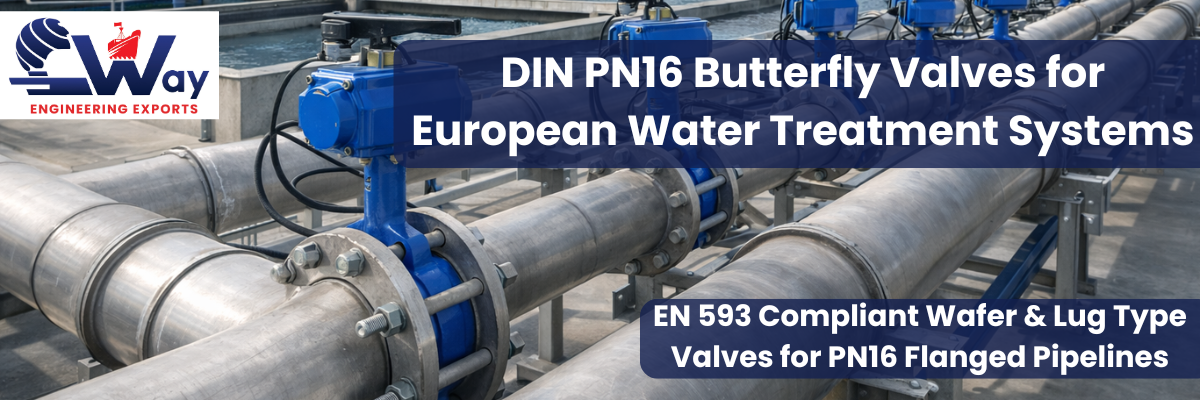
DIN PN16 Butterfly Valve for European Water Treatment Applications – An Engineering Suitability Study
Water treatment infrastructure across Europe is largely designed in accordance with DIN and EN standards. From municipal filtration plants to industrial water recycling systems, pipeline networks frequently operate under PN10 and PN16 pressure ratings, with components specified as per EN 593 butterfly valve standards, EN 1092-1 flange drilling, and EN 558 face-to-face dimensions.
Among isolation solutions, the DIN PN16 butterfly valve remains one of the most widely used valve types in water treatment pipelines due to its compact design, cost efficiency in larger diameters, and compatibility with ductile iron piping systems. However, correct application of these valves requires careful engineering evaluation beyond simply matching pressure class
At C-Way Engineering Exports, DIN EN 593 compliant wafer and lug type butterfly valves are manufactured specifically to meet European-standard pipeline requirements. Rather than focusing only on pressure class, our engineering approach evaluates flange compatibility, elastomer behaviour in treated water, torque stability, and long-term sealing reliability.
This engineering suitability study evaluates the performance considerations, configuration differences, and technical challenges associated with DIN PN16 wafer and lug type butterfly valves in European-standard water treatment systems.
DIN / EN Compliance in European Water Treatment Projects
In European pipeline installations, dimensional and testing conformity is not optional – it is foundational.
A properly designed European standard butterfly valve for PN16 service must comply with:
- EN 593 – Design and performance requirements for butterfly valves
- EN 1092-1 – Flange drilling compatibility for PN-rated systems
- EN 558 – Face-to-face dimensions for installation interchangeability
- EN 12266-1 – Pressure and leakage testing procedures
These standards ensure that a DN300 PN16 butterfly valve manufactured in one country can be installed into a compliant EN pipeline system elsewhere without dimensional modification.
In water treatment projects, strict adherence to EN face-to-face dimensions prevents installation stress, disc misalignment and uneven seat compression.
At C-Way Engineering Exports, dimensional verification of face-to-face tolerances and flange drilling alignment is conducted prior to assembly. This structured compliance approach allows our DIN PN16 butterfly valves to integrate seamlessly into European-standard pipeline systems across water treatment and industrial applications.


Butterfly Valves for Water Treatment Infrastructure
A butterfly valve for water treatment is typically installed in:
- Raw water intake pipelines
- Filtration and distribution headers
- Backwash lines
- Sludge discharge systems
- Treated water storage networks
Butterfly valves are preferred over gate valves in medium to large diameters (DN150 and above) because of:
- Reduced face-to-face dimension
- Lower weight in ductile iron construction
- Faster quarter-turn operation
- Lower torque requirement with gear or actuator
However, water treatment systems are not uniform. They involve varying pressures, chemical exposure, suspended solids, and frequent operational cycling – all of which influence valve longevity.
Engineering Challenges in DIN PN16 Butterfly Valve Applications
While DIN PN16 butterfly valves are widely used, water treatment systems present specific engineering challenges that must be evaluated carefully.
-
Pressure Fluctuation & Surge Conditions
Although PN16 indicates a nominal pressure rating of 16 bar at ambient temperature, real-world operating conditions can differ significantly.
In water treatment plants:
- Backwash systems create temporary pressure surges
- Pump start-stop cycles introduce dynamic loading
- Flow reversal during cleaning cycles increases disc stress
These pressure variations can lead to:
- Seat compression fatigue
- Disc vibration at partial opening
- Increased operating torque
Therefore, when specifying a PN16 butterfly valve, engineers must consider operational safety margins, not just static pressure values.
-
Flange Alignment & Installation Stress
European pipelines typically follow EN 1092-1 flange drilling, but field alignment can still vary.
Common installation issues include:
- Uneven bolt tightening
- Flange face misalignment
- Over-compression of elastomer seats
In wafer type butterfly valves especially, uneven bolt torque can cause:
- Disc rubbing against the seat
- Localized seat deformation
- Higher operating torque
Maintaining correct bolt tightening sequence and alignment is critical to preserving the designed sealing performance of a DIN butterfly valve.
-
Elastomer Compatibility in Treated Water
Seat material selection is one of the most critical decisions in water treatment systems.
Treated water often contains:
- Chlorine
- Ozone
- pH stabilizing chemicals
For potable and treated water, EPDM seat butterfly valves are commonly selected because EPDM offers:
- Excellent resistance to chlorinated water
- Stable compression properties
- Long service life under moderate temperatures
In contrast, NBR may be suitable for certain industrial water applications but is less ideal for potable systems with continuous chemical exposure.
Incorrect elastomer selection can result in swelling, hardening, or loss of sealing performance within months of operation.
-
Abrasive Media & Sludge Handling
Raw water intake and sludge discharge lines frequently contain:
- Sand particles
- Suspended solids
- Sludge deposits
Over time, these particles can cause:
- Disc edge erosion
- Seat surface cutting
- Progressive torque increase
In such applications, disc material selection (such as SS316) and proper surface finishing are essential to extend valve life.
A ductile iron butterfly valve EN standard compliant with appropriate coating and corrosion protection improves long-term durability in humid plant environments.
-
Wafer vs Lug Type Structural Considerations
Selection between wafer type butterfly valve DIN and lug type butterfly valve PN16 depends largely on maintenance and pipeline segmentation requirements.
Wafer Type DIN PN16 Butterfly Valves:
- Installed between EN 1092-1 flanges
- Compact and lightweight
- Suitable for continuous pipeline systems
- Typically not recommended for full dead-end service unless designed for it
Lug Type DIN PN16 Butterfly Valves:
- Threaded inserts allow independent pipeline removal
- Suitable for maintenance isolation
- Better suited for sectional shutdowns
- Can handle dead-end conditions when properly engineered
In European water treatment plants where pipeline isolation during maintenance is common, lug type designs are often preferred.
C-Way manufactures both wafer type butterfly valves (DIN PN16) and lug type butterfly valves (PN16) to address different installation requirements within European water treatment plants.
Our wafer design maintains concentric disc alignment and controlled seat compression to minimize torque variation during operation.
Material Selection for Long-Term Performance
A properly engineered DIN PN16 butterfly valve for water treatment typically includes:
- Body: EN-GJS-400-15 ductile iron
- Disc: Stainless Steel 316
- Seat: EPDM for potable water compatibility
- Coating: Fusion bonded epoxy with controlled thickness
Material traceability and documentation such as EN 10204 3.1 certification are frequently required for European-standard projects.
Testing is generally performed in accordance with EN 12266-1, ensuring pressure integrity and seat tightness before dispatch.
Manufacturing Controls for EN 593 Compliance
To meet European requirements, a DIN butterfly valve must maintain:
- Dimensional inspection of face-to-face tolerances
- Verification of flange drilling pattern
- Hydrostatic pressure testing
- Seat leakage testing
- Coating thickness measurement
Precision in machining of shaft alignment and disc concentricity directly affects long-term sealing performance and torque stability.
A European-standard butterfly valve is not defined only by its pressure rating – it is defined by dimensional precision and consistent testing.
At C-Way Engineering Exports, DIN PN16 butterfly valves undergos controlled manufacturing approach ensures suitability for projects requiring European DIN compliance, regardless of installation geography.
Engineering Insight
From an engineering perspective, premature failure in PN16 butterfly valves within water treatment systems is often not due to design limitations, but due to:
- Improper installation alignment
- Incorrect elastomer selection
- Unaccounted surge conditions
Addressing these factors during specification and installation significantly improves operational lifespan.
Conclusion
DIN PN16 butterfly valves remain a preferred isolation solution for European water treatment systems when properly specified and manufactured in accordance with EN standards.
Successful application depends on:
- Accurate EN dimensional compliance
- Proper elastomer selection (EPDM for potable water systems)
- Understanding wafer vs lug configuration requirements
- Evaluating surge and installation stress conditions
At C-Way Engineering Exports, our focus is not only on supplying DIN PN16 butterfly valves, but on supporting engineers with technical clarity, dimensional conformity, and material traceability aligned with European pipeline standards.
For projects requiring EN 593 compliant wafer or lug type butterfly valves for water treatment applications, our engineering team can assist with:
- Dimensional compatibility verification
- Pressure class evaluation
- Material selection guidance
- Actuated valve configuration support
Need assistance selecting the right DIN PN16 butterfly valve for your water treatment project? Contact our engineering team today for technical support and compliance verification


