


How to Select the Right Knife Gate Valve for Slurry Applications: A Complete Engineering Guide
Slurry handling presents some of the toughest operating conditions for industrial pipeline valves. Unlike clean water or conventional process fluids, slurry contains suspended solid particles that can cause abrasion, erosion, material buildup and premature wear. These conditions make valve selection particularly important in mining, mineral processing, wastewater treatment, power generation and other heavy industrial applications.
A valve that performs reliably in a clean-water pipeline may not deliver the same service life when exposed to abrasive slurry or media containing suspended solids. Seat damage, gate jamming, internal wear and leakage are common problems when the valve design and materials are not suitable for the operating conditions.
This is where Knife Gate Valves play an important role.
Designed with a thin, sharp-edged gate that moves through the flow passage, Knife Gate Valves are commonly used for isolating media containing solids, fibers and other suspended materials. Their construction makes them suitable for many applications where conventional valve designs may be less practical.
However, selecting the right Knife Gate Valve involves more than choosing a valve based on pipeline size and pressure rating. Slurry composition, particle characteristics, abrasion resistance, seat material, body construction and operating conditions all influence valve performance.
In this guide, we discuss the important engineering considerations for selecting a Knife Gate Valve for slurry applications and how the right selection can help improve operational reliability and maintenance planning.
Understanding Slurry Characteristics Before Selecting a Valve
The first step in selecting a Knife Gate Valve is understanding the characteristics of the media flowing through the pipeline.
Slurry composition varies significantly between industries. A mineral slurry containing hard particles creates different operating conditions than wastewater sludge containing softer suspended solids. These differences influence the type of valve construction, material and seating arrangement required.
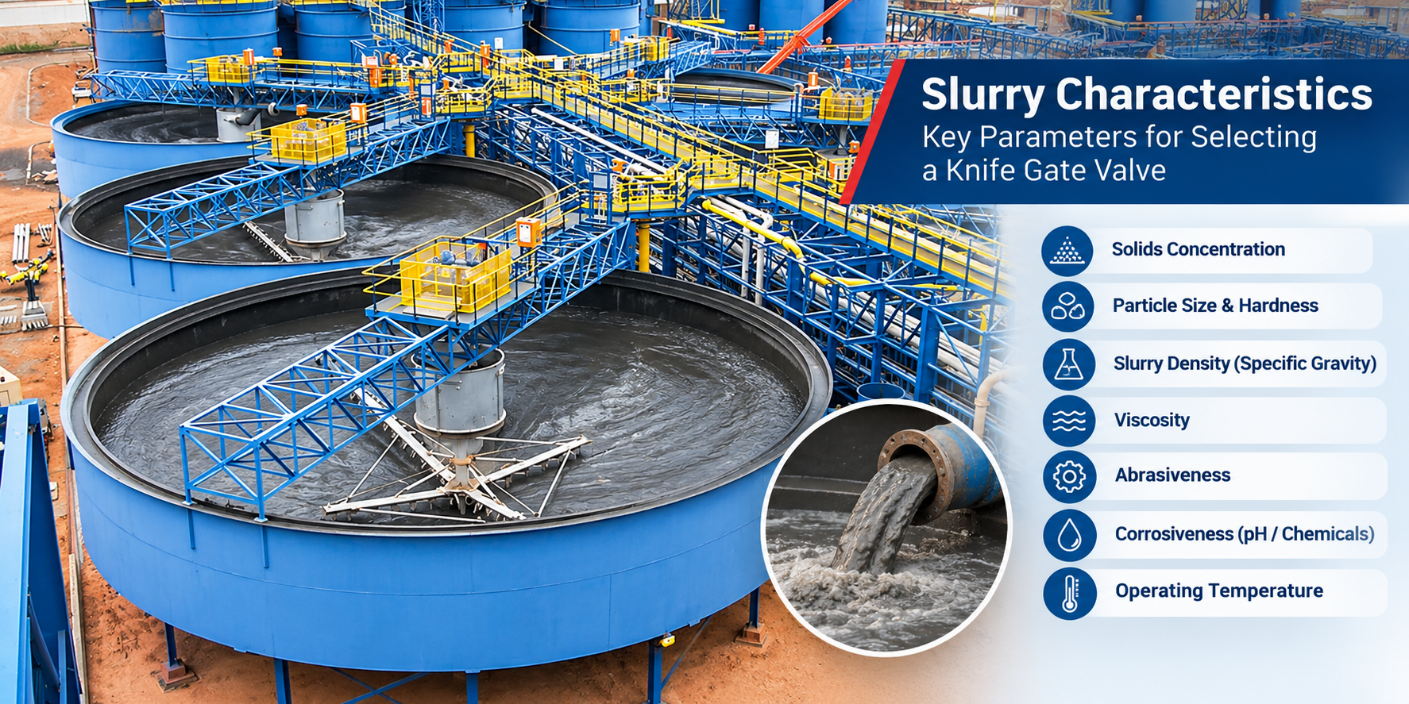
Some important slurry characteristics include:
Solids Concentration: The percentage of solid material in the slurry affects its density, flow behavior and potential for material buildup.
Particle Size: Larger particles may interfere with gate movement or become trapped around sealing areas, depending on valve design.
Particle Hardness: Hard mineral particles can increase abrasive wear on the gate, seat and other wetted components.
Slurry Density and Viscosity: These properties influence flow behavior and the operating conditions within the pipeline.
Abrasiveness: The type, shape and hardness of suspended particles determine the potential for surface wear.
Corrosiveness: Certain slurries contain chemicals or dissolved substances that can attack metallic components.
Common Industrial Slurry Applications
| Slurry Type | Typical Industry |
|---|---|
| Mineral Slurry | Mining and mineral processing |
| Tailings Slurry | Mining operations |
| Coal Slurry | Coal washing and processing |
| Lime Slurry | Water treatment and chemical processing |
| Fly Ash Slurry | Power generation |
| Pulp Slurry | Paper and pulp manufacturing |
| Sand Slurry | Dredging and construction |
Understanding these characteristics helps engineers identify the appropriate valve design and material combination before finalizing a specification.
Why Knife Gate Valves Are Used in Slurry Applications
Knife Gate Valves are widely used for on-off isolation in pipelines carrying slurry, wastewater, pulp and other solids-containing media.
The main operating component is a thin blade that travels vertically through the valve body. During closing, its sharp edge helps cut through soft solids and fibrous materials present in the flow stream.
Several design characteristics make Knife Gate Valves suitable for these applications.
Sharp-Edged Gate: The blade is designed to pass through suspended solids and fibrous materials during closing.
Unobstructed Flow Passage: Many Knife Gate Valve designs provide a full-bore or near-full-bore flow passage when fully open, depending on the construction.
Different Seating Arrangements: Resilient and metal seating options allow the valve to be configured for different media and sealing requirements.
Material Flexibility: Body, gate and internal component materials can be selected according to corrosion and wear conditions.
Compact Construction: Wafer and lug configurations can help reduce installation space in industrial pipeline systems.
It is important to note that Knife Gate Valves are generally designed for isolation rather than precise flow regulation. Their suitability for a particular slurry application depends on the valve’s design limitations and operating conditions.
Selecting the Right Seat Material for Slurry Service
Seat selection is one of the most important considerations when specifying a Knife Gate Valve for slurry applications.
The seat provides the sealing interface between the gate and valve body. If the selected material is incompatible with the process media or operating temperature, premature wear, leakage and frequent maintenance may result.
The selection should consider chemical compatibility, temperature, pressure, particle characteristics and the required shutoff performance.
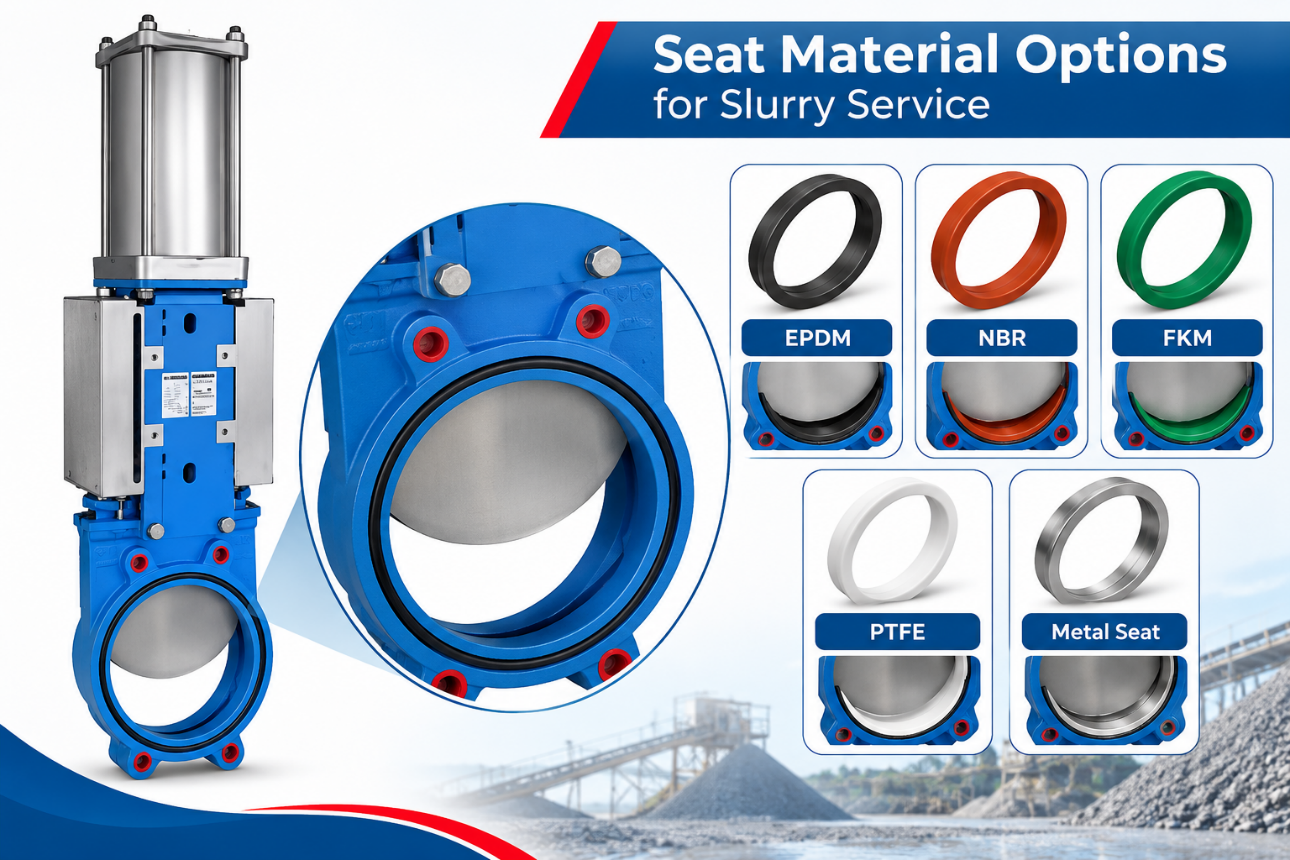
Common Knife Gate Valve Seat Materials
| Seat Material | Key Characteristics | Typical Applications |
|---|---|---|
| EPDM | Suitable for many water-based services | Water treatment and wastewater |
| NBR | Suitable for compatible oil-containing media | Industrial process fluids |
| FKM | Resistant to selected chemicals and higher temperatures | Chemical processing |
| PTFE | Offers broad chemical resistance | Corrosive process applications |
| Metal Seat | Suitable for selected abrasive and higher-temperature services | Mining and heavy industrial applications |
Actual performance depends on the compound grade, valve construction and operating conditions.
Resilient Seat vs. Metal Seat
Resilient seats are commonly considered where sealing performance and compatibility with the process media are important. EPDM, NBR, FKM and PTFE offer different chemical and temperature characteristics.
Metal-seated Knife Gate Valves may be considered for applications involving abrasive particles, elevated temperatures or demanding mechanical conditions.
However, a metal seat is not automatically the best choice for every abrasive slurry application. Particle characteristics, seat geometry, gate design and acceptable leakage requirements must also be evaluated.
For example, a slurry containing fine mineral particles may present different sealing challenges than one containing larger, harder particles. The correct seating arrangement should therefore be selected based on actual process conditions rather than material preference alone.
Choosing the Right Body and Gate Material
Material selection has a direct influence on valve durability, corrosion resistance and maintenance requirements.
A Knife Gate Valve installed in a mining slurry pipeline may require a different material combination from one used in wastewater treatment or chemical processing.
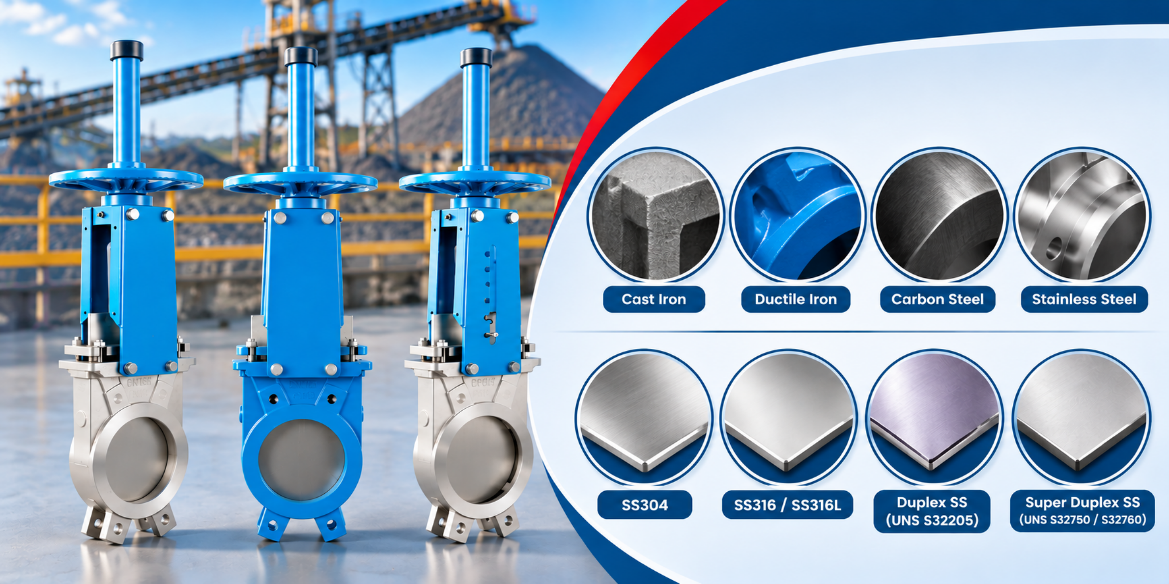
Common Valve Body Materials
| Material | General Characteristics | Typical Applications |
|---|---|---|
| Cast Iron | Suitable for many general industrial services | Water and wastewater |
| Ductile Iron | Offers improved mechanical properties compared with grey cast iron | Industrial and water applications |
| Carbon Steel | Suitable for many general industrial and process conditions | Industrial slurry systems |
| Stainless Steel CF8 | Corrosion-resistant stainless steel casting | Selected corrosive applications |
| Stainless Steel CF8M | Molybdenum-bearing stainless steel casting | More demanding corrosion conditions |
| Duplex Stainless Steel | Combines strength with corrosion resistance | Selected aggressive environments |
| Super Duplex Stainless Steel | Designed for demanding corrosive environments | Specialized industrial applications |
Common Knife Gate and Blade Materials
Depending on the valve design and application, available material options may include:
- SS304
- SS316
- SS316L
- Duplex Stainless Steel UNS S32205
- Super Duplex Stainless Steel UNS S32750 / S32760
The gate comes into direct contact with the flowing media, making its material, surface condition and mechanical properties important.
One common mistake is assuming that a higher-alloy stainless steel automatically provides better resistance to abrasive wear. Corrosion resistance and abrasion resistance are different material considerations.
For abrasive slurry, engineers should also consider particle hardness, operating velocity, blade surface condition and the expected wear pattern.
The best material combination is one that addresses the actual corrosion, abrasion and mechanical requirements of the application.
Understanding Pressure Ratings and Operating Conditions
Pressure rating is another important factor when selecting a Knife Gate Valve for slurry pipelines.
The valve must be suitable for the maximum pressure conditions expected during operation, not just the normal operating pressure.
Engineers should consider:
- Normal operating pressure.
- Maximum design pressure.
- Differential pressure across the closed valve.
- Static head in vertical pipelines.
- Pressure surges and transient conditions.
- Possible reverse pressure.
- Operating temperature.
Common Pressure Designations
| Pressure Designation | Nominal Rating |
|---|---|
| PN6 | 6 bar |
| PN10 | 10 bar |
| PN16 | 16 bar |
| ASME Class 150 | ASME pressure class designation |
PN and ASME Class ratings belong to different rating systems and should not be treated as directly interchangeable. Actual allowable pressure depends on valve construction, size, material, temperature, and the manufacturer’s approved pressure rating.
Why Differential Pressure Matters
Differential pressure is particularly important when a valve is required to close against flowing or pressurized slurry.
A valve operating under a relatively low pipeline pressure may still experience significant loading across the gate when isolating the line.
Excessive differential pressure can increase the operating force required to move the gate and may affect actuator selection, sealing performance and component life.
For this reason, engineers should confirm both the allowable operating pressure and the maximum shutoff differential pressure with the valve manufacturer.
Selecting the Appropriate Valve Configuration
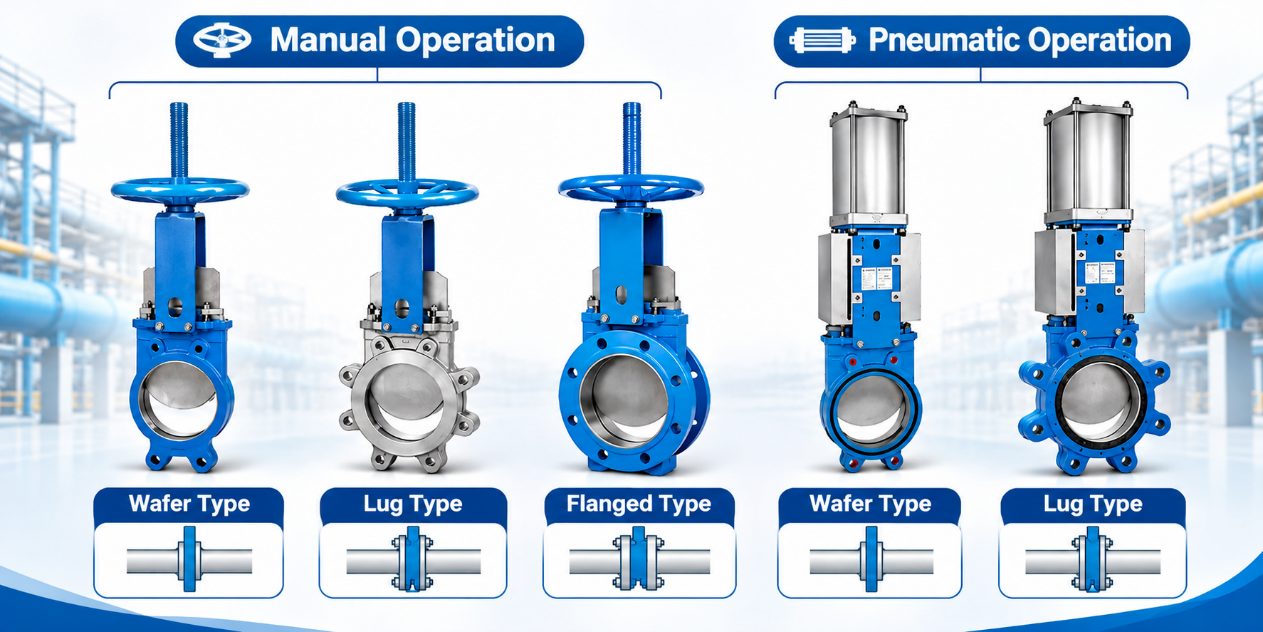
Knife Gate Valves are available in different body configurations to accommodate pipeline layouts and installation requirements.
Wafer Type Knife Gate Valve
Wafer-type valves are designed for installation between mating pipeline flanges. Their compact construction makes them suitable for installations where space is limited.
Lug Type Knife Gate Valve
Lug-type valves incorporate bolting features around the body. The exact installation arrangement depends on the valve design and manufacturer’s recommendations.
Flanged Knife Gate Valve
Flanged valves have integral flange connections for direct installation into matching pipeline flanges. They are commonly considered for industrial pipeline arrangements where flanged connections are specified.
When selecting the end connection, engineers should consider:
- Pipeline flange standard and drilling.
- Face-to-face dimensions.
- Installation space.
- Pipeline support and alignment.
- Maintenance accessibility.
- Compatibility with existing piping.
Matching the valve connection to the pipeline specification is important for straightforward installation and reliable operation.
Flow Direction: Uni-Directional and Bi-Directional Designs
Knife Gate Valves are available in uni-directional and bi-directional configurations.
A uni-directional design is intended to provide shutoff primarily against pressure from one specified direction, while a bi-directional design is intended to provide shutoff in both directions within its specified pressure and leakage limits.
The selection depends on pipeline layout, potential reverse flow and isolation requirements.
The detailed differences between these configurations should be evaluated according to the valve’s design and rated performance.
Manual and Pneumatic Operation
The operating method should be selected according to valve size, operating frequency, accessibility and plant automation requirements.
Manual handwheel operation is often suitable for installations where valves are operated occasionally and are easily accessible. Gearbox operation may be considered for larger valves where additional mechanical advantage is required.
For automated systems, pneumatic Knife Gate Valves are commonly used where a suitable compressed-air supply is available. They can be equipped with solenoid valves, limit switch boxes and other automation accessories for integration with plant control systems.
Electric actuation is another option when remote operation is required and electrical power is preferred.
Actuator selection should account for required operating thrust, differential pressure, cycle frequency and the manufacturer’s recommendations.
Common Knife Gate Valve Problems in Slurry Applications
Even a correctly selected valve requires suitable installation and maintenance. Understanding common operating problems helps engineers identify potential risks during the selection stage.
| Common Problem | Possible Cause | Recommended Consideration |
|---|---|---|
| Gate Wear | Continuous contact with abrasive particles | Review gate material and wear protection |
| Seat Leakage | Seat damage, wear or trapped solids | Review seating arrangement and sealing surfaces |
| Gate Jamming | Solids accumulation or unsuitable valve design | Evaluate media characteristics and flushing provisions |
| Stem Damage | Excessive operating thrust or mechanical loading | Verify actuator sizing and operating requirements |
| Packing Leakage | Packing wear or improper adjustment | Inspect packing and gland arrangement |
| Corrosion | Incompatible body or internal materials | Review material compatibility with process media |
Reducing Premature Valve Wear
Several factors can help improve valve service life in slurry applications:
- Select gate and seat materials according to the actual slurry characteristics.
- Avoid operating conditions beyond the manufacturer’s pressure and differential pressure limits.
- Confirm that the valve is suitable for the expected solids concentration and particle characteristics.
- Ensure correct installation and pipeline alignment.
- Follow appropriate inspection and maintenance procedures.
- Consider flushing arrangements where the valve design and process requirements permit them.
Proper selection and maintenance work together. Even a high-quality valve may experience premature wear if it is used outside its intended operating conditions.
Applicable International Standards for Knife Gate Valves
International material and product standards help establish consistency in manufacturing, material identification, inspection and documentation.
Depending on valve construction and project requirements, the following standards may be relevant.
| Standard | Description |
|---|---|
| MSS SP-81 | Metal-seated knife gate valves within its scope |
| ASTM A216 | Carbon steel castings |
| ASTM A351 | Stainless steel castings |
| ASTM A536 | Ductile iron castings |
| ASTM A240 | Stainless steel plate, sheet and strip |
| ASTM A276 | Stainless steel bars and shapes |
| EN 1561 | Grey cast iron |
| EN 1563 | Spheroidal graphite cast iron |
| EN 10088 | Stainless steel material specifications |
| EN 10204 | Inspection documents for metallic products |
It is important to distinguish between valve design standards and material specifications. For example, ASTM A216 specifies carbon steel castings; it does not independently define the complete design requirements of a Knife Gate Valve.
The applicable design, material, inspection and testing requirements should be established according to the actual valve specification and project requirements.
Conclusion: Making the Right Choice for Reliable Slurry Isolation
Selecting a Knife Gate Valve for slurry service requires a clear understanding of the process media and the operating conditions within the pipeline.
Particle size, solids concentration, abrasiveness, corrosion potential and operating pressure all influence valve performance. Seat selection, body construction, gate material and end connection should be evaluated together rather than treated as independent purchasing decisions.
For mining companies, EPC contractors and industrial procurement teams, working with a supplier that understands these technical considerations can make the valve selection process more straightforward.
Whether the requirement involves a wafer-type valve for a compact pipeline installation, a metal-seated configuration for selected abrasive services or a pneumatically operated valve for automated isolation, the selection should begin with the actual process requirements.
For technical details, available configurations and application-specific requirements, explore our Knife Gate Valve product range or contact C-Way Engineering Exports with your project specifications.
Frequently Asked Questions About Knife Gate Valves for Slurry Applications


