


Butterfly Valve Torque Calculation – How to Select the Right Actuator (Complete Engineering Guide)
In industrial automation, butterfly valve torque calculation is a critical parameter that directly impacts valve sealing, actuator performance, and overall system reliability. Engineers frequently search for how to calculate butterfly valve torque or how to select the right actuator, especially when dealing with varying pressure classes and media conditions.
In practice, torque is often underestimated because actuator selection is based only on valve size or pressure rating. However, real torque depends on differential pressure (ΔP), seat material, disc design, and operating conditions. A DN100 valve in PN16 service behaves very differently from the same valve operating under lower pressure or with PTFE lining.
This guide explains butterfly valve torque calculation, torque charts, and actuator sizing using practical engineering methods – not theoretical assumptions.
What is Torque in Butterfly Valves?
Definition of Butterfly Valve Torque
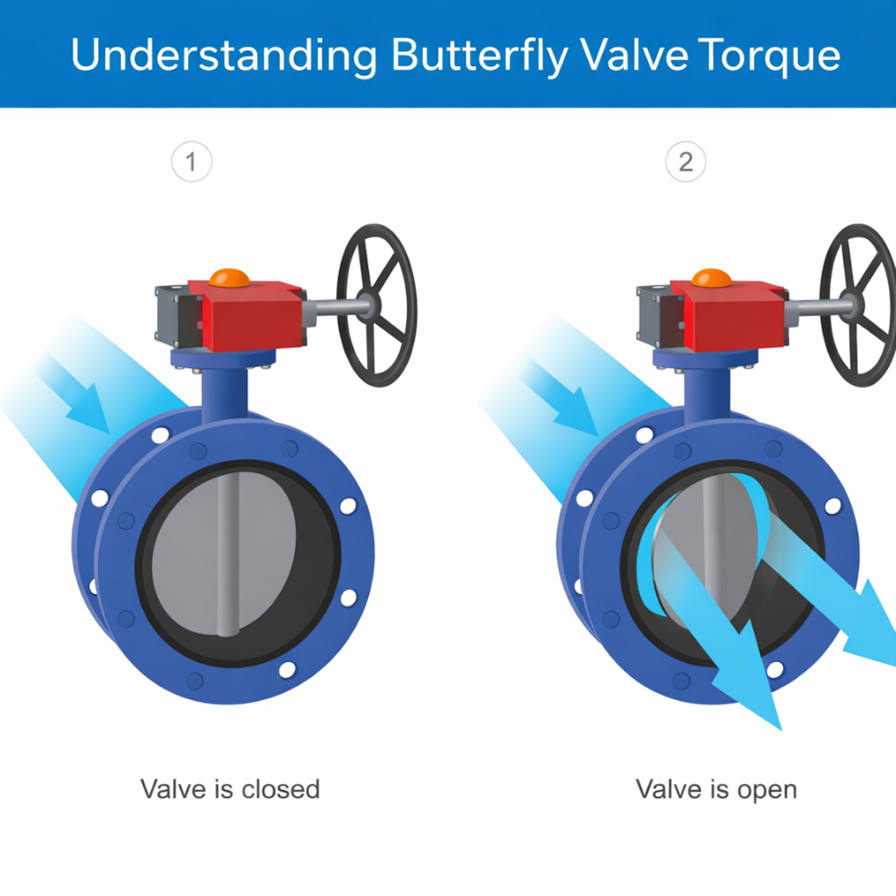
Torque is the rotational force required to overcome resistance within the valve during operation, including:
- Disc-to-seat interference force
- Hydrodynamic forces acting on the disc
- Bearing and shaft friction
Unlike other valves, butterfly valves experience continuous fluid interaction, making torque calculation more complex.
Why Torque is Critical in Actuator Selection
Correct torque ensures:
- Proper valve closure (tight shut-off)
- Stable actuator performance
- Reduced wear on seat and disc
If torque is underestimated:
- Valve may not fully close
- Leakage occurs under pressure
- Actuator may stall or fail
This is why actuator sizing for butterfly valves must always be based on torque — not just size.
Types of Torque in Butterfly Valves
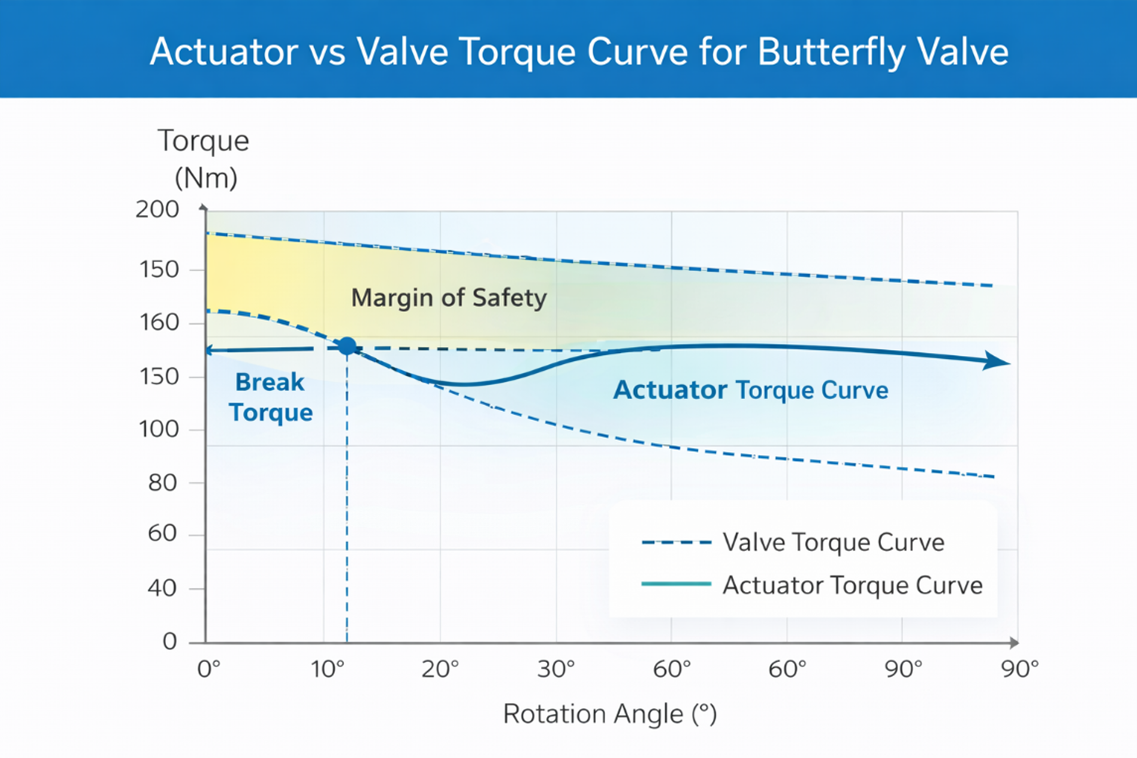
Breakaway Torque (Maximum Torque)
Break torque is the highest torque required and occurs when the valve starts opening from the fully closed position.
It is influenced by:
- Seat compression
- Static friction
- Full differential pressure
This is the key value used in actuator sizing calculations.
Running Torque (Dynamic Torque)
Once movement begins:
- Friction reduces
- Flow stabilizes
However, torque still varies with disc position and flow velocity.
Seating and Unseating Torque
- Seating torque ensures tight shut-off
- Unseating torque breaks the seal during opening
Highly dependent on seat material and design
Factors Affecting Butterfly Valve Torque Calculation
Valve Size (DN / NPS)
Torque increases with valve diameter:
Larger disc = higher pressure force = higher torque
Differential Pressure (ΔP) – Key Parameter
Torque is directly proportional to pressure across the valve.
But in reality:
Torque depends on actual operating pressure, not just rating
Seat Material (EPDM vs PTFE vs Viton)
| Seat Type | Torque Behavior |
| EPDM / NBR | Low torque |
| Viton (FKM) | Medium torque |
| PTFE | High torque |
PTFE seated valves may require 30–60% higher torque
Disc Design and Valve Type
- Concentric → higher friction
- Double offset → reduced contact
- Triple offset → minimal friction
Media Type
- Water → predictable torque
- Slurry → higher resistance
- Viscous fluids → increased torque
Temperature Conditions
At higher temperature:
- Elastomer properties change
- Friction increases
This directly increases torque requirement
How to Calculate Butterfly Valve Torque
There is no single universal formula used in the field.
Instead:
- Identify valve size
- Determine maximum differential pressure
- Refer to butterfly valve torque chart
- Apply safety factor
Simplified Torque Formula
T ∝ ΔP × D³
Where:
- ΔP = Differential pressure
- D = Valve diameter
Used only for estimation – not final selection.
Butterfly Valve Torque Chart
Below is a butterfly valve torque chart for EPDM seated valves:
| Size | PN10 | PN16 |
| DN80 | 20–35 Nm | 35–55 Nm |
| DN100 | 30–50 Nm | 50–80 Nm |
| DN150 | 60–90 Nm | 90–140 Nm |
| DN200 | 100–160 Nm | 160–250 Nm |
Example – Butterfly Valve Torque Calculation
Valve: DN100
Pressure: PN16 (16 bar)
Media: Water
From torque chart:
- Break torque ≈ 80 Nm
Apply 30% safety factor:
Final actuator torque = 104 Nm (select 110–120 Nm actuator)
Butterfly Valve Actuator Sizing (Step-by-Step)
Step 1: Determine Maximum Torque
Always use break torque.
Step 2: Apply Safety Factor
Recommended:
- 25% minimum
- 30–50% preferred
Step 3: Select Actuator Type
Pneumatic Actuator
- High torque output
- Fast operation
Electric Actuator
- Controlled movement
- Suitable for modulating service
Step 4: Verify Actuator Torque Curve
Important:
Pneumatic actuators do NOT provide constant torque
Check torque at:
- Start
- Mid stroke
- End position
Step 5: Check ISO 5211 Mounting
Ensure:
- Proper shaft connection
- Correct mounting interface
Common Mistakes in Butterfly Valve Actuator Selection
- Selecting actuator based only on valve size
- Ignoring pressure variation
- Not considering seat material (PTFE mistake)
- Using same actuator for PN10 and PN16
- No safety margin
Torque vs Pressure – Practical Insight
| Pressure Class | Torque Trend |
| PN10 | Moderate |
| PN16 | Higher |
| Class 150 | Higher |
| Class 300 | Very high |
Higher pressure = higher torque requirement
Where Accurate Torque Calculation is Critical
- Chemical plants (PTFE valves)
- Water treatment systems
- Oil & gas pipelines
- HVAC automation
Final Recommendation
- Always calculate torque based on actual operating conditions
- Never rely only on pressure class
- Use proper safety factor
- Verify actuator performance curve
Correct torque selection ensures:
- Reliable sealing
- Longer actuator life
- Reduced maintenance
FAQ – Butterfly Valve Torque Calculation
1. How to calculate butterfly valve torque?
2. What is butterfly valve torque chart?
3. Can I use same actuator for PN10 and PN16?
4. Why PTFE valves need higher torque?
Looking for accurate butterfly valve torque calculation and actuator selection?
At C-Way Engineering Exports, we provide engineering-based valve solutions – not just products. From torque calculation to actuator sizing, we help you select the right combination for real industrial conditions.
Contact C-Way Engineering Exports today for expert support and customized valve solutions.


