

Stainless Steel Pipe Fittings: Types, Standards, Grades (304/316), Sizes, and Industrial Applications
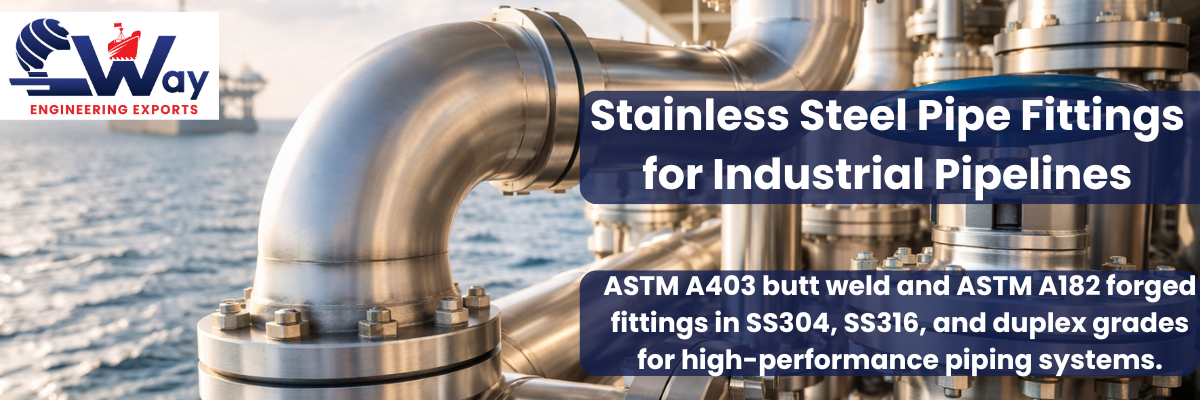
Stainless steel pipe fittings are critical components in modern industrial piping systems, enabling reliable connections, flow direction changes, and size transitions in pipelines. Known for their corrosion resistance, durability, and high-temperature performance, stainless steel fittings are widely used across industries such as oil & gas, chemical processing, water treatment, food processing, and pharmaceuticals.
These fittings are manufactured according to internationally recognized standards such as ASME B16.9 (butt weld fittings), ASME B16.11 (forged fittings), and ASTM A403 / ASTM A182 (material specifications). This guide provides a complete overview of types, grades, standards, dimensions, and applications of stainless steel pipe fittings, helping engineers and buyers make informed decisions.
What are Stainless Steel Pipe Fittings?
Stainless steel pipe fittings are mechanical components used to connect, redirect, reduce, or terminate pipelines. They are manufactured using high-quality stainless steel materials to withstand corrosive environments, high pressure, and elevated temperatures.
These fittings are broadly classified into:
- Butt Weld Pipe Fittings (ASME B16.9)
- Forged Pipe Fittings (ASME B16.11)
This classification depends on pipe size, pressure rating, and application requirements
Types of Stainless Steel Pipe Fittings (Butt Weld & Forged)
-
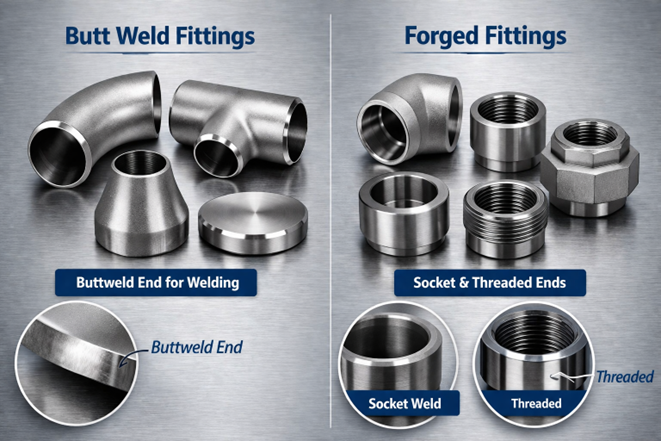
Butt Weld Pipe Fittings (ASME B16.9)
Butt weld fittings are designed to be welded directly to pipes, providing a strong, leak-proof connection and smooth internal flow.
Common Types:
- Elbows (90° LR, SR, 45°) – change flow direction
- Tees (Equal & Reducing) – create branch connections
- Reducers (Concentric & Eccentric) – connect different pipe sizes
- Pipe Caps – close pipeline ends
These fittings are widely used in high-pressure and high-temperature applications.
-
Forged Pipe Fittings (ASME B16.11)
Forged fittings are typically used for small bore piping systems and high-pressure applications.
Types of Forged Fittings:
- Strong welded connection
- Used in high-pressure systems
Threaded Fittings
- Easy installation
- Used in low-pressure applications
Common materials include ASTM A182 F304 and F316.
Stainless Steel Grades Used in Pipe Fittings
Stainless Steel 304 Pipe Fittings (ASTM A403 WP304 / ASTM A182 F304)
Stainless Steel 304 pipe fittings are widely used in industrial piping systems due to their excellent corrosion resistance, good mechanical strength, and cost-effectiveness. These fittings are available in both butt weld form (ASTM A403 WP304) and forged form (ASTM A182 F304), depending on the application and pressure requirements.
SS304 pipe fittings perform well in non-aggressive environments such as water systems, air lines, and mild chemical applications. They are widely used in industries such as food processing, water treatment, HVAC systems, and general engineering, where corrosion exposure is moderate and cost efficiency is important.
Stainless Steel 304L Pipe Fittings (ASTM A403 WP304L / ASTM A182 F304)
SS304L is the low-carbon version of 304, designed to prevent carbide precipitation during welding, which improves resistance to intergranular corrosion. This makes it ideal for welded piping systems and fabricated structures. It is commonly used in chemical processing plants, fabrication projects, and pressure piping systems, where welding integrity and corrosion resistance are critical.
Stainless Steel 316 Pipe Fittings (ASTM A403 WP316 / ASTM A182 F316)
Stainless Steel 316 pipe fittings contain molybdenum, which enhances resistance to chlorides, acids, and corrosive chemicals. These fittings are commonly used in marine environments, chemical processing, offshore pipelines, and desalination plants, where higher corrosion resistance is required.
Stainless Steel 316L Pipe Fittings (ASTM A403 WP316L / ASTM A182 F316)
SS316L is the low-carbon variant of 316, offering improved weldability and superior corrosion resistance. It is widely used in pharmaceutical, food processing, and high-purity applications, where hygiene and corrosion resistance are essential.
Duplex Stainless Steel Pipe Fittings (ASTM A815 UNS S31803)
Duplex stainless steel fittings provide a combination of high strength and excellent resistance to stress corrosion cracking. They are widely used in oil & gas, offshore platforms, and petrochemical industries, where durability and performance are critical.
Super Duplex Stainless Steel Pipe Fittings (UNS S32750 / S32760)
Super duplex stainless steel fittings offer exceptional corrosion resistance and superior mechanical strength, making them suitable for extreme environments such as offshore pipelines, marine systems, and aggressive chemical applications.
Stainless Steel Pipe Fittings Standards
Stainless steel pipe fittings are manufactured in accordance with international standards to ensure dimensional accuracy, material quality, and interchangeability across global projects.
American Standards (ASME / ASTM)
- ASME B16.9 – Dimensions for butt weld fittings
- ASME B16.11 – Forged fittings (socket weld & threaded)
- ASTM A403 – Material specification for stainless steel butt weld fittings
- ASTM A182 – Forged stainless steel fittings (socket weld & threaded)
- ASTM A312 – Stainless steel pipes
European / DIN Standards (EN Standards)
- EN 10253-4 – Butt weld stainless steel pipe fittings (equivalent to ASME B16.9)
- EN 10216-5 – Seamless stainless steel pipes
- EN 10217-7 – Welded stainless steel pipes
- EN 10088 – Stainless steel material grades and compositions
- EN 10272 – Stainless steel bars for pressure purposes
DIN Standards (Older but Still Referenced)
- DIN 2605 – Butt weld elbows
- DIN 2615 – Pipe tees
- DIN 2616 – Concentric and eccentric reducers
- DIN 2617 – Pipe caps
Sizes and Dimensions of Stainless Steel Pipe Fittings
Stainless steel pipe fittings are available in a wide range of sizes:
- Butt weld fittings: NPS ½″ to 48″
- Forged fittings: NPS ½″ to 4″
They follow standardized dimensions to ensure proper alignment and easy installation in piping systems.
Engineering charts such as:
- ASME B16.9 dimension charts
- Pipe schedule charts (SCH 10–80)
- Pipe weight charts
are essential for design, calculation, and procurement.
Why Stainless Steel Pipe Fittings Are Preferred
• Corrosion Resistance
Performs well in harsh and corrosive environments
• Long Service Life
Ensures durability with minimal maintenance
• High Temperature Performance
Suitable for high-temperature process systems
• Hygienic Properties
Ideal for food, beverage, and pharmaceutical industries
• Cost-Effective Over Lifecycle
Lower maintenance and replacement costs
Applications of Stainless Steel Pipe Fittings
Stainless steel pipe fittings are widely used in:
• Oil & Gas Industry
For high-pressure pipelines and offshore systems
• Chemical & Petrochemical Plants
Handling corrosive chemicals and acids
• Water Treatment Plants
For long-lasting corrosion-resistant systems
• Marine & Shipbuilding Industry
Used in systems requiring corrosion resistance
• Food & Beverage Industry
Maintaining clean and hygienic processing
• Pharmaceutical Industry
Used in high-purity pipelines
How to Select the Right Stainless Steel Pipe Fittings
Selecting the right fitting is critical for performance and reliability.
Key Factors:
- Material Grade: 304 vs 316 vs duplex
- Pressure & Temperature Requirements
- Corrosion Environment
- Applicable Standards (ASME / ASTM)
- Connection Type (Butt weld / Socket weld / Threaded)
Proper selection ensures long-term performance and safety.
Quality Testing and Inspection
High-quality stainless steel fittings undergo strict testing:
- PMI (Positive Material Identification)
- Hydrostatic Testing
- Ultrasonic Testing (UT)
- Radiographic Testing (RT)
- Dimensional Inspection
These ensure compliance with international standards and project specifications.
Conclusion
Stainless steel pipe fittings play a vital role in ensuring safe, efficient, and long-lasting piping systems. With a wide range of types, grades such as 304, 316, and duplex, and compliance with standards like ASME B16.9 and ASTM A403, these fittings are suitable for diverse industrial applications.
Understanding the types, material grades, standards, and selection criteria helps engineers and procurement professionals choose the right fittings for their projects.
Looking for high-quality stainless steel pipe fittings?
We are Manufacturer of:
ASTM A403 WP304 / WP316 Butt Weld Fittings
ASTM A182 Forged Fittings
Duplex & Super Duplex Fittings
Contact us today for technical support, datasheets, and competitive quotations tailored to your project requirements.
FAQ
1. What is the difference between ASTM A403 and ASTM A182 pipe fittings?
2. How do I choose between SS304 and SS316 pipe fittings for my project?
3. What standards should stainless steel pipe fittings comply with?
• ASME B16.9 (butt weld fittings dimensions)
• ASME B16.11 (forged fittings)
• ASTM A403 (material for butt weld fittings)
• ASTM A182 (material for forged fittings)
For European projects, compliance with EN 10253 and DIN standards may also be required
4. What is the typical size range for stainless steel pipe fittings?
• Forged fittings: Usually available from ½″ to 4″
The selection depends on pipeline design and pressure requirements
5. What tests are required for stainless steel pipe fittings before supply?
• PMI (Positive Material Identification)
• Hydrostatic testing
• Ultrasonic testing (UT)
• Radiographic testing (RT)
• Dimensional inspection
These tests ensure material authenticity, strength, and performance reliability
6. When should I use butt weld fittings instead of forged fittings?
Looking for accurate butterfly valve torque calculation and actuator selection?
At C-Way Engineering Exports, we provide engineering-based valve solutions – not just products. From torque calculation to actuator sizing, we help you select the right combination for real industrial conditions.
Contact C-Way Engineering Exports today for expert support and customized valve solutions.


