


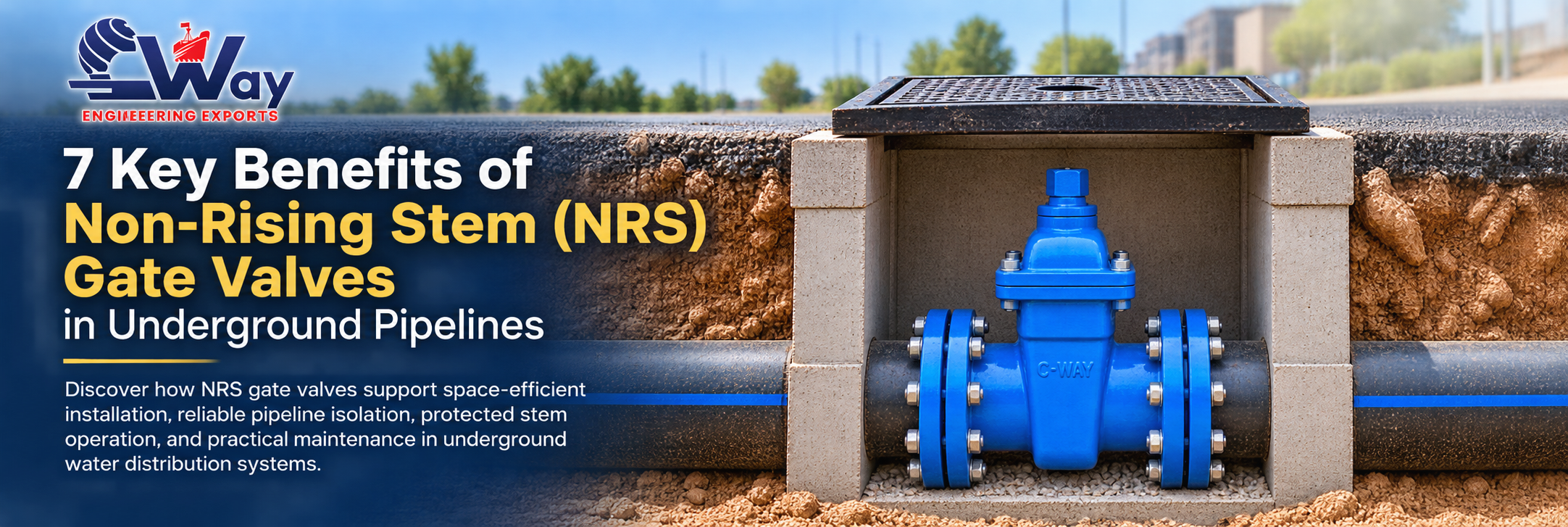
Underground pipeline systems require reliable isolation valves that fit within limited installation space, provide dependable shutoff, and remain accessible for maintenance. Non-rising stem (NRS) gate valves are widely used in water distribution networks and other compatible pipeline applications where a rising stem may not be practical.
For municipal water utilities, pipeline contractors, EPC companies, and industrial buyers, selecting the right NRS gate valve involves more than choosing a valve size. Installation depth, operating access, pressure rating, body material, sealing design, corrosion protection, and project specifications all influence long-term performance.
In this guide, we explain how non-rising stem gate valves work and review seven practical benefits to consider when specifying them for underground pipeline applications.
What Is an NRS Gate Valve? Design and Functionality
A Non-Rising Stem (NRS) Gate Valve is a gate valve designed so that its stem rotates during operation without rising vertically above the valve body in the manner of a rising stem gate valve.
The valve opens and closes by moving an internal gate or wedge away from or toward the flow passage. When the valve is fully open, the gate retracts from the main flow path. When fully closed, the gate engages the seating surfaces to isolate the pipeline.
In a typical NRS gate valve, the stem is threaded to interact with the internal gate mechanism. Turning the operating nut or handwheel rotates the stem, causing the gate to travel within the valve body while the stem remains at approximately the same external height.
This arrangement makes the NRS design useful where vertical clearance is restricted, including underground water pipelines, valve chambers, and buried utility networks.
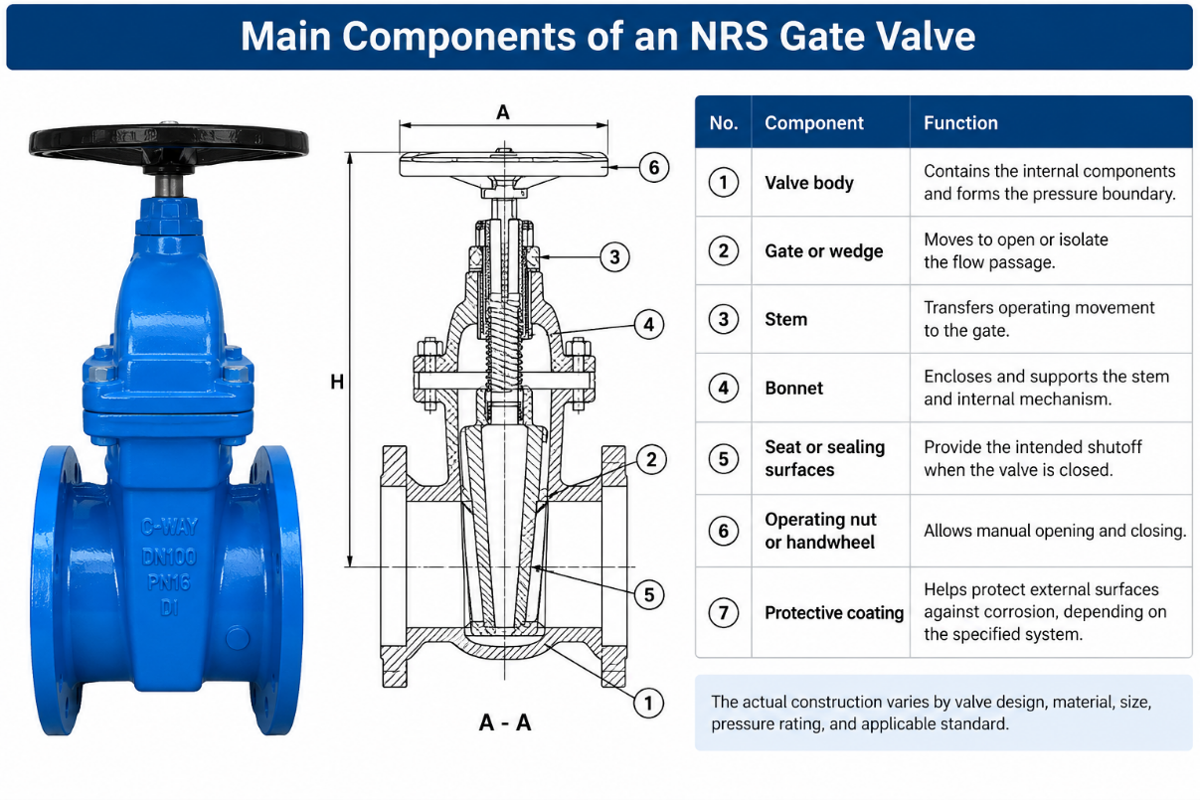
Important distinction: NRS describes the stem arrangement, not the sealing method. An NRS gate valve may use a resilient-seated or metal-seated design, depending on the product specification.
| Factor | NRS Gate Valve | Rising Stem Gate Valve |
|---|---|---|
| Stem movement | Stem rotates without rising externally | Stem moves vertically during operation |
| Vertical clearance | Generally requires less stem-travel clearance | Requires clearance for stem travel |
| Position indication | Stem position provides less direct visual indication | Visible stem movement can indicate valve position |
| Common installation | Underground chambers and confined spaces | Locations with adequate stem clearance |
| Operating access | May use an operating nut, valve key or extension stem | May use a handwheel or compatible operator |
| Selection factors | Clearance, access and service requirements | Visibility, clearance and maintenance requirements |
7 Key Benefits of Non-Rising Stem Gate Valves in Underground Pipelines
1. Space-Saving Design for Underground Installations
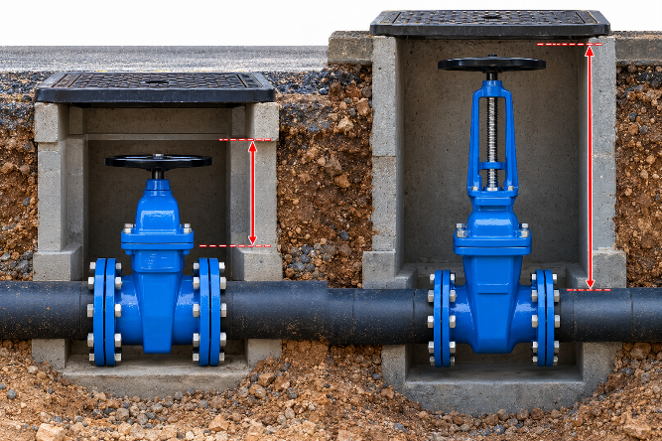
One of the main advantages of an NRS gate valve is that its stem does not extend upward as the valve opens. This can simplify installation in underground valve chambers and other locations with limited vertical clearance.
For water distribution pipelines, municipal utility networks, and buried piping systems, available space above the valve can be restricted by roadways, sidewalks, other utilities, and chamber dimensions.
Benefits:
- Reduces the need for vertical clearance associated with a rising stem.
- Supports compact valve chamber layouts.
- Can simplify installation where overhead space is restricted.
- Helps accommodate valves in confined underground utility locations.
The complete installation still needs sufficient space for the operating nut, valve box, extension stem, and maintenance access.
2. Practical Operation at or Below Ground Level
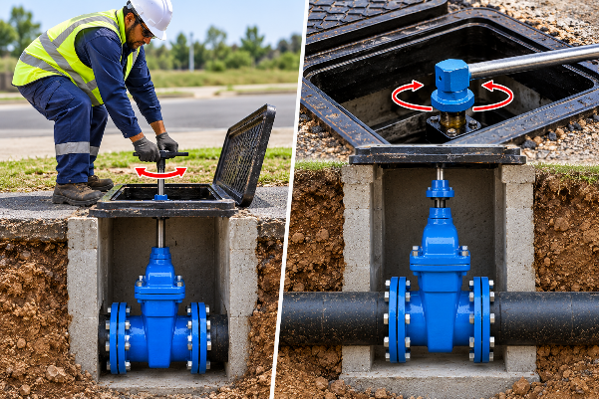
NRS gate valves can be configured for operation from ground level using an operating nut and suitable valve key. Where the valve is installed deeper underground, an extension stem can connect the valve’s operating mechanism to an accessible point.
This arrangement is particularly useful for buried water distribution networks where the valve body is not directly accessible.
Benefits:
- Allows operation without requiring the stem to rise above the valve.
- Supports access through a valve box or chamber.
- Can accommodate different installation depths through suitable accessories.
- Helps keep the operating point accessible for utility maintenance teams.
When specifying the valve, buyers should confirm the operating nut dimensions, extension stem length, operating direction, and compatibility with the required operating tool.
3. Suitable for Water Distribution and Pipeline Isolation
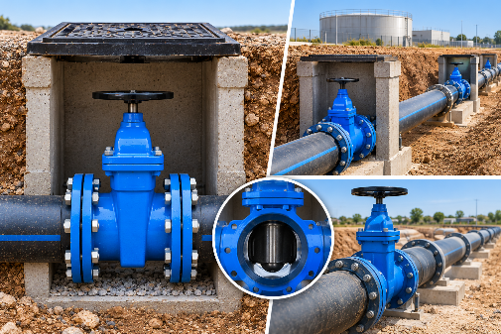
Gate valves are commonly selected for on/off isolation duties. An NRS gate valve can isolate a section of a compatible water pipeline so that maintenance or repair work can be carried out on the affected section.
Applications may include municipal water distribution, water treatment plants, pumping stations, reservoir connections, irrigation networks, and industrial water systems.
Benefits for buyers:
- Provides an isolation point within the pipeline network.
- Supports planned maintenance and repair activities.
- Can be incorporated into water distribution and transmission systems.
- Offers a practical valve arrangement for buried utility infrastructure.
The valve must be selected for the actual fluid, pressure, temperature, leakage requirements, and governing project specifications. Gate valves are generally intended for isolation rather than continuous flow throttling.
4. Available with Different Materials and Sealing Designs
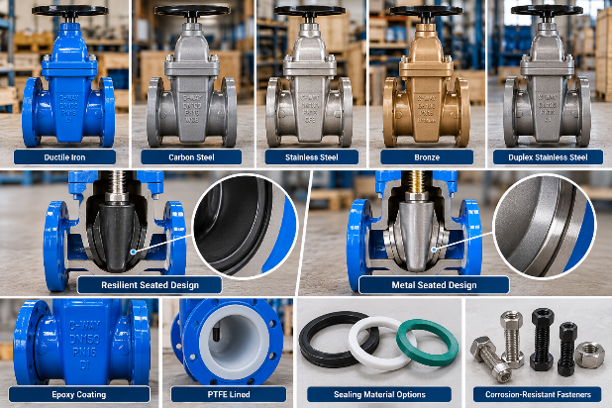
NRS gate valves are available in different body materials and seating configurations to suit project requirements. Ductile iron is commonly considered for water distribution applications, while other materials may be required for different operating conditions.
A resilient-seated design uses an elastomeric sealing surface. A metal-seated design uses metal sealing surfaces and may be appropriate for different service requirements.
Benefits for buyers:
- Allows selection based on the intended application.
- Supports different pressure and material specifications.
- Provides options for resilient or metal seating.
- Allows corrosion protection and sealing materials to be specified for the service environment.
5. Protected Stem Reduces the Risk of External Damage & Corrosion for Buried Service
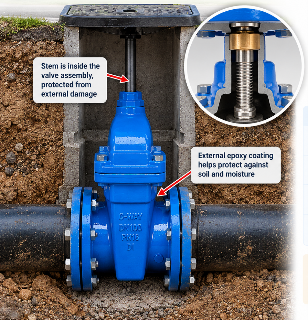
For many water distribution applications, buyers evaluate ductile iron bodies, suitable elastomers, and protective coatings. However, the final material combination must match the required valve design and service conditions.
For potable water projects, confirm any required approvals for materials in contact with drinking water in the destination market.
Underground valves can be exposed to moisture, groundwater, soil chemicals, and other environmental conditions. Selecting a suitable valve coating and material combination is therefore important for buried installations.
Depending on the valve design and project requirements, protective measures may include external epoxy coating, specified internal lining, corrosion-resistant fasteners, and additional protection based on site conditions.
Benefits:
- Allows corrosion protection to be matched to the installation environment.
- Helps protect external valve surfaces when the specified coating is suitable and properly applied.
- Supports project-specific inspection and coating requirements.
- Helps integrate the valve into the pipeline’s overall corrosion-control strategy.
Specification note: The non-rising stem arrangement alone does not guarantee corrosion resistance. Confirm the coating system, material requirements and inspection criteria in the project specification
6. Multiple Operating and Accessory Options
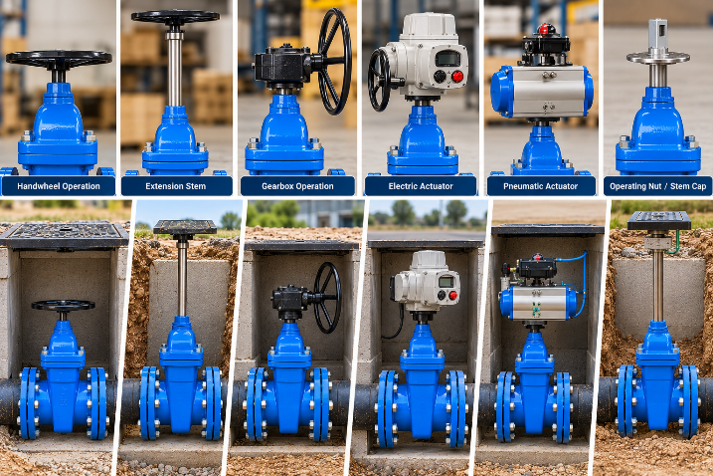
Although NRS gate valves are commonly associated with underground installations, their operating arrangement can be selected to suit different site conditions.
Depending on the valve design and available configurations, options may include operating nuts, extension stems, handwheels, gear operators, and compatible actuation arrangements.
Benefits:
- Allows the operating arrangement to match installation depth.
- Supports access through valve boxes or chambers.
- Provides options for larger valves that may require reduced operating effort.
- Helps coordinate the valve with the project’s maintenance and operating procedures.
The operating accessories should be included in the original specification. An extension stem, valve box, or operating interface should not be assumed to be included unless explicitly confirmed in the quotation.
7. Potential Cost Savings in Underground Installations
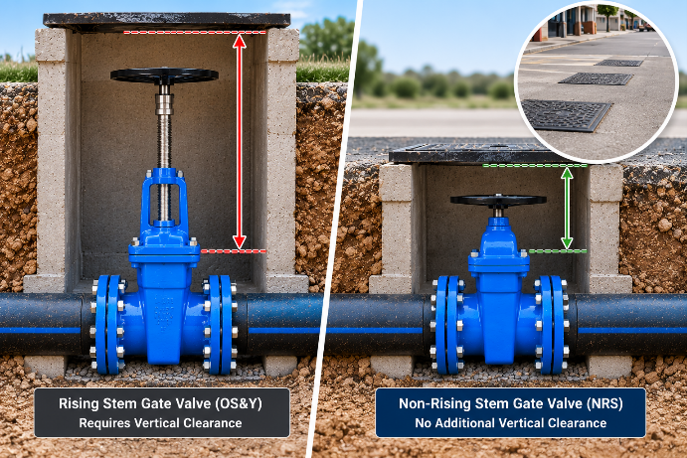
The compact operating arrangement of a Non-Rising Stem (NRS) Gate Valve can help simplify installations where vertical clearance is limited. Depending on the pipeline layout, it may reduce the need for additional overhead clearance or modifications to accommodate a rising stem.
For municipal water networks and underground pipeline projects, the overall cost depends on the valve price, operating accessories, valve chamber design, installation labor, and maintenance requirements.
Potential cost advantages include:
- Reduced need for vertical clearance above the valve.
- Potentially simpler valve chamber arrangements.
- Lower installation costs where the design avoids additional structural modifications.
- Efficient use of space in underground utility networks.
Actual savings depend on the project design, installation conditions, and selected valve configuration.
NRS Gate Valve vs. Rising Stem Gate Valve: When Does NRS Make Sense?
NRS gate valves are often considered where vertical clearance is restricted, particularly in underground water distribution systems. Rising stem designs provide visible stem movement that can help indicate the valve’s position, but they require sufficient clearance for stem travel.
The right choice depends on the installation arrangement, operating access, visibility requirements, maintenance practices, and project specifications. For buyers who need a detailed comparison, see our related guide on rising stem versus non-rising stem gate valves.
Looking for an NRS gate valve for an underground water pipeline, municipal water distribution network, water treatment plant, irrigation system, or industrial utility project?
Send us the required valve size, pressure rating, material, sealing design, end connections, operating accessories, applicable standards, quantity, and destination country.
Non-rising stem gate valves offer a practical option for underground pipelines where vertical clearance and operating access are important considerations. Their suitability depends on the complete valve design, service conditions, installation arrangement, sealing materials, corrosion protection, and required accessories.
Before specifying an NRS gate valve, confirm the size, pressure rating, media, temperature, material, seat design, end connections, applicable standards, and operating-access requirements.
Looking for an NRS gate valve for your project? Contact C-Way Engineering Exports with your valve size, pressure rating, material, sealing design, end connections, operating accessories, quantity, and destination country.
Contact C-Way Engineering Exports to discuss your NRS gate valve requirements.


