


High-Pressure Steam Gate Valve Leakage Case Study: How Proper Valve Selection Solved the Problem
From an initial single-valve replacement to 77 additional gate valves in different sizes, this case study demonstrates how application- focused valve selection, product quality and reliable support can build long-term customer confidence
A leaking gate valve on a high-pressure steam line required an industrial customer to identify a suitable replacement. Rather than treating the requirement as a simple like-for-like valve purchase, C-Way Engineering Exports approached the replacement based on the application and approved project requirements. High-pressure steam systems demand reliable isolation equipment. When a gate valve begins leaking in a steam line, the problem can lead to increased maintenance requirements, steam loss, operational concerns and the need for an urgent replacement.
However, replacing a leaking valve is not simply a matter of selecting another valve with the same size and connection.
The replacement must be evaluated against the actual application, including operating pressure, temperature, pressure class, valve construction, materials, sealing arrangement, end connection and intended service.
This case study describes how C-Way Exports supported an industrial customer with the replacement of an existing gate valve in a high-pressure steam application.
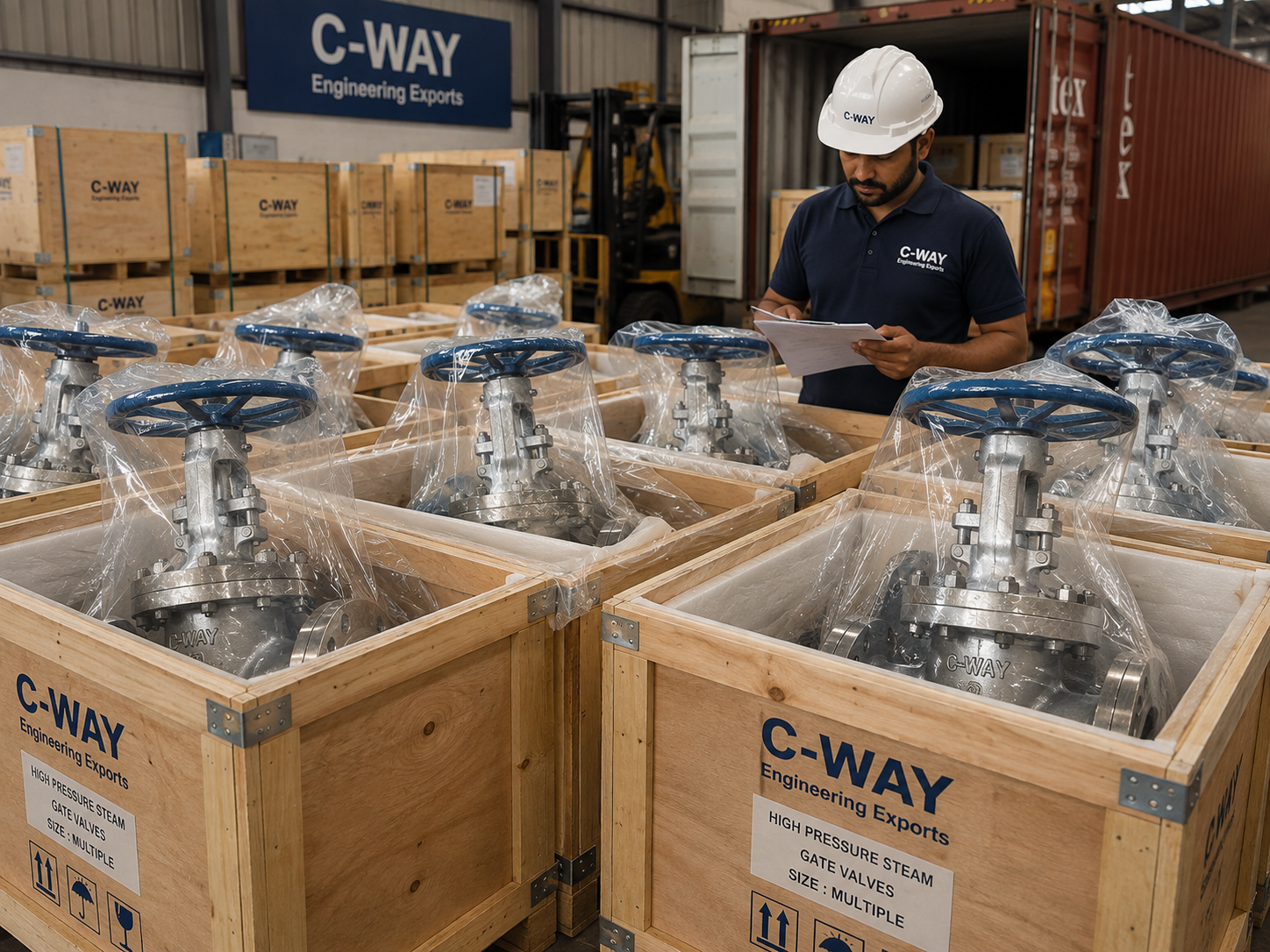
The customer initially placed an order for one replacement gate valve. Following successful supply and installation, the customer developed confidence in C-Way’s product quality and technical approach. This subsequently led to a much larger requirement for 77 additional gate valves in different sizes.
The project demonstrates how a single successful valve replacement can become the foundation for a larger industrial valve supply relationship.
Case Study at a Glance
| Project Parameter | Details |
|---|---|
| Application | High-pressure steam |
| Valve type | Gate valve |
| Primary function | Isolation |
| Initial requirement | 1 replacement gate valve |
| Subsequent requirement | 77 additional gate valves |
| Total across both requirements | 78 valves |
| Valve sizes | Multiple sizes |
| Requirement type | Industrial valve replacement |
| Supplier | C-Way Engineering Exports |
Project progression: 1 replacement valve → successful supply and installation → 77 additional gate valves → 78 valves across both requirements.
Project-specific pressure, temperature, material and valve construction details should be added from approved project documentation where disclosure is permitted.
The Customer’s High-Pressure Steam Valve Requirement
The customer had an existing gate valve installed on a high-pressure steam line. The valve had developed leakage and required replacement.
In an industrial steam system, a leaking valve can create operational and maintenance concerns. Depending on the location and severity of the leakage, escaping steam may contribute to energy loss, equipment deterioration, increased maintenance requirements and potential safety risks.
The customer’s immediate requirement was therefore straightforward:
Replace the existing leaking gate valve with a suitable valve for the application.
However, selecting the replacement was not simply a matter of matching the existing valve’s nominal size.
The replacement needed to be evaluated against the actual service conditions and approved project requirements.
These considerations included:
- Steam service
- Valve size
- Operating pressure
- Design pressure
- Operating temperature
- Design temperature
- Pressure class
- Pressure-temperature rating
- Valve function
- Body and trim materials
- Seating arrangement
- Stem and packing arrangement
- End connection
- Applicable standards
- Testing requirements
- Inspection and documentation requirements
The central engineering question was:
What valve specification is appropriate for the customer’s actual high-pressure steam service?
Application Overview
| Parameter | Application |
|---|---|
| Medium | High-pressure steam |
| Valve function | Isolation |
| Valve type | Gate valve |
| Initial requirement | 1 replacement valve |
| Subsequent requirement | 77 additional valves |
| Sizes | Multiple sizes |
| Service | Industrial steam application |
The exact operating pressure, temperature, pressure class, material and valve specifications should be added from the approved project documentation.
The Problem: Leakage From an Existing Gate Valve
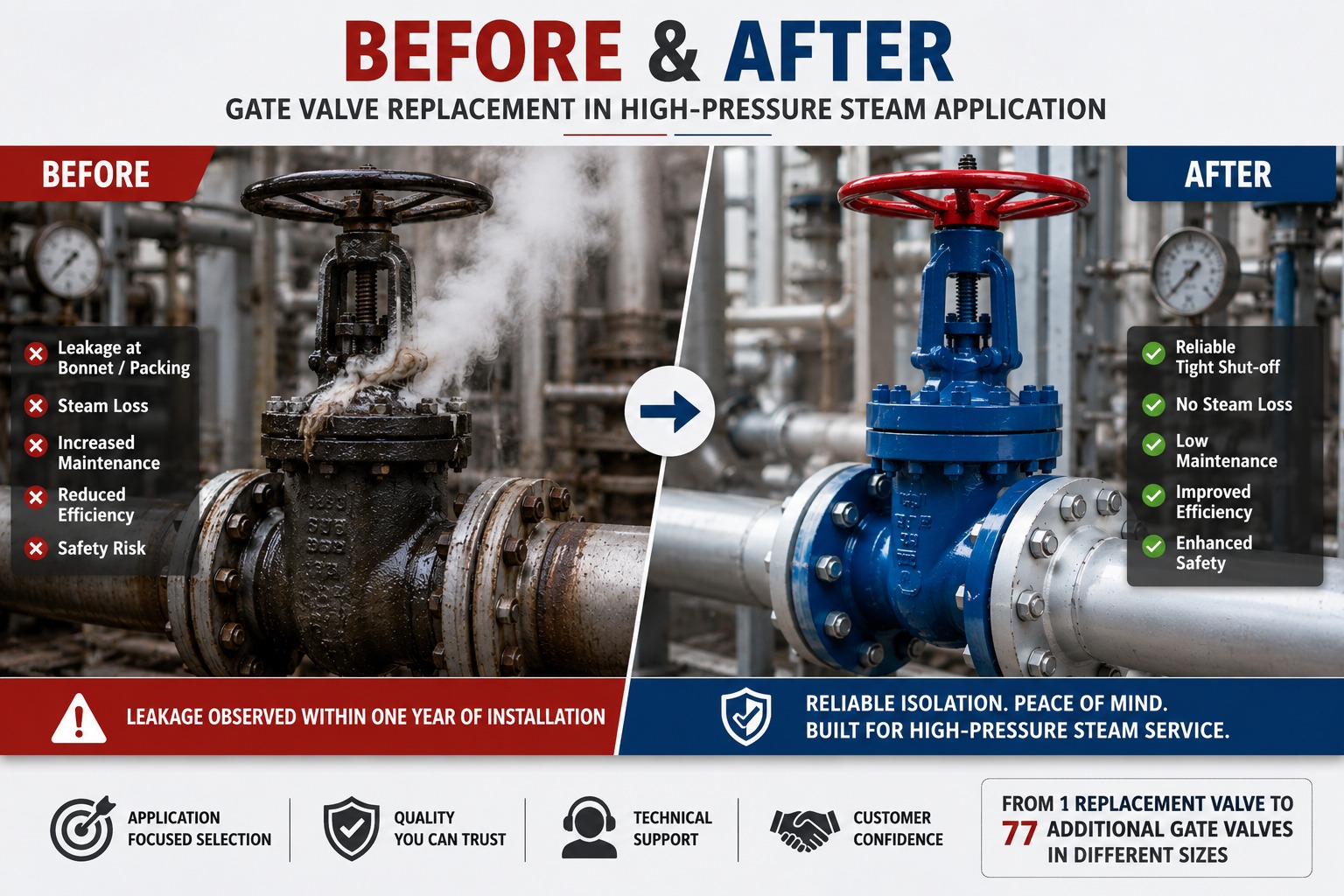
The customer’s existing valve had developed recurring leakage and required replacement.
In high-temperature steam service, leakage cannot simply be viewed as a minor inconvenience. Even a relatively small steam leak can result in continuous energy loss, increasing operating costs and reducing overall system efficiency. Escaping high-temperature steam can also create serious safety hazards for personnel and may damage nearby insulation, equipment or piping components. If leakage is allowed to continue, it can worsen over time and lead to more extensive valve damage, unplanned maintenance or forced shutdowns. For these reasons, recurring steam leakage should be investigated and corrected before it develops into a larger operational or safety problem.
Depending on the location and severity of leakage, it can contribute to:
- Steam loss
- Increased maintenance
- Reduced equipment reliability
- Unplanned intervention
- Operational concerns
- Potential safety issues
The important question for the replacement was therefore:
What valve specification would be appropriate for the customer’s actual operating conditions?
The objective was not merely to supply another valve that physically fitted the pipeline.
The replacement needed to be suitable for the service.
Why Gate Valve Selection Matters in High-Pressure Steam Service
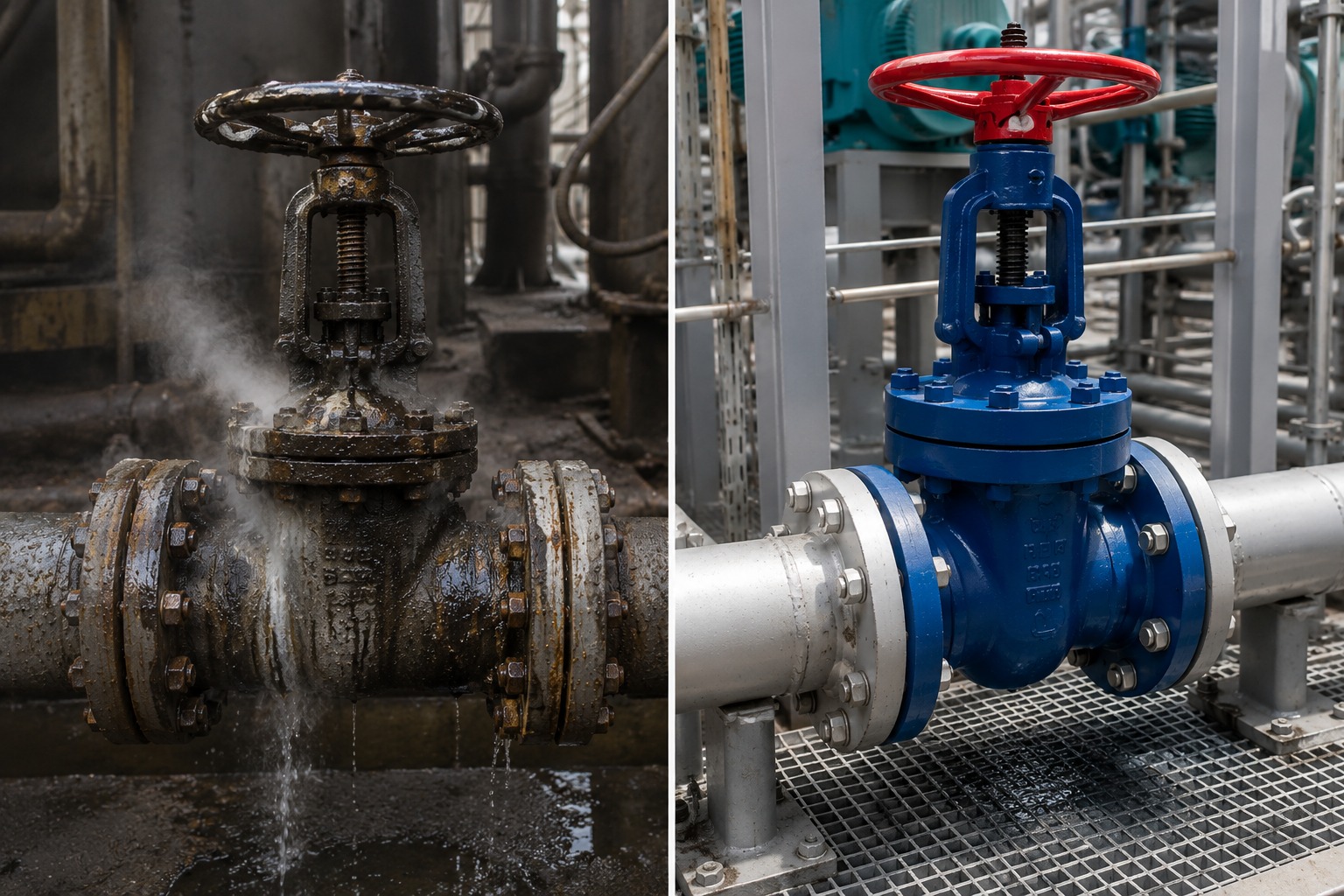
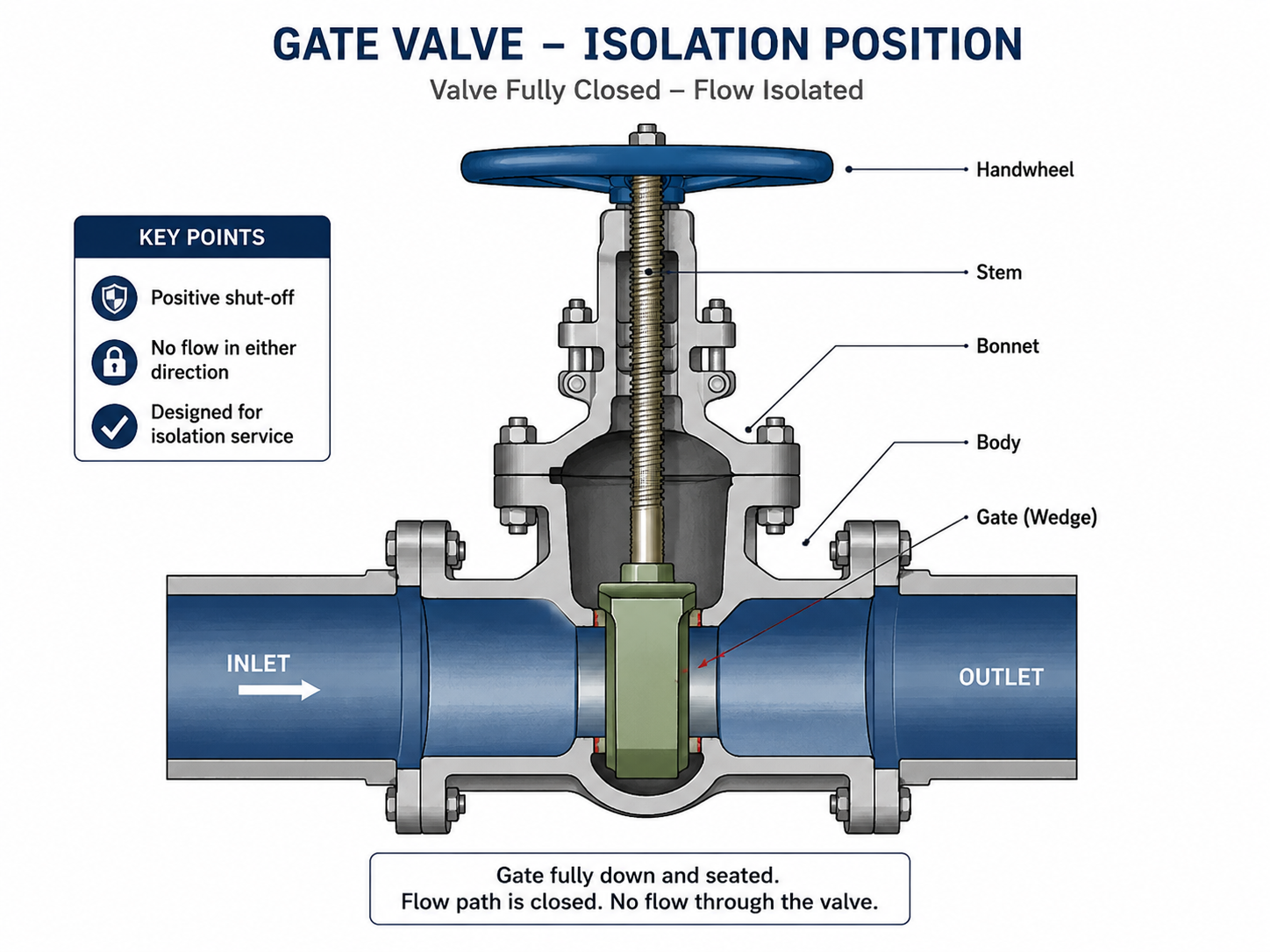
Gate valves are commonly used for isolation applications where the valve is operated primarily in the fully open or fully closed position.
For demanding steam applications, however, several technical factors need to be evaluated before selecting the valve.
Pressure
The operating and design pressure need to be established.
The selected valve must have an appropriate pressure rating for the actual service conditions.
Temperature
Steam temperature is equally important.
High-temperature service can affect material properties, sealing performance and allowable pressure.
Therefore, pressure and temperature must be evaluated together.
Pressure-Temperature Rating
The nominal pressure class alone does not provide the complete picture.
The allowable pressure at the operating temperature must be checked against the applicable pressure-temperature rating for the valve material and design.
Valve Construction
Body, bonnet, wedge, stem and seating construction should be appropriate for the application.
Materials
Body and trim materials should be selected according to the pressure, temperature and service requirements.
Sealing Arrangement
For an application where leakage was the primary concern, the sealing arrangement was an important part of the replacement specification.
This includes consideration of the valve seats and stem packing system.
Valve Function
Because the application required isolation, a gate valve was appropriate to evaluate for the service.
A conventional gate valve should generally not be selected as a substitute for a control valve where continuous throttling is required.
C-Way’s Approach to the Initial Replacement
The customer approached C-Way Exports for the replacement of one gate valve.
The initial order provided an opportunity to evaluate the application and establish the appropriate valve specification.
The selection process focused on the customer’s requirements rather than simply duplicating the existing valve.
The relevant parameters included:
- Valve size
- Steam service
- Operating pressure
- Design pressure
- Operating temperature
- Design temperature
- Valve function
- Pressure class
- Body material
- Trim material
- Seat arrangement
- Stem and packing arrangement
- End connection
- Testing requirements
- Documentation requirements
This application-based approach helped ensure that the replacement valve was specified according to the customer’s actual service requirements.
Selecting the Replacement Gate Valve
For the initial replacement, the gate valve specification was established according to the customer’s approved requirements.
The valve selection considered the complete operating envelope rather than relying only on nominal line size.
From One Valve to Customer Confidence
The initial order was for only one replacement valve.
For the customer, this first supply represented an opportunity to evaluate the product before considering a larger replacement requirement.
After the initial valve was supplied, installed and put into service, the customer was satisfied with the replacement valve and C-Way’s overall handling of the requirement.
This successful first supply became an important factor in the customer’s decision to consider C-Way for a much larger valve replacement program.
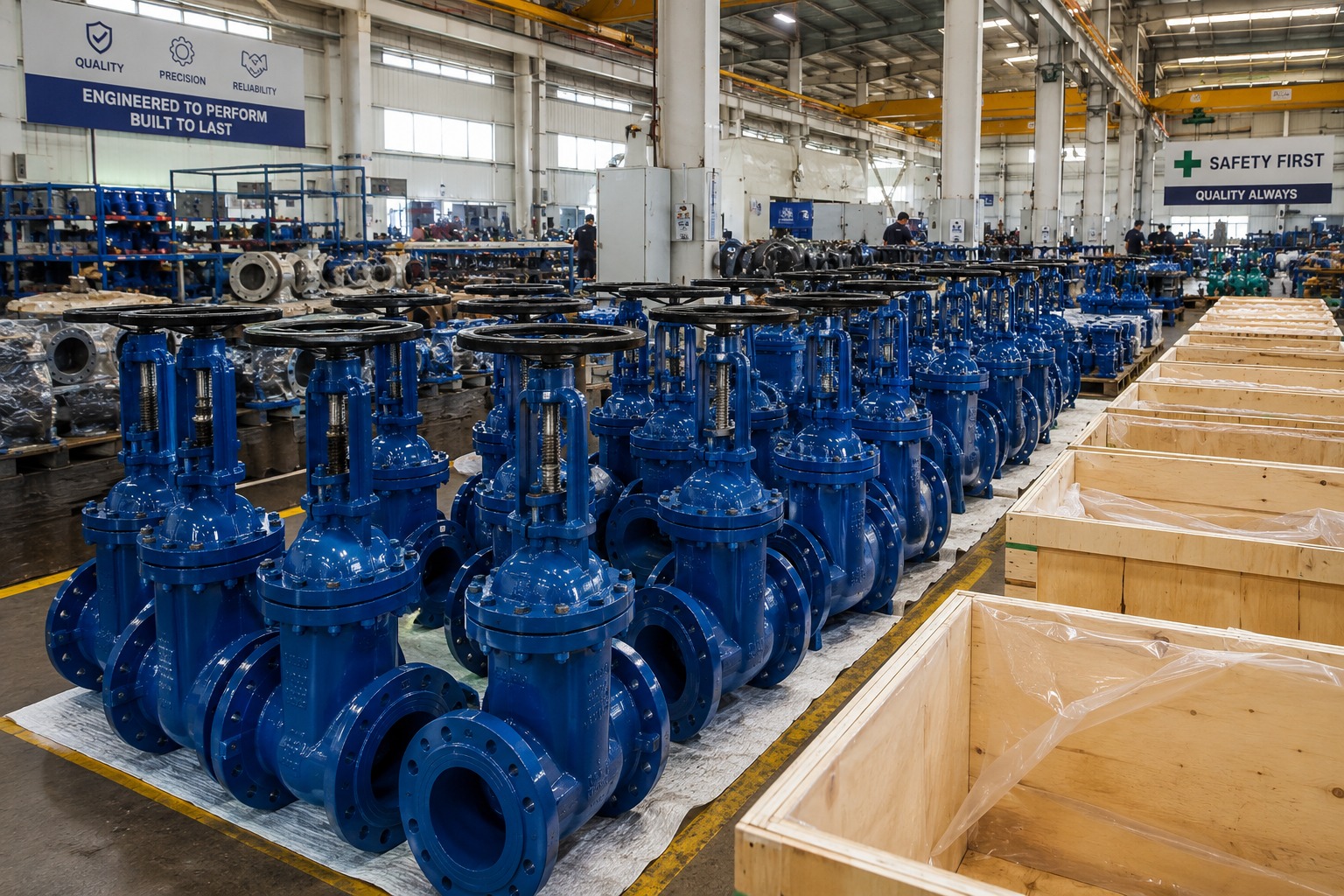
Following the successful initial replacement. The customer subsequently awarded C-Way the replacement of 77 additional gate valves in different sizes.
What Made the Initial Replacement Successful?
The success of an industrial valve replacement is rarely determined by one specification alone.
It depends on how the complete requirement is handled.
For this project, the important areas included:
Application Understanding
Understanding the customer’s steam service and valve function.
Correct Specification
Selecting the valve based on the actual operating requirements.
Product Quality
Supplying valves that conform to the approved specification.
Inspection and Testing
Ensuring that the required quality and testing requirements are addressed.
Technical Support
Helping the customer evaluate the valve requirement rather than treating the purchase as a purely transactional order.
Consistency
Demonstrating the ability to support a larger requirement involving multiple valve sizes.
Together, these factors helped build the customer’s confidence in C-Way.
How Proper Valve Selection Helps Prevent Steam Leakage
The case also highlights a broader engineering principle.
When replacing a gate valve in high-pressure steam service, the replacement should not automatically be specified as an identical copy of the existing valve.
The existing valve may itself have been selected for different operating conditions, or the original specification may not fully reflect the current service requirements.
A proper replacement assessment should consider:
1. Medium
Confirm that the valve is suitable for steam service.
2. Operating Pressure
Determine the normal operating pressure.
3. Design Pressure
Confirm the maximum design pressure that the valve may need to withstand.
4. Operating Temperature
Determine the normal steam temperature.
5. Design Temperature
Confirm the design temperature used for equipment selection.
6. Pressure Class
Select the appropriate pressure class based on the applicable pressure-temperature rating.
7. Valve Function
Confirm whether the valve is required for isolation, throttling or another function.
8. Material
Select suitable body, trim, stem and seating materials.
9. Sealing System
Consider seat sealing and stem packing requirements.
10. Connection
Verify flange, weld-end or other connection requirements.
11. Testing
Establish the applicable shell, seat and functional testing requirements.
12. Installation
Review piping alignment, external loads and thermal expansion considerations.
Installation and Commissioning
Correct valve selection is only one part of achieving reliable service.
Installation also plays an important role.
Before installation, the valve should be checked for:
- Correct size
- Correct pressure class
- Correct material
- Correct end connection
- Visible damage
- Proper identification
- Required documentation
During installation, care should be taken to avoid excessive mechanical loading caused by pipe misalignment or unsupported piping.
For high-temperature steam systems, thermal expansion also needs to be considered.
After installation, the valve should be tested and commissioned according to the applicable project and manufacturer requirements.
The valve should then be monitored during operation for:
- External leakage
- Seat leakage
- Packing condition
- Operating torque
- Abnormal vibration
- Other signs of malfunction
The Result: From One Replacement Valve to 77 More
The most significant result of the project was not simply the replacement of the initial valve.
It was the customer’s decision to expand the relationship with C-Way.
After the initial replacement, the customer subsequently awarded C-Way the replacement of 77 additional gate valves in different sizes.
This progression provided a clear indication of the customer’s confidence in C-Way’s ability to supply industrial valves for its requirements.
Project Progression
| Stage | Requirement |
|---|---|
| Initial customer requirement | 1 replacement gate valve |
| Initial supply | 1 valve |
| Customer evaluation | Product quality and performance assessed |
| Subsequent requirement | 77 additional gate valves |
| Total valves across both requirements | 78 |
| Valve sizes | Multiple sizes |
The project therefore evolved from a single replacement requirement into a substantially larger valve replacement program.
Customer Feedback
Customer Review — Procurement Head
“We purchased the earlier valves around 8–10 months ago, but after about six months, we started experiencing leakage in one of the valves. Gradually, the leakage became more serious, so we decided that it was time to replace it.
When we received and inspected the C-Way valve, we could immediately see the difference in quality and construction. I was very happy with what we received. Finally, we felt that we had found a reliable valve supplier for our requirement.”
— Michael Anderson, Procurement Head
Customer name changed for confidentiality.
Customer Review — Maintenance Head
“We were experiencing leakage, and I was concerned that continued leakage could eventually affect the pipeline and create a difficult situation for our workers. The service involves high temperatures, so we could not afford to wait for too long.
I am sharing this review after observing the replacement valve in service for more than six months. We are very satisfied with its performance. Thank you to C-Way Engineering for providing this valve.
I also recommended to our procurement team that we continue purchasing C-Way valves because the valves are robust and perform well, especially in steam service.”
— David Miller, Maintenance Head
Customer name changed for confidentiality.
Key Take away
1. A replacement valve should be evaluated on application requirements
Simply copying an existing valve specification may not always be the best approach.
2. High-pressure steam requires careful valve selection
Pressure, temperature and pressure-temperature rating should be considered together.
3. Valve function matters
Gate valves are primarily isolation valves and should be selected accordingly.
4. Sealing performance matters
Stem packing and closure components should be suitable for the service conditions.
5. Installation is part of valve reliability
Even a correctly selected valve requires proper installation and commissioning.
6. Supplier capability matters for larger projects
When replacing dozens of valves, consistency, inspection, documentation and delivery capability become increasingly important.
7. A successful first supply can establish long-term confidence
For industrial customers, a single successful replacement can provide the confidence needed to award a larger requirement to the same supplier.
8. A successful first supply can build long-term customer confidence
The progression from one replacement valve to 77 additional valves demonstrates the commercial value of delivering successfully on the first requirement.
Request a Valve Replacement Review
Have a high-pressure steam gate valve requirement?
Send your existing valve specification or project requirements to C-Way Engineering Exports for review and quotation.
Conclusion
High-pressure steam valve replacement is an engineering decision, not simply a procurement exercise.
In this case, an industrial customer initially approached C-Way Exports for the replacement of one gate valve experiencing leakage in a high-pressure steam application.
C-Way evaluated the replacement requirement according to the application’s service conditions and supplied the valve to the agreed specification.
The successful initial supply helped establish customer confidence in C-Way’s product quality and technical approach.
That confidence subsequently resulted in a significantly larger requirement: 77 additional gate valves in different sizes.
The project demonstrates an important principle in industrial valve supply:
A successful first valve can prove much more than product availability—it can demonstrate quality, consistency, technical capability and reliability.
For C-Way, the progression from one replacement valve to 77 additional valves represents the value of building customer relationships through dependable industrial valve solutions.
When selecting gate valves for high-pressure steam applications, the focus should always remain on the complete service requirement—pressure, temperature, valve function, pressure-temperature rating, materials, sealing arrangement, construction, testing and installation.
C-Way Engineering Exports supports industrial customers with gate valve selection and supply for demanding applications, with specifications developed around the actual service and project requirements.
Have a high-pressure steam gate valve requirement? Request a valve quotation from C-Way Engineering Exports.
Frequently Asked Questions
1. What causes leakage in a high-pressure steam gate valve?
2. How do you select a gate valve for high-pressure steam?
3. Are gate valves suitable for high-pressure steam?
4. Why is pressure-temperature rating important for a steam gate valve?
5. What was the customer’s initial requirement in this case study?
6. Why did the customer subsequently order 77 additional gate valves?
7. How many gate valves were involved across both requirements?
8. How can steam gate valve leakage be reduced?
9. Can an existing leaking gate valve simply be replaced with the same specification?
10. What information is required to select a high-pressure steam gate valve?


