


Duplex & Super Duplex Pipe Fittings: Complete Material Selection Guide for Corrosive Service
When a piping system operates in a corrosive environment, the fitting material is just as important as the pipe itself. An elbow, tee, reducer, or flange may be a relatively small component, but a material failure at one of these points can result in leaks, unplanned shutdowns, and expensive repairs.
That is why Duplex and Super Duplex stainless steel pipe fittings are widely used in demanding industries such as oil and gas, chemical processing, offshore production, marine systems, and desalination.
These alloys offer an attractive combination of corrosion resistance, mechanical strength, and resistance to chloride-induced stress corrosion cracking. But choosing the right grade is not simply a matter of selecting the most corrosion-resistant material available.
The real question is:
Which material provides the right level of performance for the actual service conditions?
For many applications, Duplex 2205 provides an excellent balance of performance and cost. More aggressive environments may justify Super Duplex 2507.
This guide explains the differences between these materials and provides a practical approach to selecting Duplex and Super Duplex pipe fittings for corrosive industrial service.
| Factor | Duplex 2205 | Super Duplex 2507 |
|---|---|---|
| Common UNS designation | S31803 / S32205 | S32750 |
| Corrosion resistance | High | Very high |
| Pitting resistance | High | Very high |
| Chloride resistance | Excellent | Very high |
| Mechanical strength | High | Very high |
| Stress corrosion cracking resistance | Excellent | Excellent |
| Typical service | Moderate to severe | Severe to extreme |
| Common applications | Oil & gas, chemical, process piping | Seawater, offshore, desalination |
| Relative material cost | Lower | Higher |
What Makes Duplex Stainless Steel Different?
Duplex stainless steels are named for their two-phase microstructure, which contains both austenitic and ferritic phases.
This combination gives Duplex stainless steel a useful balance of properties. Compared with many conventional austenitic stainless steels, Duplex grades offer higher mechanical strength while maintaining excellent corrosion resistance.
They are also well known for their resistance to chloride stress corrosion cracking.
One of the most widely used grades is Duplex 2205, commonly specified as UNS S31803 or UNS S32205.
Duplex 2205 is used extensively in:
- Oil and gas processing
- Chemical plants
- Petrochemical facilities
- Marine applications
- Desalination systems
- Process piping
- Pulp and paper facilities
The advantage is not simply corrosion resistance. Duplex 2205 can allow designers to achieve the required mechanical performance with less material than some lower-strength stainless steel alternatives.
What Is Super Duplex 2507?
Super Duplex stainless steels take the Duplex concept a step further.
They contain higher levels of alloying elements such as chromium and molybdenum, along with nitrogen. The result is significantly higher resistance to localized corrosion and high mechanical strength.
The most commonly recognized grade is Super Duplex 2507, UNS S32750. UNS S32760 is another important Super Duplex grade used in demanding applications.
Super Duplex is particularly attractive when the piping system is exposed to aggressive chloride-containing environments.
Typical applications include:
- Seawater systems
- Offshore platforms
- Desalination plants
- Produced-water systems
- Chemical processing
- Oil and gas production
- High-chloride process services
The additional alloy content comes at a higher material cost, so Super Duplex should be selected when its additional performance is actually needed.
Duplex 2205 vs. Super Duplex 2507
The difference between Duplex 2205 and Super Duplex 2507 is best understood in terms of service severity.
| Property | Duplex 2205 | Super Duplex 2507 |
|---|---|---|
| Corrosion resistance | High | Very high |
| Chloride resistance | Excellent | Very high |
| Mechanical strength | High | Very high |
| Pitting resistance | High | Very high |
| Stress corrosion cracking resistance | Excellent | Excellent |
| Typical service | Moderate to severe | Severe to extreme |
| Common applications | Chemical, oil & gas, process piping |
Seawater, offshore, desalination |
When Does Duplex 2205 Make Sense?
Duplex 2205 is often a strong choice when the application requires:
- Excellent general corrosion resistance
- Good chloride resistance
- High mechanical strength
- Resistance to stress corrosion cracking
- Long service life
- A balance between performance and material cost
For many industrial applications, there is no technical reason to move to Super Duplex if Duplex 2205 already meets the project requirements.
When Should You Consider Super Duplex 2507?
Super Duplex becomes more attractive as the environment becomes more aggressive.
It may be appropriate for:
- High-chloride environments
- Seawater service
- Offshore applications
- Aggressive brine
- Severe pitting or crevice corrosion conditions
- Applications requiring higher localized corrosion resistance
The final selection should always be based on the actual process conditions and applicable project specifications.
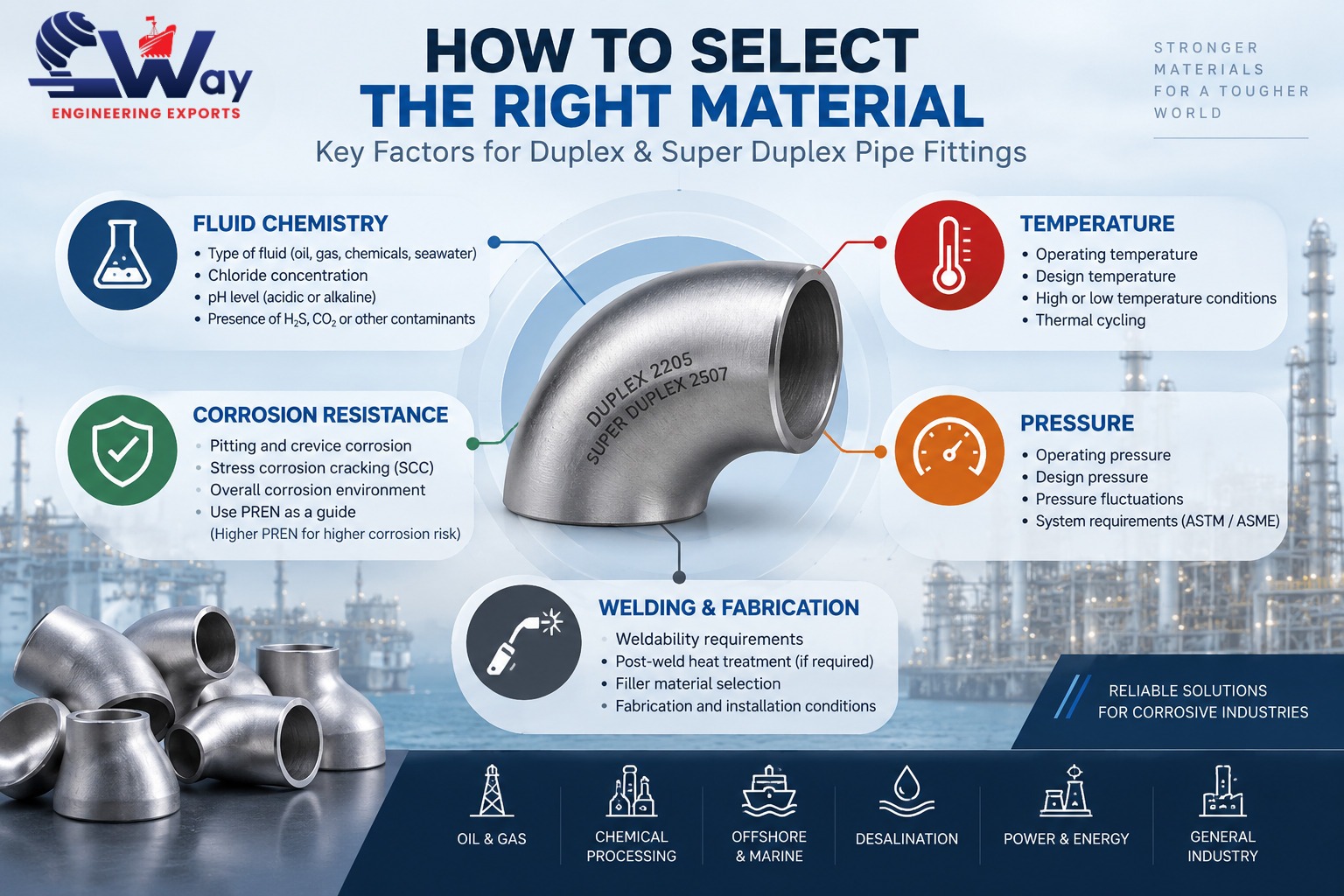
How to Select the Right Material for Corrosive Service
Choosing between Duplex and Super Duplex requires more than looking at the material designation. Several operating factors need to be evaluated together.
Chloride Concentration
Chlorides are one of the primary concerns when selecting stainless steel for corrosive service.
High chloride concentrations can increase the risk of:
- Pitting corrosion
- Crevice corrosion
- Stress corrosion cracking
Seawater applications are particularly demanding because of their high chloride content.
Operating Temperature
Temperature can significantly affect corrosion behavior.
A material that performs well in a relatively cool environment may face greater corrosion challenges at elevated temperatures, particularly when chlorides are present.
The material review should consider both normal operating conditions and the maximum design temperature.
Fluid Chemistry
The actual composition of the process fluid is critical.
Depending on the application, engineers may need to evaluate:
- Chlorides
- Acids
- Hydrogen sulfide
- Carbon dioxide
- Sulfur compounds
- Seawater
- Produced water
- Chemical additives
Two systems may have the same temperature and pressure but require different materials because their fluid chemistry is different.
Pressure and Mechanical Requirements
Duplex and Super Duplex alloys are attractive not only because of their corrosion resistance, but also because of their high strength.
The fitting specification should identify:
- Nominal pipe size
- Wall thickness or schedule
- Design pressure
- Design temperature
- Pressure class, where applicable
- Applicable piping code
The selected fitting must meet the mechanical and pressure-temperature requirements of the system.
Welding and Fabrication
A fitting can have excellent corrosion resistance in its original condition, but fabrication and welding can affect the final performance of the piping system.
Improper welding can alter the material’s microstructure and influence:
- Phase balance
- Corrosion resistance
- Toughness
- Mechanical properties
For critical applications, qualified welding procedures and appropriate inspection requirements should be established as part of the project specification.
Understanding PREN
When comparing stainless steel grades for resistance to localized corrosion, engineers often use the Pitting Resistance Equivalent Number (PREN).
A commonly used calculation is:
PREN ≈ %Cr + 3.3 × %Mo + 16 × %N
The formula illustrates the contribution of chromium, molybdenum, and nitrogen to pitting resistance.
In general, a higher PREN indicates greater resistance to pitting corrosion.
However, PREN is not a complete material-selection method.
Actual corrosion performance also depends on factors such as:
- Temperature
- Chloride concentration
- Fluid chemistry
- Surface condition
- Welding
- Heat treatment
- Crevice conditions
- Flow conditions
PREN is therefore best used as one part of a broader engineering evaluation.
Types of Duplex & Super Duplex Pipe Fittings
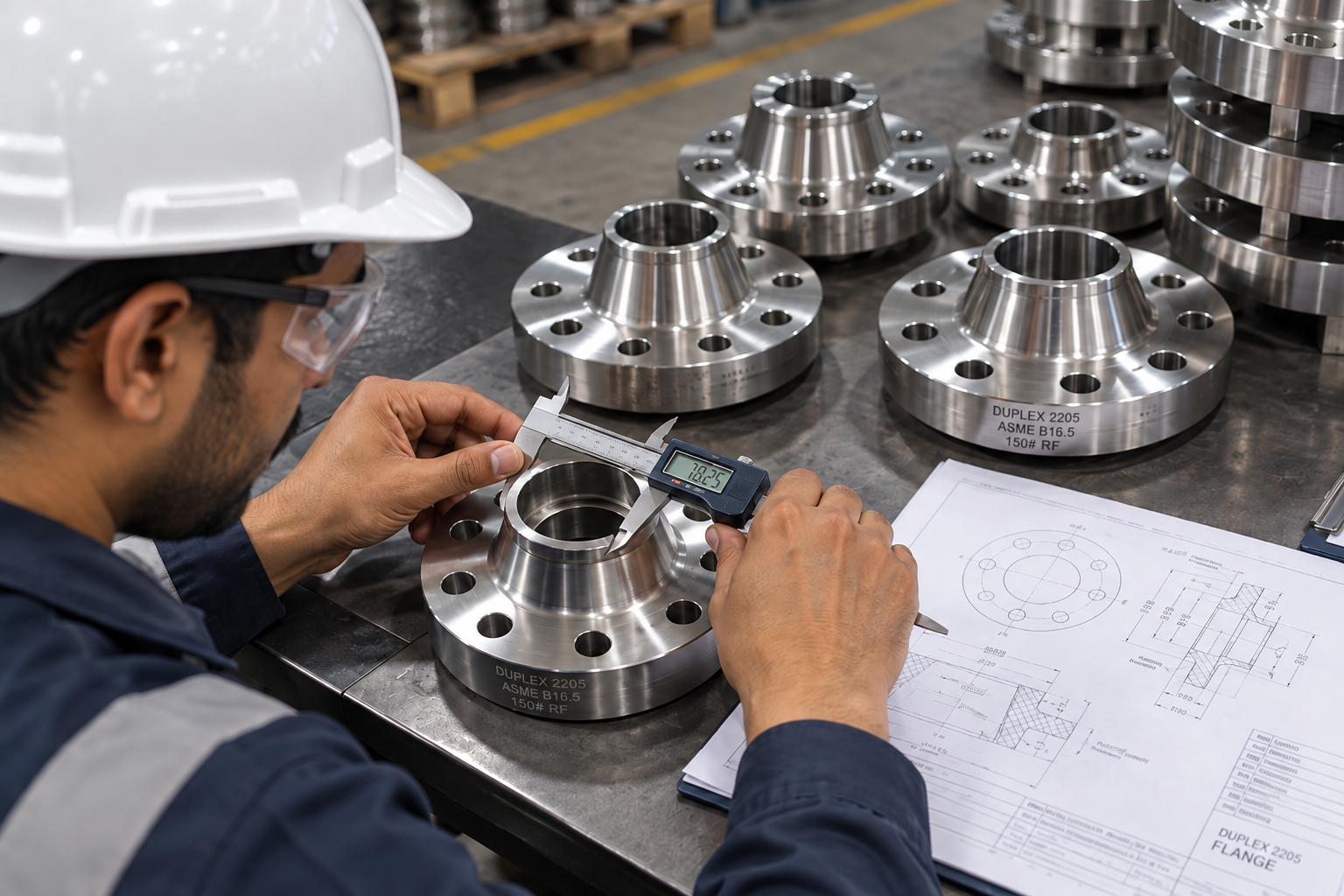
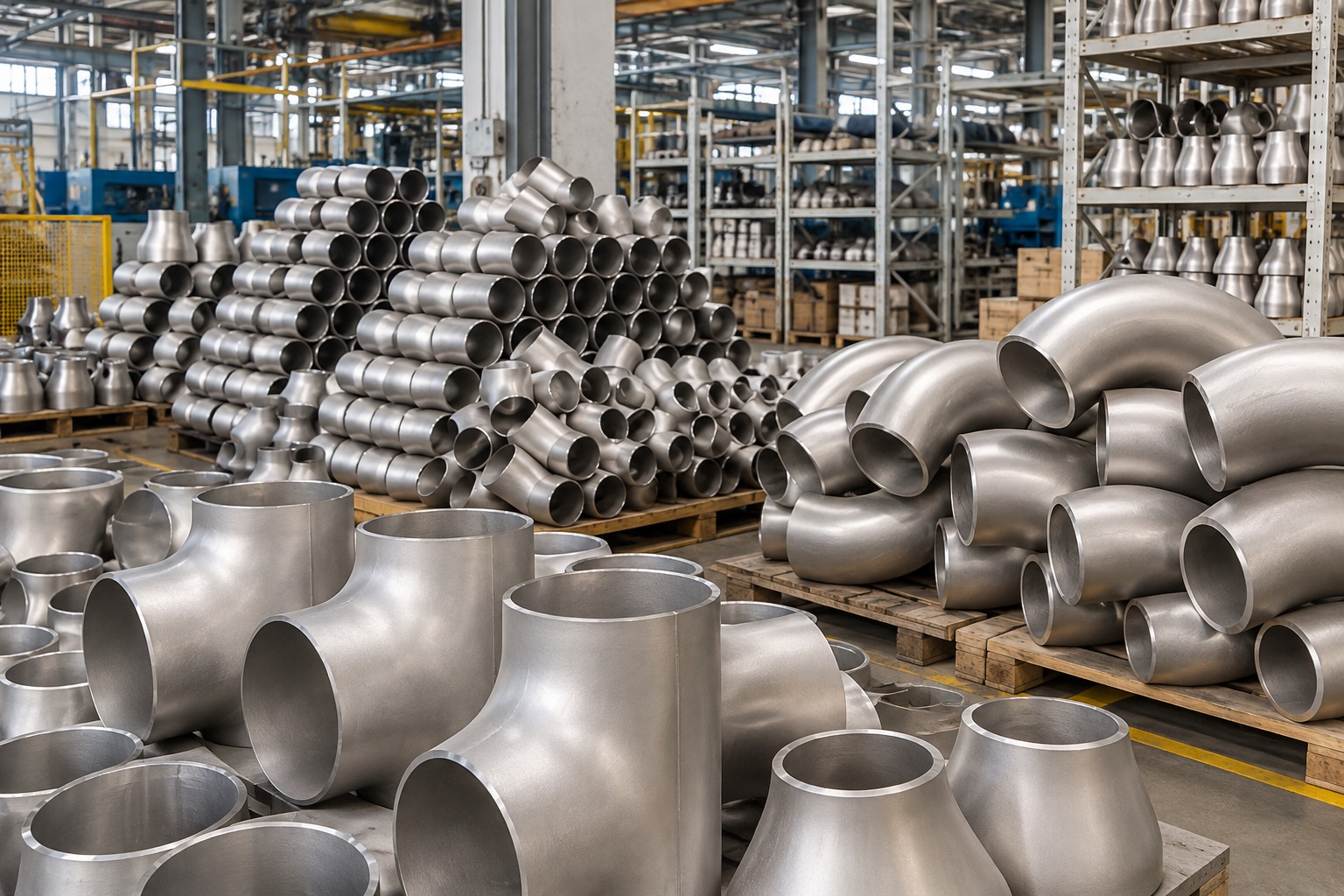
Duplex and Super Duplex stainless steels are available in a wide range of configurations for industrial piping systems.
Butt-Weld Fittings
Common configurations include:
- 45° elbows
- 90° elbows
- Long-radius elbows
- Equal tees
- Reducing tees
- Concentric reducers
- Eccentric reducers
- Caps
- Stub ends
Forged Fittings
Typical forged products include:
- Socket weld elbows
- Socket weld tees
- Couplings
- Bushings
- Swage nipples
- Threaded fittings
Flanges
Depending on the application, Duplex and Super Duplex flanges can include:
- Weld neck flanges
- Slip-on flanges
- Blind flanges
- Socket weld flanges
- Threaded flanges
- Lap joint flanges
The purchase specification should clearly identify the fitting type, material grade, size, dimensions, pressure requirements, and applicable standards.
ASTM and ASME Standards for Duplex Fittings
One of the most common sources of confusion when purchasing pipe fittings is the difference between material specifications and dimensional standards.
ASTM A815
ASTM A815 is an important specification covering wrought ferritic, austenitic, and Duplex stainless steel fittings within its scope.
The exact grade should always be specified.
For example:
ASTM A815 – UNS S32205
is much more precise than simply specifying “Duplex stainless steel.”
ASTM A182
ASTM A182 is commonly associated with forged or rolled alloy and stainless steel flanges and forged fittings for pressure applications.
ASME B16.9
ASME B16.9 covers dimensions and tolerances for factory-made wrought butt-welding fittings.
ASME B16.11
ASME B16.11 covers forged socket-welding and threaded fittings.
ASME B16.5
ASME B16.5 is widely used for pipe flanges and flanged fittings within its applicable size and pressure-class range.
Why This Matters
A specification might look like this:
ASTM A815 / UNS S32205 / ASME B16.9
In this example, the ASTM designation addresses the material/product requirements, while ASME B16.9 addresses the dimensional requirements.
A complete purchase specification may need both.
Where Are Duplex and Super Duplex Fittings Used?
The combination of strength and corrosion resistance makes these alloys useful across a wide range of industries.
Oil & Gas
Duplex fittings are commonly considered for:
- Production systems
- Offshore piping
- Process piping
- Produced-water systems
- Pipeline components
Chemical & Petrochemical
Applications can include:
- Chemical transfer lines
- Process piping
- Corrosive fluid handling
- Processing systems
Marine & Offshore
These materials are particularly useful in:
- Seawater piping
- Cooling-water systems
- Offshore platforms
- Fire-water systems
Desalination
Applications include:
- Reverse osmosis systems
- Seawater piping
- Brine systems
- High-pressure piping
Power Generation
Potential applications include:
- Cooling-water systems
- Process-water piping
- Condenser-related systems
The appropriate grade should always be selected based on the specific service conditions.
Duplex & Super Duplex Pipe Fitting Buying Checklist
Before requesting a quotation or placing an order, make sure the specification includes the information the manufacturer needs.
Product
- Fitting type
- Nominal size
- Schedule or wall thickness
- End connection
- Quantity
- Pressure class, where applicable
Material
- Duplex or Super Duplex
- Exact grade
- UNS number and/or Werkstoffnummer
- ASTM or EN material specification
Service
- Fluid or chemical
- Chloride concentration
- Operating temperature
- Design temperature
- Operating pressure
- Design pressure
Standards & Inspection
- Applicable ASTM/ASME or EN/DIN EN standard
- MTC requirements
- PMI requirements
- NDT requirements
- Additional testing requirements
A complete specification helps prevent material substitutions, dimensional misunderstandings, and quotation discrepancies.
How to Specify a Duplex Pipe Fitting
A clear RFQ allows the manufacturer to understand the technical requirements without making assumptions.
For example:
Product: 90° Long Radius Elbow
Size: NPS 6
Material: Duplex Stainless Steel
Grade: UNS S32205
Material Standard: ASTM A815
Dimension Standard: ASME B16.9
Schedule: As specified
End Connection: Butt Weld
Quantity: 20 pcs
Application: Process Piping
Inspection: As specified
Documentation: EN 10204 3.1 MTC
The exact specification should always be confirmed against the project piping class, applicable standards, service conditions, and engineering requirements.
Why Material Traceability Matters for Duplex Fittings
For critical industrial applications, material traceability helps confirm that the supplied fittings correspond to the specified material grade.
Depending on the project, traceability may include:
- Heat number
- Material Test Certificate
- Chemical composition
- Mechanical properties
- Product identification
- PMI verification where specified
- Inspection records
This becomes particularly important when purchasing Duplex 2205 or Super Duplex 2507 fittings for EPC projects, offshore facilities, chemical plants, desalination systems, and other critical applications.
Quality and Inspection Requirements
The inspection requirements for Duplex and Super Duplex fittings should be established before production.
Depending on the application and purchase specification, inspection may include:
- Chemical composition verification
- Mechanical testing
- Dimensional inspection
- Visual inspection
- PMI
- NDT
- Surface examination
- Heat treatment records
- Material traceability
- Third-party inspection
Not every project requires every inspection method. Requirements should be based on the applicable product standard, engineering specification, service conditions, and purchase order.
Duplex & Super Duplex Fittings for EPC Projects
EPC projects often require more than simply supplying the correct material.
Procurement teams may need coordinated support for:
- Multiple fitting configurations
- Different sizes and schedules
- Multiple material grades
- Applicable ASTM/ASME standards
- Inspection requirements
- Material certificates
- Traceability
- Third-party inspection
- Export packing
- Project documentation
For this reason, suppliers should receive the complete technical specification and project requirements before quotation and production.
A clearly defined specification reduces the risk of material substitutions, incorrect dimensions, missing documentation, and delays during inspection or installation.
Final Thoughts: Choosing the Right Duplex Fitting
There is no single Duplex grade that is right for every corrosive application.
For many demanding industrial environments, Duplex 2205 provides an excellent combination of corrosion resistance, strength, and cost efficiency.
When the environment becomes significantly more aggressive—particularly with high chloride exposure, seawater, offshore service, or severe localized-corrosion concerns—Super Duplex 2507 may provide the additional performance required.
The key is to select the material based on the actual service conditions, not simply the highest available alloy grade.
Before making the final selection, evaluate:
Fluid chemistry + chloride concentration + temperature + pressure + mechanical requirements + welding conditions + applicable standards.
FAQ
1. What is the difference between Duplex 2205 and Super Duplex 2507?
▲
Super Duplex 2507 contains higher levels of alloying elements and generally provides higher resistance to localized corrosion and higher mechanical strength than Duplex 2205.
Duplex 2205 is often selected when it meets the required service conditions and provides a more economical balance of corrosion resistance and mechanical performance.
2. What is Duplex 2205 pipe fitting?
▼
A Duplex 2205 pipe fitting is a corrosion-resistant piping component manufactured from Duplex stainless steel, commonly associated with UNS S31803 or UNS S32205.
Common configurations include elbows, tees, reducers, caps, stub ends, and other fittings used in industrial piping systems.
3. What is Super Duplex 2507 pipe fitting?
▼
A Super Duplex 2507 pipe fitting is a piping component manufactured from Super Duplex stainless steel, commonly associated with UNS S32750.
These fittings are used in demanding applications such as seawater, offshore, desalination, and other chloride-containing services where high localized corrosion resistance is required.
4. Is Duplex 2205 suitable for seawater?
▼
Duplex 2205 can be suitable for certain seawater applications, but the answer depends on temperature, chloride concentration, flow conditions, oxygenation, crevice conditions, fabrication, and other factors.
More severe seawater service may require Super Duplex.
5. When should Super Duplex 2507 be used?
▼
Super Duplex 2507 is generally considered when the service environment demands very high resistance to localized corrosion, particularly in aggressive chloride-containing applications.
The final grade should be confirmed against the actual process and design conditions.
6. What is PREN?
▼
PREN stands for Pitting Resistance Equivalent Number.
It is a comparative parameter used to evaluate the relative pitting resistance of stainless steel grades, commonly using chromium, molybdenum, and nitrogen content in the calculation.
7. What is UNS S32205?
▼
8. What is UNS S31803?
▼
UNS S31803 is another UNS designation associated with the Duplex 2205 material family.
The applicable material specification and project requirements should be checked when specifying the exact grade.
9. What is UNS S32750?
▼
10. What is ASTM A815?
▼
ASTM A815 is a specification covering wrought ferritic, austenitic, and Duplex stainless steel fittings within its defined scope.
The exact material grade and applicable product requirements should be specified separately.
11. What is the difference between ASTM A815 and ASME B16.9?
▼
ASTM A815 addresses material and product requirements within its scope, while ASME B16.9 covers dimensions and tolerances for factory-made wrought butt-welding fittings.
A purchase specification may therefore require both a material specification and a dimensional standard.
12. Are Duplex and Super Duplex fittings suitable for corrosive service?
▼
Yes, these materials are widely considered for demanding corrosive applications because they combine corrosion resistance with high mechanical strength.
However, the appropriate grade depends on the actual fluid chemistry, chloride concentration, temperature, pressure, fabrication conditions, and project requirements.
13. Can Duplex 2205 replace Super Duplex 2507?
▼
Not automatically.
A substitution should only be considered after confirming that Duplex 2205 meets the required corrosion resistance, mechanical properties, design conditions, applicable standards, and project specification.
Likewise, selecting Super Duplex 2507 instead of Duplex 2205 may increase material cost without providing a necessary engineering benefit.


