


Case Study: Preventing Thermal Binding and Unseating Failure in a Steam Isolation Gate Valve
Gate valves used for high-temperature steam isolation are expected to provide reliable shutoff and operate when needed, even after exposure to significant temperature changes. In practice, however, thermal expansion can affect the relationship between the valve body, wedge, seats, and other internal components.
One of the problems that can result is thermal binding, a condition in which the gate valve becomes difficult to open after operating at elevated temperature or after a heating and cooling cycle.
This case study examines the causes of thermal binding in a wedge gate valve, the factors that influence wedge selection, and the engineering considerations used to reduce the risk of difficult unseating in high-temperature steam service.
The Challenge: High-Temperature Steam Gate Valve Stuck Closed
The application involved a gate valve intended for steam isolation under elevated temperature and pressure conditions.
The valve needed to perform two basic functions reliably:
- Provide effective isolation when closed
- Open reliably when the system required steam flow to be restored
The concern was not simply whether the valve could close and seal. The valve also needed to unseat reliably after exposure to high operating temperatures and temperature changes.
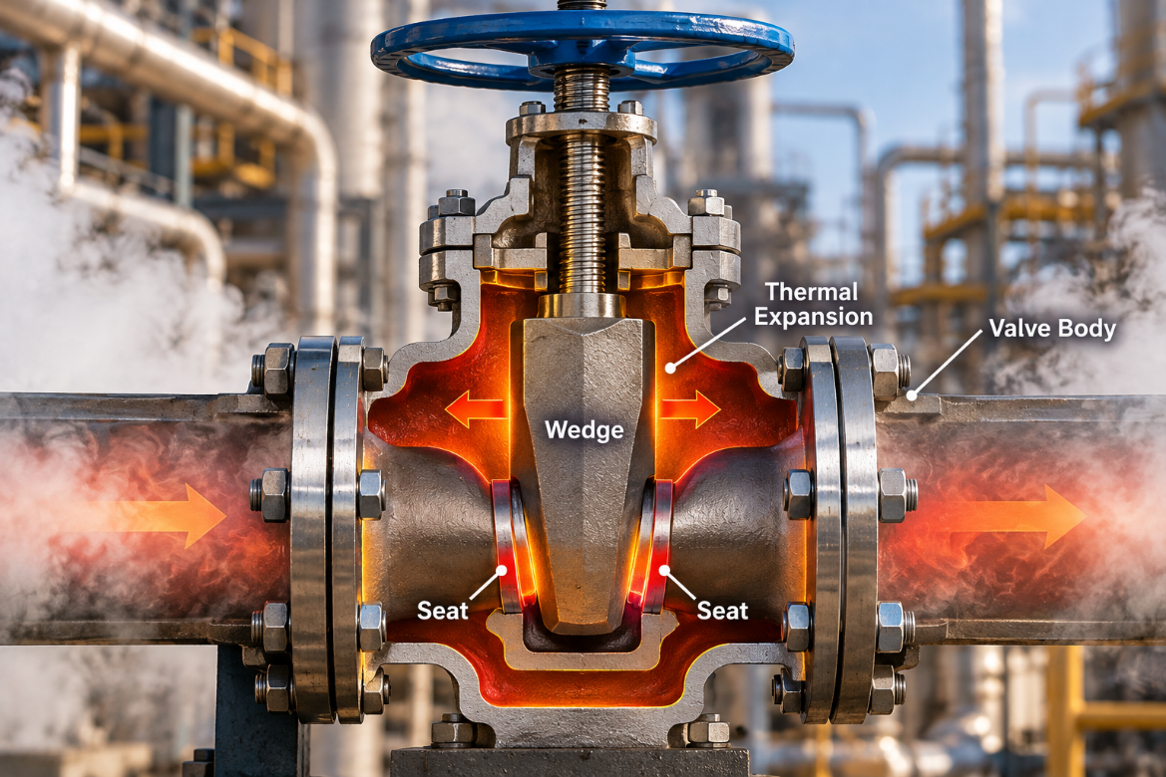
A gate valve may operate normally under ambient or initial conditions but behave differently after the valve and piping have reached operating temperature. Thermal expansion can change the contact conditions between the wedge and seats, increasing the force required to initiate movement.
This is particularly important in steam service, where temperature changes can be significant during startup, shutdown, and other operating transitions.
What Causes Thermal Binding in a Gate Valve?
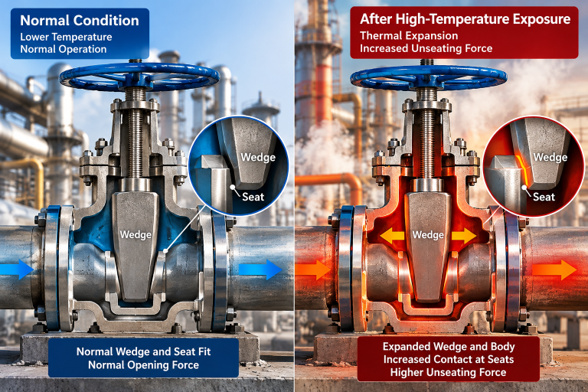
Thermal binding occurs when temperature-related expansion and operating conditions create excessive resistance to wedge movement.
Several factors can contribute.
Thermal Expansion of the Wedge and Body
As the valve reaches operating temperature, its metallic components expand. The wedge, body, seats, and stem may not all experience the same amount of dimensional change.
The resulting change in clearances and contact forces can affect valve operation.
Temperature Gradients
A valve does not always heat uniformly. One portion of the valve may reach operating temperature faster than another.
These temperature differences can create temporary dimensional changes that influence the wedge-to-seat relationship.
Differential Expansion
Different materials have different coefficients of thermal expansion. Even when the components are designed to work together, differences in expansion behavior need to be considered when selecting a valve for demanding temperature service.
Trapped Pressure
Depending on the valve configuration and operating condition, pressure can become trapped in the valve body cavity. The resulting pressure differential can add to the force required to move the wedge.
For this reason, thermal binding should not be viewed as a single-variable problem. Temperature, pressure, valve design, installation, and operating conditions can all interact.
Thermal Binding in Steam Gate Valve Applications
High-temperature steam service places additional demands on isolation valves.
A valve may experience:
- High operating temperatures
- Repeated heating and cooling
- Pressure changes during startup and shutdown
- Thermal cycling
- Extended periods in the open or closed position
- Different temperature conditions between the valve and surrounding piping
These conditions make proper valve selection particularly important.
The valve should not be selected based only on line size and pressure class. Temperature, steam conditions, thermal cycling, materials, wedge configuration, installation conditions, and actuation requirements should also be reviewed. For applications requiring visible stem movement and accessible external operation, a Rising Stem Gate Valve may be considered based on the valve configuration and project requirements.
A valve that is suitable for a general industrial application may require a different configuration when it is exposed to repeated high-temperature steam cycles.
Flexible Wedge vs. Solid Wedge for Thermal Binding
Wedge design is an important consideration when evaluating a gate valve for high-temperature service.
Wedge design is an important consideration when evaluating a gate valve for high-temperature service.
For a detailed comparison of different wedge configurations, see our solid, flexible and split wedge gate valves guide.
| Parameter | Solid Wedge | Flexible Wedge |
|---|---|---|
| Construction | Rigid wedge construction | Wedge with designed flexibility |
| Thermal movement | Limited accommodation | Can accommodate certain dimensional changes |
| Thermal cycling | Requires evaluation | May offer advantages depending on design |
| Typical consideration | Simple and robust construction | Useful where thermal movement is a significant consideration |
| Selection basis | Temperature, pressure, size and service | Temperature, pressure, thermal cycling, size and service |
| Universal choice? | No | No |
Solid Wedge Gate Valve
A solid wedge is a rigid construction that provides a simple and robust design.
It is widely used in industrial gate valve applications and can be suitable for many services. However, when thermal cycling is a significant part of the application, the effects of thermal expansion and changes in wedge-to-seat contact should be evaluated during valve selection.
Flexible Wedge Gate Valve
A flexible wedge incorporates a designed degree of flexibility into the wedge structure.
This allows the wedge to accommodate certain dimensional changes and seating conditions as the valve experiences temperature variations.
For applications involving high-temperature steam and thermal cycling, a flexible wedge may offer advantages depending on the specific valve design and operating conditions.
Which Wedge Should Be Selected?
There is no universal rule that a flexible wedge is always better than a solid wedge.
The appropriate choice depends on factors such as:
- Operating temperature
- Pressure
- Valve size
- Thermal cycling
- Valve configuration
- Piping arrangement
- Required operating frequency
- Actuation method
The important point is to evaluate the complete service condition, rather than selecting a wedge based on temperature alone.
How to Prevent Wedge Gate Valve Thermal Binding
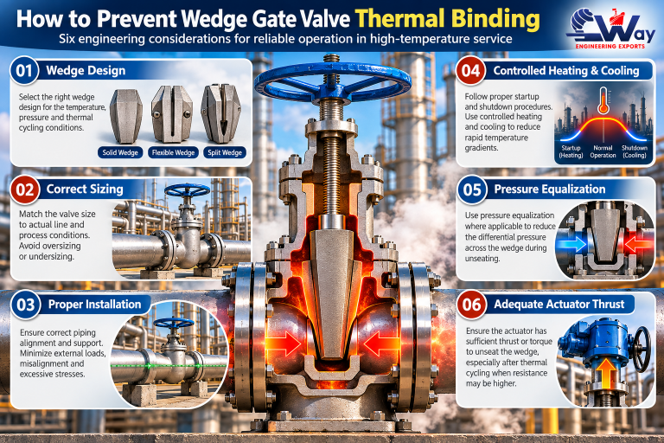
Thermal binding cannot always be addressed by changing one component. A reliable approach starts with reviewing the complete valve and operating environment.
Select the Appropriate Wedge Design
The wedge should be selected according to the temperature, pressure, thermal cycling, and overall service requirements.
Where thermal movement is a significant concern, the ability of the selected wedge design to accommodate operating conditions should be evaluated.
Size the Valve Correctly
Valve sizing should consider the actual line and process conditions. Oversizing or selecting a valve without considering the operating duty can affect valve performance and operating requirements.
Pay Attention to Installation
Proper piping alignment and installation are important.
External loads, piping misalignment, or excessive stresses transferred to the valve can affect internal alignment and valve operation.
Follow Controlled Operating Procedures
Startup and shutdown procedures can influence thermal gradients within the valve.
Where the process allows, controlled heating and cooling can help reduce rapid temperature differences between valve components.
Consider Pressure Equalization
Where applicable, pressure equalization should be considered when a pressure differential could contribute to the force required to unseat the wedge.
Verify Actuator Thrust
The actuator must have sufficient thrust or torque to operate the valve under the expected service conditions.
This is especially important when evaluating a valve that may experience increased unseating resistance after thermal cycling.
Thermal Binding and Gate Valve Unseating Failure
One of the most important concerns with thermal binding is the additional force required to open the valve.
Under normal conditions, the actuator may have sufficient capacity to operate the valve. After high-temperature exposure, however, the required unseating force may increase.
The sequence can be summarized as:
Temperature change → thermal expansion → increased wedge/seat interaction → higher unseating force → increased actuator thrust requirement
If the available actuator thrust is insufficient, the valve may fail to unseat.
This does not necessarily mean that the valve was incorrectly manufactured. It can indicate that the operating conditions, valve configuration, wedge design, or actuator requirements were not fully considered together.
For critical steam isolation applications, unseating requirements should therefore be considered during valve and actuator selection—not after the valve has been installed.
C-Way Engineering Approach
For a high-temperature steam gate valve application, C-Way Engineering Exports approaches valve selection by reviewing the complete service requirement rather than focusing on a single specification.
The engineering review can include:
Service Conditions
- Operating pressure
- Operating temperature
- Steam service
- Temperature cycling
- Valve size
- Pressure class
- Installation conditions
Valve Configuration
The appropriate gate valve configuration and wedge design are evaluated based on the application requirements.
Material Selection
Valve body, wedge, stem, seats, and other wetted components are selected according to the required pressure, temperature, material compatibility, and applicable specifications.
For additional guidance on valve body manufacturing methods, see our forged vs cast steel gate valves comparison guide.
Actuation
Where an actuator or gearbox is required, the operating requirements—including seating and unseating loads—are considered during selection.
Testing and Inspection
Depending on the project requirements, testing and inspection may include:
- Shell pressure testing
- Seat leakage testing
- Functional operation
- Dimensional inspection
- Material certification
- EN 10204 documentation
- Third-party inspection where required
The objective is to ensure that the valve is evaluated not only as a pressure-containing component, but as an operating assembly designed for its intended service.
Engineering Outcome
For the steam isolation application, the valve configuration was selected after reviewing the operating temperature, pressure, thermal conditions, wedge requirements, and actuation needs.
The engineering focus was to reduce the potential for excessive wedge resistance during thermal cycling and ensure that the valve and actuator were appropriately matched to the service.
The final valve configuration was then subjected to the required inspection and testing program, with the applicable technical documentation prepared for the project.
The key lesson from the application was clear:
Reliable gate valve operation in high-temperature steam service depends on more than pressure rating and valve size. Wedge design, thermal conditions, installation, and unseating requirements all need to be considered together.
Key Takeaways
- Thermal binding can make a gate valve difficult to open after high-temperature operation or thermal cycling.
- Thermal expansion, temperature gradients, differential expansion, and trapped pressure can contribute to increased wedge resistance.
- Flexible and solid wedges have different design characteristics and should be selected according to the application.
- Steam gate valve selection should consider temperature and thermal cycling in addition to pressure and line size.
- Actuator thrust should account for the required unseating force under the expected operating conditions.
- Proper installation, operating procedures, testing, and documentation are important parts of a reliable valve solution.
Conclusion
Thermal binding is an important consideration when selecting gate valves for high-temperature steam isolation service. A valve that operates correctly under one condition may require substantially different operating force after exposure to temperature changes.
By evaluating wedge design, thermal expansion, pressure conditions, installation, materials, and actuator requirements together, engineers can reduce the risk of difficult unseating and improve the reliability of steam isolation systems.
For demanding industrial applications, the right gate valve is not simply the one that meets the pressure and size requirements. It is the one whose design and operating characteristics match the actual service conditions.
Need help selecting a gate valve for high-temperature steam service?
Share your operating temperature, pressure, valve size, service conditions and wedge requirements with our team.
Contact C-Way Engineering Exports to discuss your application.
Frequently Asked Questions


