


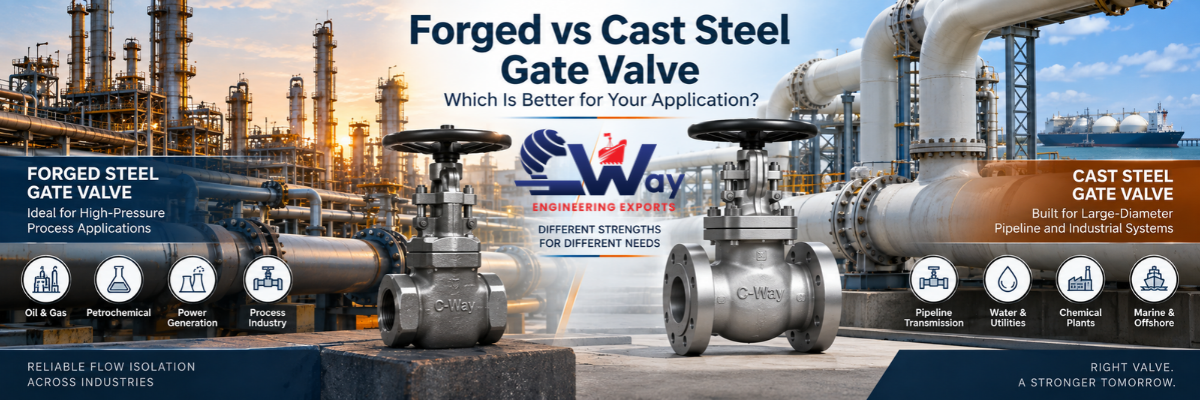
Forged vs Cast Steel Gate Valve: Which Is Better for Your Application?
Forged and cast steel gate valves are both widely used for flow isolation in industrial piping systems. Although they perform the same basic function—starting, stopping, and isolating flow, their manufacturing methods are different, and that difference affects valve construction, size capability, weight, cost, and typical applications.
A forged steel gate valve is manufactured from steel that is heated and mechanically formed under controlled pressure. A cast steel gate valve is produced by pouring molten steel into a mold and then machining and heat treating the resulting valve body.
Neither construction method is automatically better for every application. The appropriate choice depends on factors such as valve size, pressure class, temperature, material grade, service conditions, applicable standards, installation requirements, and project specifications.
This guide explains the differences between forged and cast steel gate valves, including their manufacturing processes, advantages, applications, and the considerations that engineers and procurement teams should evaluate before selecting a valve.
Forged vs Cast Steel Gate Valve: What Is the Difference?
The main difference between forged and cast steel gate valves is how the valve body is manufactured. Forged gate valves are formed from heated steel using mechanical force and are commonly used in smaller, compact valve designs. Cast steel gate valves are produced by pouring molten steel into a mold and are widely used where larger valve bodies or more complex geometries are required. The appropriate choice depends on valve size, pressure class, temperature, material, service conditions, applicable standards and project requirements.
What Is a Forged Steel Gate Valve?
A forged steel gate valve is a gate valve manufactured from forged steel rather than a cast valve body. During manufacturing, a steel billet or forging blank is heated to a controlled temperature and mechanically formed using forging equipment. The forged component is then heat treated, machined, assembled, and pressure tested.
Forged gate valves are commonly used in small- to medium-bore piping systems, particularly where pressure ratings are high and a compact valve design is desirable.
Common forged materials include:
- ASTM A105 carbon steel
- ASTM A350 LF2 low-temperature carbon steel
- ASTM A182 F5 alloy steel
- ASTM A182 F11 and F22 alloy steel
- ASTM A182 F304 stainless steel
- ASTM A182 F316 and F316L stainless steel
- Duplex and super duplex grades for specialized services
For many industrial applications, forged gate valves are manufactured to standards such as API 602 and ASME B16.34, depending on the valve design and project specification.
A forged steel gate valve may be supplied with flanged, threaded, or socket weld ends, with manual handwheel operation or automation where required.
The compact construction of forged valves can also be useful where installation space is limited.
What Is a Cast Steel Gate Valve?
A cast steel gate valve is manufactured by pouring molten steel into a mold that forms the basic shape of the valve body. After the metal solidifies, the casting is removed from the mold and subjected to cleaning, inspection, heat treatment, machining, assembly, and pressure testing.
Casting provides greater flexibility when manufacturing larger valve bodies and more complex geometries. For this reason, cast steel gate valves are widely used in medium- and large-diameter industrial piping and pipeline applications.
Common cast steel materials include:
- ASTM A216 WCB carbon steel
- ASTM A216 WCC carbon steel
- ASTM A216 WC6 alloy steel
- ASTM A216 WC9 alloy steel
- ASTM A351 CF8 stainless steel
- ASTM A351 CF8M stainless steel
- ASTM A351 CF3M stainless steel
Cast steel gate valves are commonly associated with API 600 designs, although the applicable standard depends on the valve design and project requirements.
They are available in a broad range of sizes and pressure classes and can be supplied with different end connections, trims, body materials, and operating arrangements.
For large-diameter applications, casting provides practical manufacturing advantages because the valve body can be produced in a size and geometry that would be difficult or impractical to manufacture by forging.
How Are Forged and Cast Steel Gate Valves Manufactured?
The primary difference between these valves begins with the manufacturing process.
Forged Steel Gate Valve Manufacturing Process
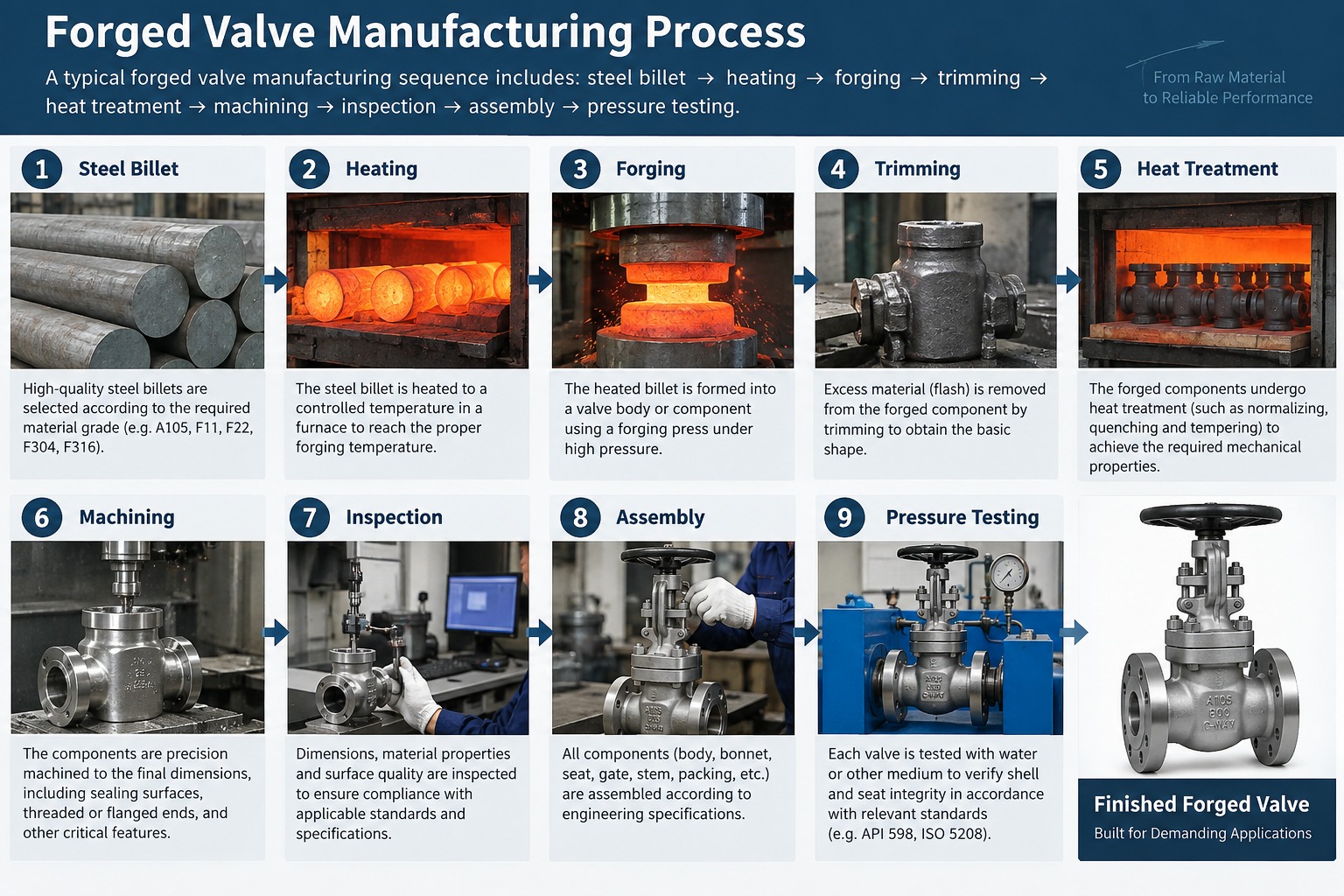
The steel is heated to a controlled temperature and mechanically formed into the required component. After forging, the component undergoes heat treatment and precision machining to produce the valve body, bonnet, seats, stem interfaces, and other critical dimensions.
The manufacturing process provides a compact pressure-boundary component with controlled material properties.
However, forging is subject to practical limitations in terms of the size and geometry of components that can be economically produced. This is one reason forged gate valves are particularly common in smaller nominal sizes.
Cast Steel Gate Valve Manufacturing Process
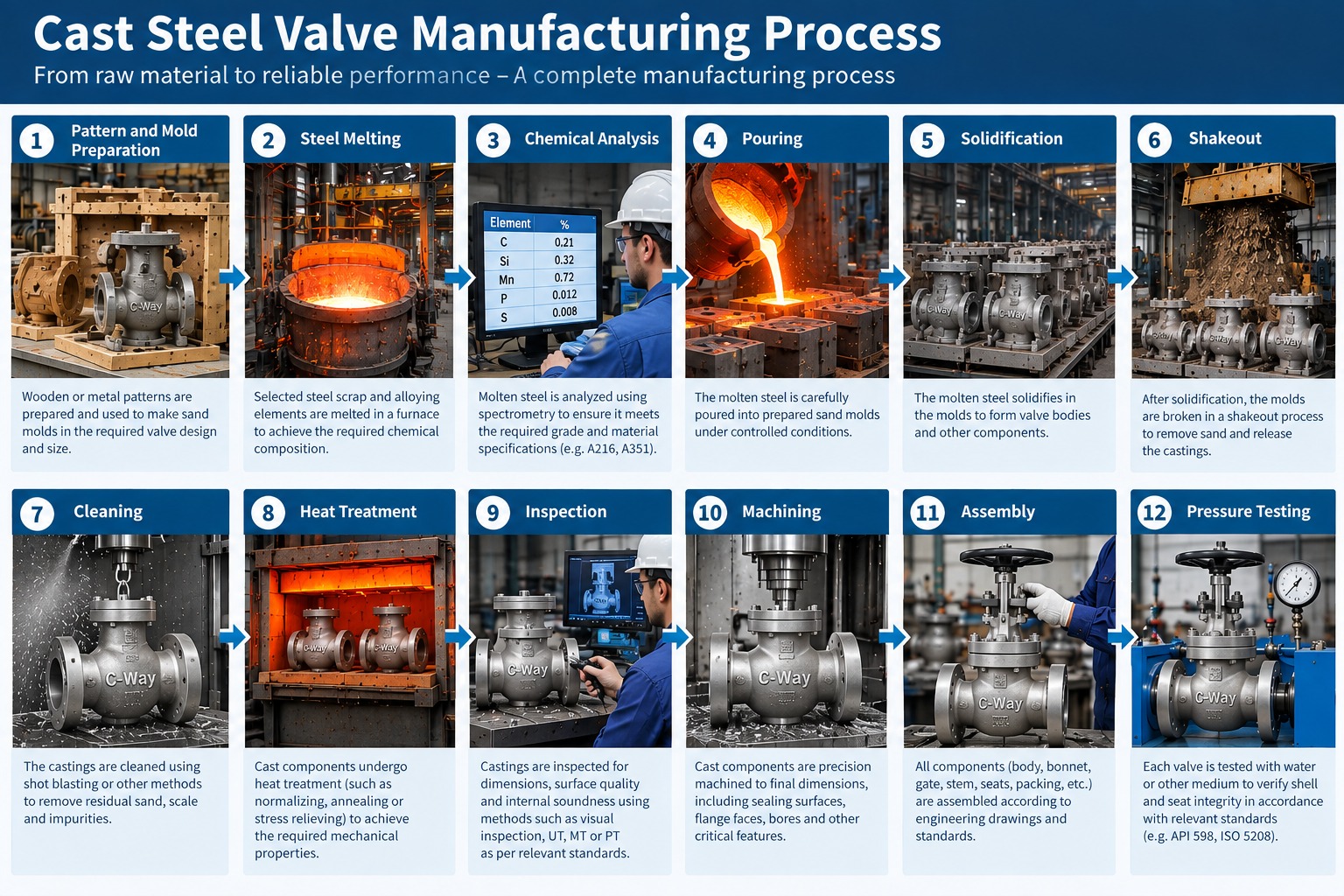
Molten steel is poured into a prepared mold that defines the basic valve-body geometry. Once solidified, the casting is removed, cleaned, heat treated, inspected, and machined.
Casting allows manufacturers to produce large valve bodies and complex shapes without requiring the large forging forces and equipment that would be necessary for comparable forged components.
Why Does the Manufacturing Method Matter?
The manufacturing method influences several practical characteristics of a gate valve, including:
- Valve size capability
- Body geometry
- Material processing
- Weight
- Machining requirements
- Manufacturing cost
- Availability
- Application suitability
It is important, however, not to treat forging or casting as a simple measure of valve quality. A properly engineered cast steel valve and a properly engineered forged valve can both provide reliable service when manufactured, inspected, tested, and specified correctly.
Does Forged Mean Better Than Cast?
Not necessarily.
Forging and casting are different manufacturing methods, and neither should be treated as an automatic indicator of overall valve quality.
The reliability of an industrial gate valve depends on the complete design and manufacturing process, including:
- Material grade
- Valve design
- Pressure class
- Temperature rating
- Manufacturing controls
- Heat treatment
- Machining
- Welding, where applicable
- Inspection
- Pressure testing
- Trim selection
- Packing and gasket arrangement
- Applicable valve standard
- Service conditions
A properly manufactured cast steel gate valve can provide reliable service in applications for which its design and rating are suitable. Likewise, a forged gate valve must be correctly specified and manufactured for the intended service.
The correct question is therefore not simply “forged or cast?” but “which valve construction meets the requirements of this application?”
Advantages of Forged Steel Gate Valves
Forged construction is particularly useful in applications where compact dimensions, high pressure ratings, and robust pressure-boundary construction are important.
Compact Construction
Forged gate valves are commonly available in compact designs, making them useful where piping space is limited.
This can be important in:
- Process skids
- Refineries
- Power plants
- High-pressure piping
Compact equipment packages.
Forging vs Casting: Manufacturing Comparison
| Manufacturing Factor | Forged Steel | Cast Steel |
|---|---|---|
| Starting material | Steel billet/forging stock | Molten steel |
| Primary process | Mechanical deformation | Mold casting |
| Typical geometry | Compact and relatively controlled | Greater flexibility for complex shapes |
| Large body production | More challenging | Generally more practical |
| Machining | Required for critical dimensions | Required after casting |
| Heat treatment | Typically specified as required by material/standard | Typically specified as required by material/standard |
| Inspection | Dimensional, visual and pressure testing as applicable | Casting inspection plus dimensional, visual and pressure testing as applicable |
Suitable for High-Pressure Applications
Forged gate valves are widely used in high-pressure services, particularly in smaller nominal sizes.
The valve specification still needs to be evaluated for the actual pressure-temperature conditions rather than selecting a valve based solely on whether it is forged.
Broad Material Availability
Forged construction is available in carbon steel, low-temperature carbon steel, alloy steel, stainless steel, duplex, and other specialized materials.
This makes forged gate valves suitable for a wide range of process conditions.
Suitable for Smaller Bore Sizes
Forged construction is particularly common in smaller nominal sizes where manufacturing a compact forged body is practical and economical.
API 602 forged gate valves are a common example in industrial process piping.
High-Temperature and Critical Process Service
With the correct material grade, trim, pressure class, packing, gasket, and design, forged gate valves can be specified for high-temperature process applications.
The actual service temperature must always be checked against the applicable material and pressure-temperature rating.
Advantages of Cast Steel Gate Valves
Cast construction provides different advantages, particularly as valve size and body complexity increase.
Suitable for Large Valve Sizes
One of the main reasons cast steel construction is widely used is its practicality for larger valve bodies.
Large-diameter gate valves can be produced with body geometries that would be difficult or uneconomical to manufacture from a forging.
Greater Design Flexibility
Casting provides greater freedom in creating complex valve-body geometries.
This can be particularly useful for larger valves where internal passages, body dimensions, bonnet configurations, and other design requirements need to be accommodated.
Wide Range of Materials
Cast steel gate valves are available in carbon steel, alloy steel, stainless steel, and other corrosion-resistant materials.
Material selection can therefore be matched to:
- Fluid composition
- Operating temperature
- Pressure
- Corrosion conditions
- Process requirements
Economical for Larger Valves
For larger valve sizes, cast construction can offer manufacturing and material-cost advantages compared with attempting to produce a large forged body.
The actual valve price depends on many factors, including material grade, size, pressure class, trim, testing, certification, quantity, and manufacturing requirements.
Well Suited to Pipeline and Process Applications
Cast steel gate valves are widely used in applications where larger valve sizes are required, including oil and gas pipelines, power generation, refineries, petrochemical plants, and large process systems.
Forged vs Cast Steel Gate Valve: Key Differences
The following comparison provides a practical overview.
| Parameter | Forged Steel Gate Valve | Cast Steel Gate Valve |
|---|---|---|
| Manufacturing method | Forging | Casting |
| Typical standard | API 602 | API 600 |
| Typical size range | Commonly smaller bore sizes | Commonly medium to large bore sizes |
| Body construction | Forged steel body | Cast steel body |
| Geometry | Generally more compact | Greater flexibility for larger bodies |
| High-pressure service | Common | Common |
| Large-diameter applications | Less common | Common |
| Material options | Carbon, alloy, stainless, duplex | Carbon, alloy, stainless, specialized grades |
| Weight | Often compact for smaller sizes | Can be heavier in larger sizes |
| Manufacturing flexibility | Limited by forging size and geometry | Greater flexibility for large and complex bodies |
| Typical applications | High-pressure process piping | Pipeline and large process piping |
| Common standards | API 602, ASME B16.34 | API 600, ASME B16.34 |
The table should be used as a general engineering guide rather than an absolute rule.
Forged vs Cast Steel Gate Valve: Application Comparison
The most useful way to select between the two constructions is to consider the application.
Forged Gate Valves Are Commonly Selected For:
High-Pressure Small-Bore Piping
Forged gate valves are frequently used where a small valve must withstand relatively high operating pressures.
Compact Process Systems
Their compact construction can be advantageous where space around equipment and piping is limited.
Refineries and Petrochemical Plants
Forged gate valves are widely used for isolation in process and utility piping.
Steam and Power Applications
Appropriately specified forged alloy-steel gate valves can be used in high-temperature steam and power-generation services.
Socket Weld and Threaded Piping
Forged gate valves are commonly available with socket weld and threaded ends, making them suitable for smaller piping systems.
Cast Steel Gate Valves Are Commonly Selected For:
Large-Diameter Pipelines
Cast construction is particularly practical when valve body dimensions become too large for conventional forged construction.
Large cast steel gate valves are commonly used for pipeline isolation and process applications.
Large Process Plants
Refineries, petrochemical plants, power plants, and chemical facilities often require cast steel gate valves in larger sizes.
Cast gate valves can be used for large-diameter isolation where the material, pressure class, seat design, and corrosion requirements are suitable.
API 602 vs API 600 Gate Valves
A comparison between forged and cast steel gate valves often leads to another important question: What is the difference between API 602 and API 600 gate valves?
In general, API 602 is associated with compact forged steel gate valves, while API 600 covers bolted bonnet steel gate valves commonly manufactured using cast construction.
The standards should not be viewed simply as competing specifications.
API 602 Forged Gate Valve
API 602 is commonly associated with:
- Forged steel construction
- Compact valve designs
- Smaller nominal sizes
- Flanged, threaded, and socket weld connections
- Industrial process and high-pressure applications
API 600 Cast Steel Gate Valve
API 600 is commonly associated with:
- Bolted bonnet steel gate valves
- Cast construction
- Larger nominal sizes
- Flanged-end configurations
- Oil & gas, refinery, petrochemical, and process applications
The correct standard depends on the project specification, valve design, size, pressure class, and service conditions.
Forged vs Cast Steel Gate Valve: Which Should You Choose?
There is no single answer for every piping system.
The decision should start with the valve size and service requirements, followed by pressure, temperature, material, standards, and installation conditions.
Consider a Forged Steel Gate Valve When:
- The valve is in a smaller nominal size.
- High-pressure service is involved.
- A compact valve design is preferred.
- Socket weld or threaded ends are required.
- The application calls for an API 602 design.
- Installation space is limited.
- The service requires a suitable forged alloy or stainless-steel material.
Consider a Cast Steel Gate Valve When:
- A larger nominal valve size is required.
- The application involves large-diameter piping.
- A larger or more complex body configuration is needed.
- Pipeline isolation is required.
- The project specification calls for an API 600 gate valve.
- Cast construction provides a more practical manufacturing solution.
The final selection should consider:
Valve size → pressure class → temperature → fluid → material grade → trim → end connection → applicable standard → testing requirements → project specification
This approach is more reliable than choosing a valve simply because it is forged or cast
Forged vs Cast Steel Gate Valve: Cost Considerations
Cost is another important factor in valve selection, but the manufacturing method alone does not determine the final price.
The cost of a gate valve can be affected by: Nominal valve size, Pressure class, Body material and other specifications.
For smaller high-pressure valves, forged construction can be a practical manufacturing choice. As valve size increases, cast construction can become more economical because of the manufacturing requirements associated with large valve bodies.
For procurement teams, it is therefore better to compare complete valve specifications rather than comparing forged and cast valves based only on unit price.
Forged vs Cast Steel Gate Valve: Final Takeaway
Forged and cast steel gate valves are both established solutions for industrial flow isolation.
Forged steel gate valves are commonly associated with compact designs, smaller nominal sizes, high-pressure service, and API 602 applications.
Cast steel gate valves are widely used for larger valve sizes, pipeline isolation, and large process systems where casting provides practical manufacturing flexibility.
The better choice is not determined by the manufacturing process alone. Valve size, pressure class, temperature, material, fluid service, applicable standards, installation requirements, and project specifications should all be considered before selecting the valve construction.
For a properly specified industrial gate valve, the focus should be on matching the valve design and material to the actual operating conditions, followed by appropriate manufacturing controls, inspection, pressure testing, and documentation.
C-Way Engineering Exports supplies forged and cast steel gate valves in carbon steel, alloy steel, stainless steel, duplex and other materials for industrial applications. Valve specifications can be tailored to project requirements, applicable standards, pressure classes, materials, end connections and service conditions.
Need help selecting the right forged or cast steel gate valve? Contact C-Way Engineering Exports to discuss your valve size, pressure class, material, end connection, and project requirements.


