


ASTM A234 WPB vs. ASTM A420 WPL6 vs. ASTM A403 Stainless Steel Pipe Fittings: Key Differences and Applications
When you’re sourcing butt-weld pipe fittings for an industrial project, choosing the right material specification is just as important as getting the dimensions right.
ASTM A234 WPB, ASTM A420 WPL6, and ASTM A403 stainless steel fittings may appear similar on a quotation, but they’re designed for different material and service requirements. Selecting the wrong specification can lead to material rejection, additional inspection, procurement delays, and costly rework.
For piping engineers, procurement managers, EPC contractors, and industrial distributors, understanding these differences makes it easier to specify the right fittings, compare supplier quotations, and avoid problems before production begins.
In this guide, we’ll compare ASTM A234 WPB, ASTM A420 WPL6, and ASTM A403 stainless steel pipe fittings, explain where each specification is commonly used, and outline what to check before placing an order.
-
What Is ASTM A234 WPB?
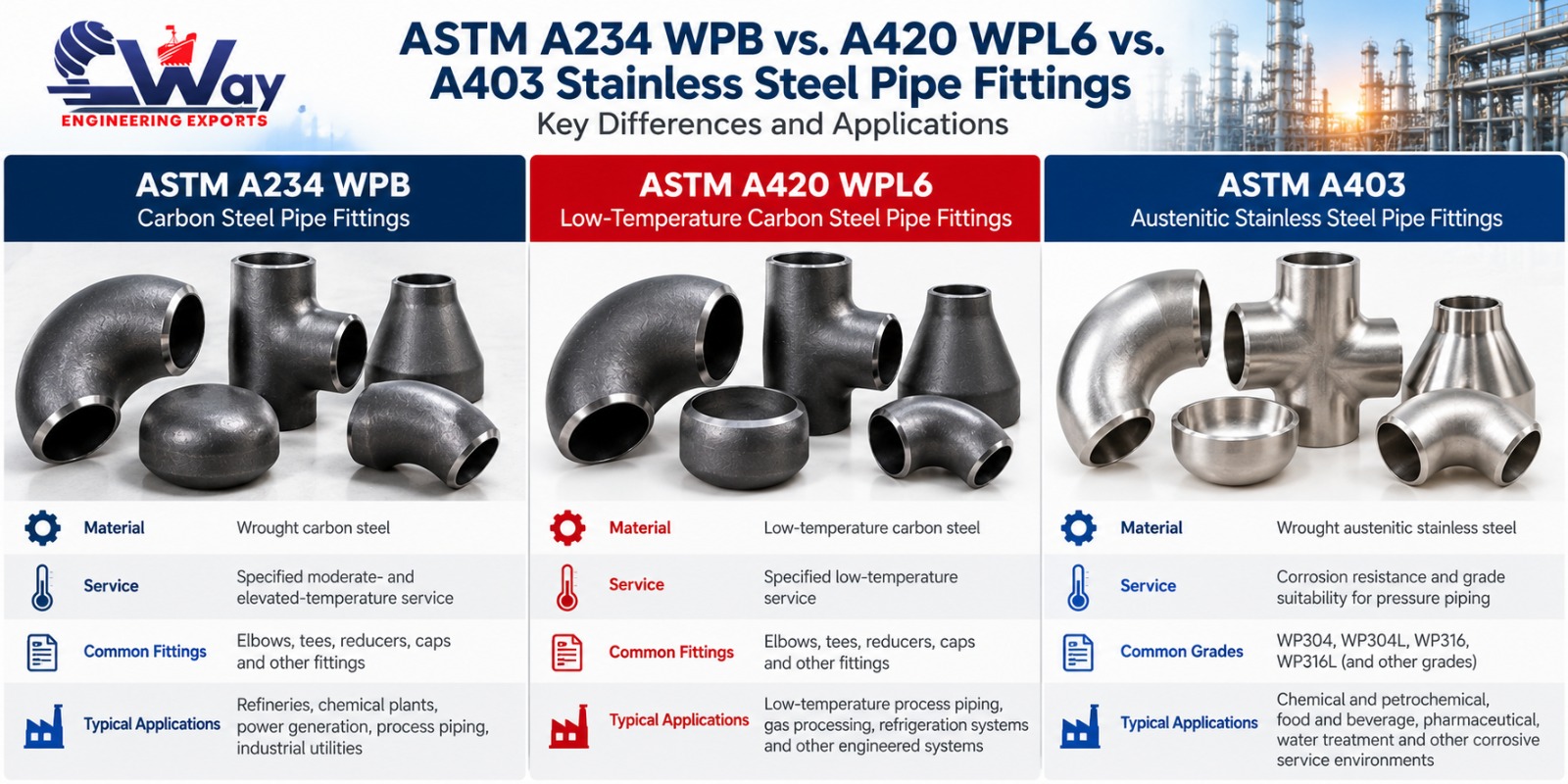
ASTM A234/A234M covers wrought carbon steel and alloy steel piping fittings intended for specified moderate- and elevated-temperature service. WPB is one of the most widely used grades under this specification.
ASTM A234 WPB fittings are commonly specified for industrial piping systems where carbon steel meets the mechanical, temperature, and other design requirements.
Key characteristics of ASTM A234 WPB fittings
- Material: Wrought carbon steel.
- Common fitting types: Butt-weld elbows, tees, reducers, caps, and other fittings within the applicable specification.
- Common dimensional standard: ASME B16.9 for factory-made wrought butt-welding fittings, where applicable. For dimensional requirements, refer to our guide to ASME B16.9 pipe fitting dimensions.
- Typical applications: Refineries, chemical plants, power generation, process piping, and industrial utility systems.
- Primary selection considerations: Design temperature, pressure, wall thickness, corrosion allowance, and applicable piping code.
Where are ASTM A234 WPB fittings used?
WPB fittings are frequently specified for carbon steel piping systems carrying compatible process fluids, steam, water, and other industrial media, subject to the design conditions.
For example, a refinery piping project may require carbon steel elbows and tees to connect sections of a process line. If the material specification, dimensions, and design conditions are suitable, ASTM A234 WPB may be an appropriate choice.
However, the material designation alone does not establish the fitting’s allowable operating pressure or suitability for every temperature. Those factors must be evaluated against the applicable piping code, material properties, fitting dimensions, and project requirements.
When should you specify ASTM A234 WPB?
Consider ASTM A234 WPB when the project calls for wrought carbon steel fittings and the operating conditions fall within the approved design limits.
If the system may experience low temperatures, don’t assume WPB is acceptable simply because the fitting has the correct dimensions. Verify the minimum design metal temperature and any applicable toughness requirements before approving the material.
-
What Is ASTM A420 WPL6?
ASTM A420/A420M covers wrought carbon steel and alloy steel fittings intended for low-temperature service. WPL6 is a commonly specified grade for low-temperature carbon steel piping applications.
The important difference between WPL6 and ordinary carbon steel fitting specifications is not just the material designation. Low-temperature service places particular emphasis on material toughness and resistance to brittle fracture under the specified conditions.
Key characteristics of ASTM A420 WPL6 fittings
- Material: Low-temperature carbon steel.
- Common fitting types: Butt-weld elbows, tees, reducers, caps, and other fittings covered by the applicable specification.
- Common dimensional standard: ASME B16.9 for applicable butt-weld fittings.
- Typical applications: Low-temperature process piping, gas processing, and other engineered systems requiring suitable low-temperature material properties.
- Primary selection considerations: Minimum design metal temperature, impact testing, heat treatment, material thickness, and applicable code requirements.
Why does low-temperature toughness matter?
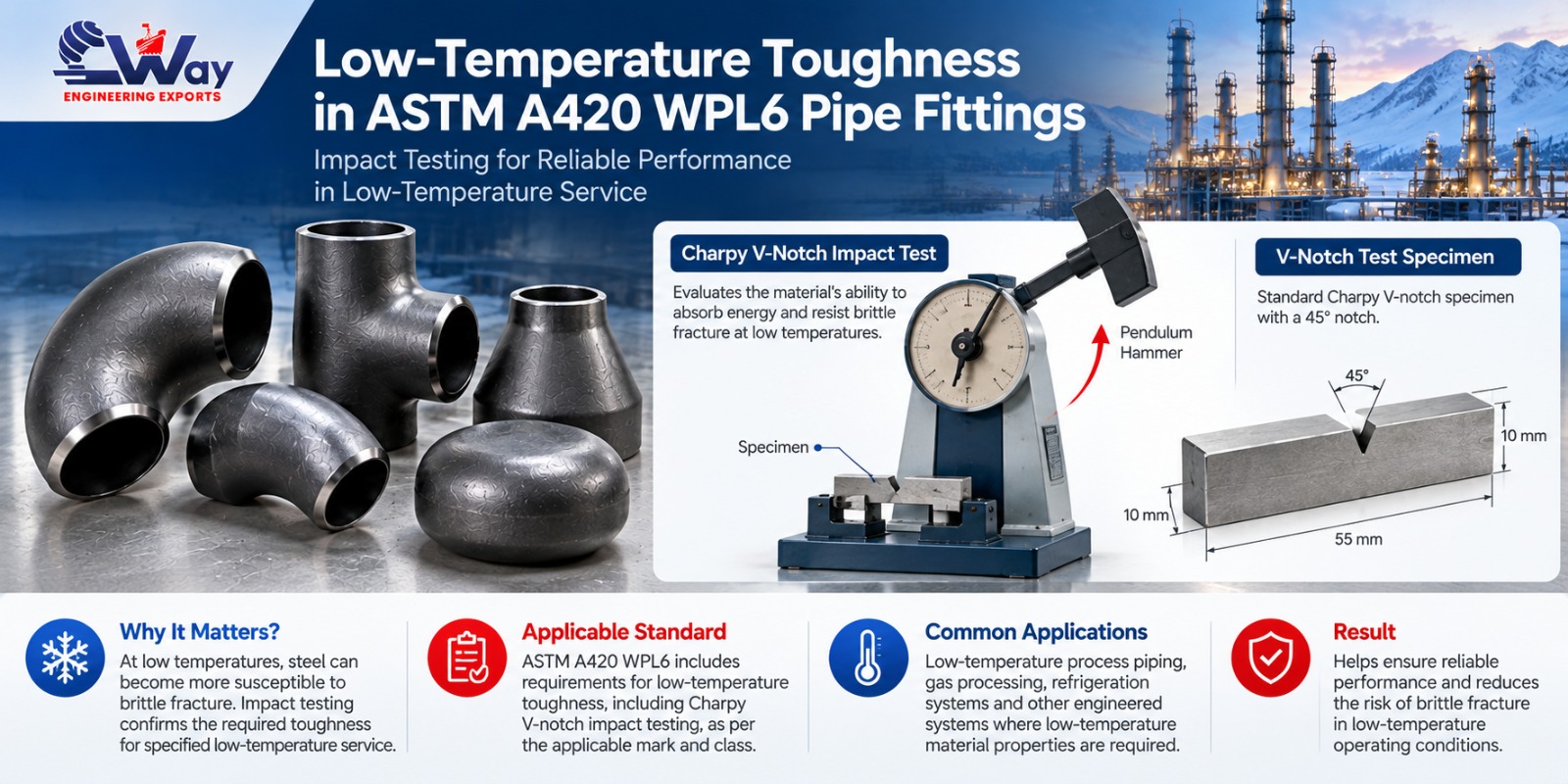
Steel does not behave identically at every temperature. Under certain conditions, some steels become more susceptible to brittle fracture as temperatures decrease.
This is a serious consideration in piping systems exposed to cold process fluids, low-temperature startup conditions, or other operating scenarios involving low metal temperatures.
ASTM A420 WPL6 addresses low-temperature fitting requirements, including applicable Charpy V-notch impact-testing provisions. The required test temperature and acceptance criteria must be verified against the governing specification and project documents.
For procurement teams, this means that ordering a fitting with the correct dimensions is only part of the job. The material and required testing must also match the approved specification.
Where are ASTM A420 WPL6 fittings used?
WPL6 fittings may be specified for low-temperature process piping, selected gas processing applications, and other systems where the engineering design requires suitable low-temperature toughness.
The actual application depends on the minimum design metal temperature, material requirements, pressure-temperature conditions, and applicable code.
When should you specify ASTM A420 WPL6?
Specify WPL6 when the approved piping material specification calls for ASTM A420 WPL6 and the fitting meets the project’s dimensional, testing, and documentation requirements.
Do not substitute ASTM A234 WPB for ASTM A420 WPL6 without an engineering review and formal approval. Similar dimensions do not establish equivalent low-temperature performance.
-
What Is ASTM A403 Stainless Steel?
ASTM A403/A403M covers wrought austenitic stainless steel fittings for pressure piping applications. Unlike WPB and WPL6, which are carbon steel grades, ASTM A403 covers a family of stainless steel fitting grades.
This distinction matters because the required stainless steel grade must be identified explicitly in the purchase order.
Common ASTM A403 grades
ASTM A403 WP304
WP304 is a widely used austenitic stainless steel fitting grade. It may be suitable for many industrial applications where stainless steel is required, depending on the operating environment.
ASTM A403 WP304L
WP304L is a low-carbon stainless steel grade. Its lower carbon content can help reduce the risk of sensitization during certain welding and thermal exposure conditions.
ASTM A403 WP316
WP316 contains molybdenum, which generally improves resistance to certain forms of corrosion compared with WP304. Whether that improvement is sufficient depends on the actual fluid and operating conditions.
ASTM A403 WP316L
WP316L combines the molybdenum-bearing 316 family with a low-carbon composition. It is commonly considered for applications requiring appropriate corrosion resistance and welded fabrication characteristics.
These grades are not interchangeable in every application. Chloride concentration, temperature, chemical composition, fabrication practices, and other service conditions can affect corrosion performance.
Where are ASTM A403 fittings used?
ASTM A403 fittings are used in piping systems where an appropriate austenitic stainless steel grade is required.
Common applications include:
- Chemical and petrochemical processing.
- Food and beverage processing.
- Pharmaceutical process piping, subject to applicable system requirements.
- Water treatment and industrial utilities.
- Selected marine and corrosive service environments.
For example, a chemical processing line may require stainless steel fittings to resist the specific fluid being handled. In that case, the engineer must determine whether WP304, WP316, or another suitable grade meets the corrosion and design requirements.
Stainless steel should not automatically be considered suitable for every corrosive service. duplex and super duplex pipe fittings correct grade depends on the actual environment.
When should you specify ASTM A403?
Consider ASTM A403 when the project requires wrought austenitic stainless steel fittings and the selected grade meets the specified mechanical, corrosion, temperature, and fabrication requirements.
When requesting a quotation, specify the complete grade rather than writing only “ASTM A403 stainless steel fittings.”
-
ASTM A234 WPB vs. A420 WPL6 vs. A403: Key Differences
The following table provides a practical comparison for reviewing pipe fitting specifications.
| Factor | ASTM A234 WPB | ASTM A420 WPL6 | ASTM A403 |
|---|---|---|---|
| Material family | Carbon steel | Low-temperature carbon steel | Wrought austenitic stainless steel |
| Main service consideration | Specified moderate- and elevated-temperature service | Specified low-temperature service | Corrosion resistance and grade suitability |
| Material designation | WPB | WPL6 | Grades such as WP304, WP304L, WP316 and WP316L |
| Low-temperature toughness | Must meet applicable design and material requirements | Specific low-temperature toughness requirements are important | Depends on the selected grade and applicable requirements |
| Corrosion behavior | Depends on the fluid, environment and protection | Depends on the fluid, environment and protection | Depends on the stainless steel grade and service environment |
| Typical application focus | General industrial carbon steel piping | Low-temperature carbon steel piping | Stainless steel process and utility piping |
| Cost considerations | Often economical for suitable service | Depends on material, testing and availability | Depends on grade, market conditions and specifications |
| Can it replace the others directly? | No | No | No |
This comparison is a starting point for material selection, not a substitute for engineering review. The applicable ASTM specification, dimensional standard, piping code, and project requirements determine what is acceptable for a particular order.
-
ASTM A234 WPB vs. ASTM A420 WPL6: Can You Substitute One for the Other?
This is one of the most important questions when purchasing carbon steel pipe fittings.
Both specifications cover wrought steel fittings, but they address different service requirements.
ASTM A234 WPB is commonly used for specified moderate- and elevated-temperature service. ASTM A420 WPL6 is intended for low-temperature service and includes requirements addressing toughness.
The difference goes beyond dimensions
A WPB elbow and a WPL6 elbow may have the same nominal size, wall thickness, and center-to-end dimensions when manufactured to the same applicable dimensional standard.
That does not mean the materials are equivalent.
The required material properties, qualification requirements, and applicable testing may differ. A fitting can be dimensionally correct and still fail to meet the specified material requirements.
What should you check?
Before approving a substitution, confirm:
- The minimum design metal temperature.
- The specified material grade.
- Applicable impact-testing requirements.
- Required heat treatment and material condition.
- The governing piping code and project specification.
- Whether the design authority permits the proposed substitution.
Practical example
Suppose an EPC contractor is purchasing butt-weld fittings for a process line that may experience low metal temperatures during operation or an abnormal condition.
The contractor receives one quotation for ASTM A234 WPB fittings and another for ASTM A420 WPL6 fittings.
Even if the WPB quotation is less expensive, you should not select it simply because the dimensions match. If the approved piping specification requires WPL6, the material must meet that requirement unless an acceptable alternative is formally reviewed and approved.
The correct purchasing decision starts with the engineering specification, not the price difference.
-
ASTM A234 WPB vs. ASTM A403: When Should You Choose Carbon Steel or Stainless Steel?
The choice between carbon steel and stainless steel depends on the service conditions, not on a general assumption that one material is always better.
Corrosion resistance
Carbon steel can be a suitable and economical option for many industrial piping systems when the fluid, temperature, and corrosion allowance are compatible with the material.
Stainless steel may be appropriate where the service requires greater resistance to particular forms of corrosion.
However, not all stainless steel grades perform equally. For example, WP316 may offer improved resistance to certain corrosive environments compared with WP304, but neither grade is universally suitable for every chemical or chloride-containing fluid.
Temperature and pressure
Material selection must account for the full operating envelope.
The applicable piping code, design temperature, pressure, fitting dimensions, material properties, and other design factors determine the suitability of the fitting.
Stainless steel should not automatically be selected simply because an application involves high pressure or temperature. The material grade and complete design must be evaluated.
Purchase price and long-term cost
Carbon steel is often an economical option where its material properties meet the application requirements.
Stainless steel may cost more initially, but the additional expense may be justified when corrosion resistance, maintenance requirements, or other service considerations are important.
A sound comparison looks beyond the purchase price to the expected service conditions, maintenance needs, replacement risks, and total cost of ownership.
Practical example
A carbon steel fitting may be suitable for a utility line carrying a compatible fluid under specified operating conditions.
A chemical process line exposed to a more corrosive medium may require an appropriate stainless steel grade.
The correct choice depends on the fluid composition, concentration, temperature, and other relevant factors. The material should be selected for the actual service, not simply by comparing carbon steel and stainless steel in general terms.
Need a quotation for industrial pipe fittings?
Contact C-Way Engineering Exports to discuss your pipe fitting requirements and the applicable material specifications for your project.
Frequently Asked Questions
Frequently Asked Questions
1. What is the difference between ASTM A234 WPB and ASTM A420 WPL6?
2. What is ASTM A403 used for?
3. Is ASTM A420 WPL6 suitable for low-temperature piping?
4. Is ASTM A403 WP316 better than WP304?
5. Can ASTM A234 WPB fittings replace ASTM A420 WPL6 fittings?
6. Does ASTM A234 WPB specify the dimensions of a butt-weld fitting?
7. What documents should I request when purchasing ASTM pipe fittings?
8. How do I choose between carbon steel and stainless steel pipe fittings?
Final Takeaway
ASTM A234 WPB, ASTM A420 WPL6, and ASTM A403 stainless steel fittings serve different material and application requirements.
Choose ASTM A234 WPB when the specified carbon steel properties meet the design requirements. Consider ASTM A420 WPL6 when the approved specification calls for low-temperature carbon steel fittings with the required toughness. Choose the appropriate ASTM A403 grade when the application requires wrought austenitic stainless steel.
The key is to match the fitting to the actual service conditions and project specification, not just the dimensions or initial purchase price.
Before placing an order, confirm the material grade, dimensional standard, inspection requirements, documentation, and delivery terms. Doing this upfront helps prevent avoidable procurement problems and gives your project team a clear basis for comparing suppliers.


