


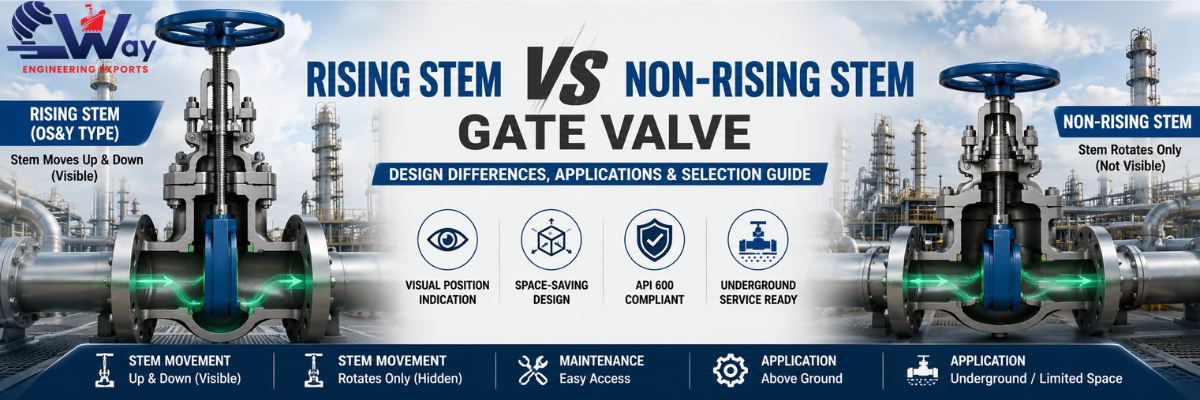
Rising Stem vs Non-Rising Stem Gate Valve: Key Differences, Advantages, Applications & Selection Guide
Gate valves are among the most widely used isolation valves in industrial piping systems. They are designed to provide full flow with minimal pressure drop when fully open and reliable shutoff when fully closed. Industries such as oil & gas, petrochemical, power generation, water treatment, marine, and chemical processing rely heavily on gate valves for critical flow control applications.
One of the most important design considerations when selecting a gate valve is the stem configuration. The two primary designs are the Rising Stem Gate Valve and the Non-Rising Stem Gate Valve. Although both perform the same basic function, their operating mechanisms, maintenance requirements, installation constraints, and application suitability differ significantly.
Choosing the correct stem design can improve operational safety, reduce maintenance costs, and enhance the overall reliability of a piping system. This article provides a detailed comparison of Rising Stem and Non-Rising Stem Gate Valves, helping engineers and procurement professionals select the right solution for their applications.
What is a Gate Valve?
A gate valve is a linear-motion isolation valve used to start or stop fluid flow. It operates by raising or lowering a gate (disc or wedge) perpendicular to the flow path. Industrial gate valves are available in various configurations including wedge gate valves, resilient seated designs, forged steel gate valves, and API 600 gate valves depending on service requirements.
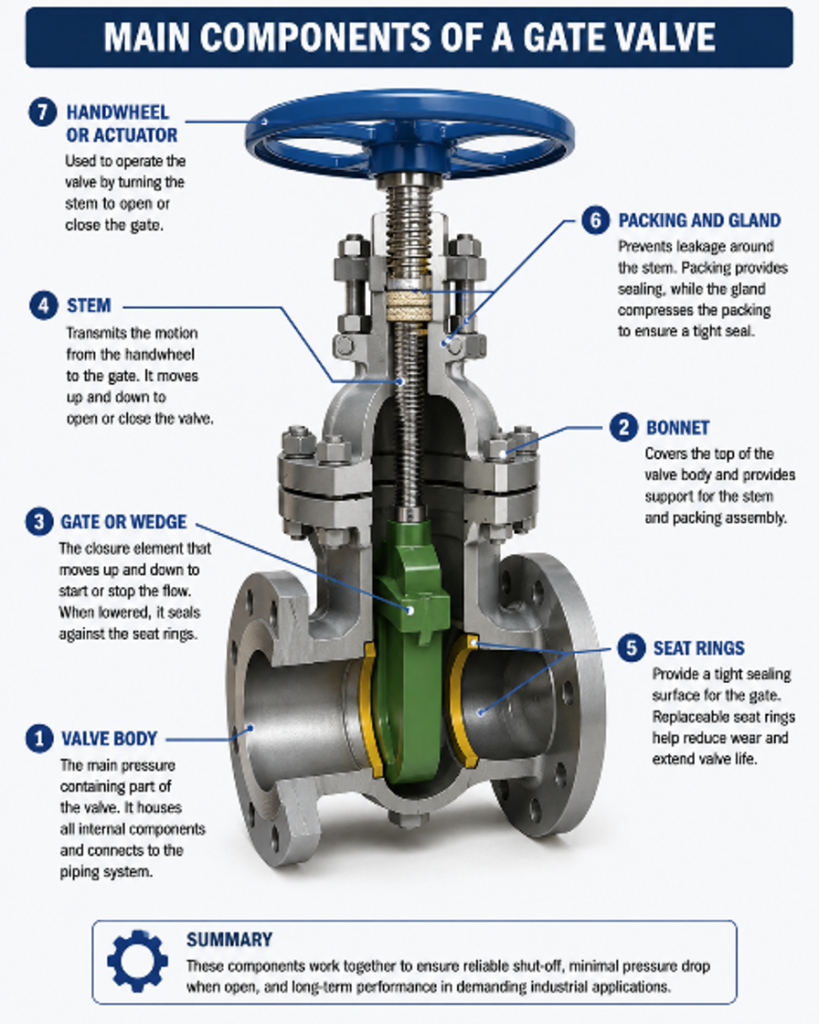
Main Components of a Gate Valve
- Valve Body
- Bonnet
- Gate or Wedge
- Stem
- Seat Rings
- Packing and Gland
- Handwheel or Actuator
Working Principle
When the handwheel is rotated, the stem moves the gate upward or downward.
- Fully Open: Gate is completely removed from the flow path.
- Fully Closed: Gate seals against the seats to stop flow.
Gate valves are generally not recommended for throttling applications because partial opening may cause vibration, seat erosion, and reduced valve life.
Common Materials
- ASTM A216 WCB Carbon Steel
- ASTM A351 CF8 (SS304)
- ASTM A351 CF8M (SS316)
- Duplex Stainless Steel
- Super Duplex Stainless Steel
- Alloy Steel
- Bronze
Material selection plays a significant role in valve reliability, particularly when choosing between carbon steel, stainless steel, duplex stainless steel, and corrosion-resistant alloys for demanding industrial services.
Typical Applications
- Oil & Gas Pipelines
- Refineries
- Chemical Plants
- Water Distribution Systems
- Power Plants
- Fire Protection Systems
What is a Rising Stem Gate Valve?
A Rising Stem Gate Valve features a stem that physically moves upward when the valve opens and downward when the valve closes.
This design is commonly known as an OS&Y (Outside Screw and Yoke) Gate Valve.
Construction and Operation
The stem threads are located outside the valve body. As the handwheel rotates, the stem rises vertically while the gate travels with it.
The visible stem movement provides a clear indication of valve position.
Valve Position Indication
- Stem extended upward = Valve Open
- Stem lowered downward = Valve Closed
This visual indication allows operators to quickly verify valve status from a distance.
Advantages of Rising Stem Gate Valves
Easy Position Identification
Operators can instantly determine whether the valve is open or closed.
Better Stem Protection
Stem threads remain outside the process fluid, reducing corrosion and wear.
Easier Maintenance
External threads are accessible for inspection and lubrication.
Improved Reliability
Preferred in critical services where operational visibility is important.
Ideal for Hazardous Environments
Widely used in:
- Oil Refineries
- Petrochemical Plants
- Offshore Platforms
- Power Plants
Limitations
- Requires greater vertical installation space.
- Not suitable for underground installations.
- Higher installation height requirements.
What is a Non-Rising Stem Gate Valve?
A Non-Rising Stem Gate Valve uses a stem that rotates without moving vertically. Instead, the gate moves up and down along the threaded stem inside the valve body.
This design is often called an Inside Screw Gate Valve.
Construction and Operation
The stem remains fixed in position while rotating.
As the handwheel turns, the gate travels along the stem threads, opening or closing the flow passage.
Unlike rising stem valves, there is no external stem movement.
Advantages of Non-Rising Stem Gate Valves
Compact Design
Requires minimal vertical clearance.
Space Saving
Ideal for confined installation locations.
Suitable for Underground Service
Frequently used in buried pipelines and municipal water systems.
Lower Installation Height
Can be installed inside chambers, pits, and vaults.
Cost Effective
Often preferred where space limitations outweigh maintenance concerns.
Limitations
No Visual Position Indication
Valve position cannot be determined by stem observation.
Internal Thread Exposure
Stem threads remain exposed to process fluid.
More Difficult Maintenance
Inspection of internal threads requires valve disassembly.
Higher Corrosion Risk
Aggressive fluids may accelerate thread wear.
Rising Stem vs Non-Rising Stem Gate Valve
| Feature | Rising Stem Gate Valve | Non-Rising Stem Gate Valve |
| Stem Movement | Moves vertically | Rotates only |
| Position Indication | Visible | Not visible |
| Installation Height | High | Low |
| Maintenance Access | Easy | Moderate |
| Stem Thread Location | Outside body | Inside body |
| Corrosion Resistance | Better | Lower |
| Underground Installation | Not recommended | Highly suitable |
| Above Ground Installation | Excellent | Good |
| Operational Safety | Higher visibility | Limited visibility |
| Typical Industries | Oil & Gas, Petrochemical | Water Distribution, Municipal |
| Initial Cost | Slightly higher | Lower |
| Service Life | Longer in harsh environments | Depends on fluid conditions |
Major Differences
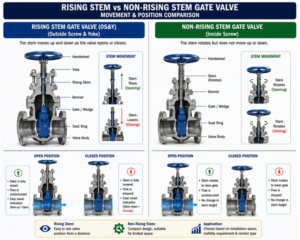
The most significant difference is stem movement.
In a Rising Stem Gate Valve, the stem physically moves upward and provides direct visual confirmation of valve position. In contrast, a Non-Rising Stem Gate Valve maintains a fixed stem position while the gate travels internally.
Another major distinction is maintenance. Rising stem designs allow easier inspection and lubrication because the threads are located outside the process fluid. Non-rising stem designs may require more frequent maintenance in corrosive services.
Industrial Applications
Oil & Gas Industry
Rising Stem Gate Valves are generally preferred because operators can easily verify valve status and perform maintenance.
Petrochemical Plants
OS&Y Gate Valves are widely used in process units handling hazardous fluids.
Chemical Processing
Stainless steel and alloy steel rising stem valves offer superior reliability.
Water Treatment Plants
Both designs are used depending on installation requirements.
Municipal Water Distribution
Non-Rising Stem Gate Valves dominate because they fit inside underground valve chambers.
Power Plants
Rising stem designs are common due to ease of inspection and maintenance.
Fire Protection Systems
Both configurations are used, although OS&Y valves are often preferred for position monitoring.
Marine Applications
Space limitations frequently make non-rising stem valves an attractive option.
How to Select the Right Gate Valve
Selecting the proper gate valve depends on several factors.
Choose a Rising Stem Gate Valve When:
- Visual position indication is required.
- Maintenance access is available.
- Safety is a priority.
- Corrosive service conditions exist.
- The valve is installed above ground.
Choose a Non-Rising Stem Gate Valve When:
- Space is limited.
- Underground installation is required.
- Valve chambers are shallow.
- Water distribution service is involved.
Rising Stem & Non- Rising Stem Gate Valve Selection Guide by Industry Application
Selecting the right gate valve depends on factors such as installation environment, fluid characteristics, maintenance accessibility, pressure rating, and material compatibility. The table below provides a quick reference guide for choosing between Rising Stem and Non-Rising Stem Gate Valves for common industrial applications.
| Application | Recommended Valve Type | Recommended Material | Why It Is Preferred |
| Refinery Process Lines | Rising Stem Gate Valve | ASTM A216 WCB Carbon Steel | Provides clear visual position indication, easy maintenance, and compliance with API 600 requirements. |
| Chemical Processing Plants | Rising Stem Gate Valve | Stainless Steel 316 (CF8M) | Excellent corrosion resistance and easy inspection in aggressive chemical environments. |
| Underground Water Pipelines | Non-Rising Stem Gate Valve | Ductile Iron | Compact design suitable for buried installations and underground valve chambers. |
| Fire Water Systems | Non-Rising Stem Gate Valve | Ductile Iron | Requires minimal installation space and offers reliable shut-off for emergency service. |
| Offshore Oil & Gas Platforms | Rising Stem Gate Valve | Duplex Stainless Steel 2205 | Superior corrosion resistance against seawater and harsh offshore conditions. |
| Thermal & Power Plants | Rising Stem Gate Valve | ASTM A216 WCB / ASTM A217 WC6 | Suitable for high-temperature and high-pressure applications with easy maintenance access. |
| Municipal Water Distribution Networks | Non-Rising Stem Gate Valve | Ductile Iron with EPDM Seat | Widely used for underground water transmission and distribution systems. |
| Petrochemical Facilities | Rising Stem Gate Valve | ASTM A216 WCB / SS316 | Ensures operational safety through visible valve position indication. |
| Marine Applications | Non-Rising Stem Gate Valve | Bronze or Duplex Stainless Steel | Compact design and excellent resistance to seawater corrosion. |
| LNG & Cryogenic Service | Rising Stem Gate Valve | Stainless Steel 316L | Provides reliable operation at low temperatures and easy monitoring of valve status. |
Quick Selection Tips
- Choose a Rising Stem Gate Valve when visual position indication, maintenance accessibility, and operational safety are important.
- Choose a Non-Rising Stem Gate Valve when installation space is limited or the valve will be installed underground.
- For API 600 refinery and petrochemical applications, Rising Stem (OS&Y) Gate Valves are generally the preferred choice.
- For municipal water supply and buried pipelines, Non-Rising Stem Gate Valves are typically the industry standard.
- Always select valve materials based on pressure, temperature, fluid compatibility, and corrosion resistance requirements.
Why Standards Matter
Industrial gate valves should comply with internationally recognized standards such as:
- API 600
- API 602
- API 6D
- ASME B16.34
- ASME B16.10
- API 598
- ISO 5208
- EN 12266
Compliance ensures proper design, pressure integrity, face-to-face dimensions, and testing requirements.
Gate Valve Solutions from C-Way Engineering Exports
C-Way Engineering Exports is an ISO 9001:2015 certified manufacturer and exporter of industrial valves serving customers in more than 110 countries worldwide.
The company supplies:
- API 600 Gate Valves
- Cast Steel Gate Valves
- Stainless Steel Gate Valves
- Duplex and Super Duplex Gate Valves
- Alloy Steel Gate Valves
- Customized Industrial Valve Solutions
All products are manufactured according to international standards including API, ASME, DIN, EN, and ISO specifications.
Rising Stem vs Non-Rising Stem Gate Valve: Quick Comparison
| Feature | Rising Stem | Non-Rising Stem |
|---|---|---|
| Position Indication | Visible | Not Visible |
| Installation Space | Higher | Lower |
| Underground Use | No | Yes |
| Maintenance | Easier | Moderate |
| Corrosion Protection | Better | Lower |
| Best Application | Refineries & Process Plants | Water Distribution Systems |
Conclusion
Both Rising Stem and Non-Rising Stem Gate Valves provide reliable isolation for industrial piping systems, but each is designed for different operating environments.
Rising Stem Gate Valves offer superior visibility, easier maintenance, and improved reliability, making them ideal for oil & gas, petrochemical, and power generation facilities. Non-Rising Stem Gate Valves excel in space-constrained and underground installations, making them the preferred choice for municipal water networks and buried pipelines.
Understanding the differences in stem movement, maintenance requirements, installation space, and application suitability will help engineers select the most efficient and cost-effective gate valve for their system requirements.
Frequently Asked Questions
1. What is an OS&Y Gate Valve?
2. What is the price difference between Rising Stem and Non-Rising Stem Gate Valves?
3. Which gate valve is preferred for API 600 service?
4. Can a Rising Stem Gate Valve be installed underground?
5. Which gate valve is best for refinery applications?
6. Do Rising Stem Gate Valves require more installation space?
7. Which industries commonly use Rising Stem Gate Valves?
• Oil & Gas
• Petrochemical Plants
• Chemical Processing Facilities
• Power Generation Plants
• Offshore Platforms
• LNG Terminals
• Industrial Process Systems
8. Which industries commonly use Non-Rising Stem Gate Valves?
• Municipal Water Distribution
• Wastewater Treatment Plants
• Fire Protection Systems
• Irrigation Networks
• Underground Utility Pipelines
• HVAC Systems
9. What is the lifespan of an industrial gate valve?
10. How do I select the right gate valve for my application?
• Installation environment
• Available space
• Pressure rating
• Temperature range
• Fluid type
• Corrosion resistance requirements
• Industry standards
• Maintenance accessibility
Consulting an experienced gate valve manufacturer can help ensure proper valve selection
11. What materials are available for Rising Stem Gate Valves?
• ASTM A216 WCB Carbon Steel
• ASTM A217 WC6 and WC9 Alloy Steel
• ASTM A351 CF8 (SS304)
• ASTM A351 CF8M (SS316)
• ASTM A182 F304 and F316 Forged Stainless Steel
• Duplex Stainless Steel 2205
• Super Duplex Stainless Steel 2507
• Monel®
• Inconel®
• Hastelloy®
Material selection should be based on operating pressure, temperature, fluid compatibility, corrosion resistance requirements, and applicable industry standards.


