


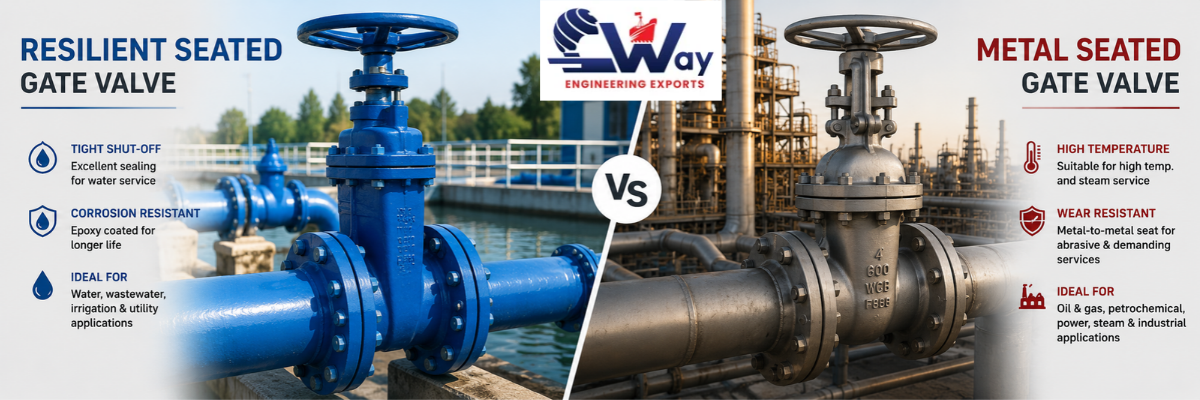
Metal Seated vs Resilient Seated Gate Valve: Differences, Applications & Selection Guide
Choosing the right gate valve is not simply a matter of selecting the correct valve size and pressure class. The seat design can significantly affect shutoff performance, temperature capability, wear resistance, maintenance requirements, service life, and overall valve suitability.
The two commonly specified options are metal seated gate valves and resilient seated gate valves. Resilient seated designs are also commonly referred to as soft seated gate valves.
So, which one gate valve should you choose?
The answer depends on the actual service conditions. Fluid type, operating temperature, pressure, solids content, chemical compatibility, required leakage performance, applicable standards, and project specifications should all be considered before selecting the seat design.
A resilient seated gate valve may be an excellent choice for a municipal water pipeline, while a metal seated gate valve may be more appropriate for certain high-temperature or demanding industrial services.
This guide explains the difference between metal seated and resilient seated gate valves, compares their advantages and limitations, reviews applications across different industries, and provides a practical framework for selecting the appropriate gate valve seat.
Metal Seated vs Resilient Seated Gate Valve: At a Glance
The fundamental difference is the material used for the primary seating surfaces.
| Valve Type | Main Advantages | Main Limitations |
|---|---|---|
| Metal Seated Gate Valve | Higher temperature capability, durable metallic seating, suitable for demanding services | May require more precise seating surfaces; performance depends on service and design |
| Resilient / Soft Seated Gate Valve | Excellent shutoff, widely used for water, practical and economical for many utility applications | Elastomer has temperature and chemical compatibility limitations |
There is no universal winner. The appropriate seat depends on the actual operating conditions and the complete valve specification.
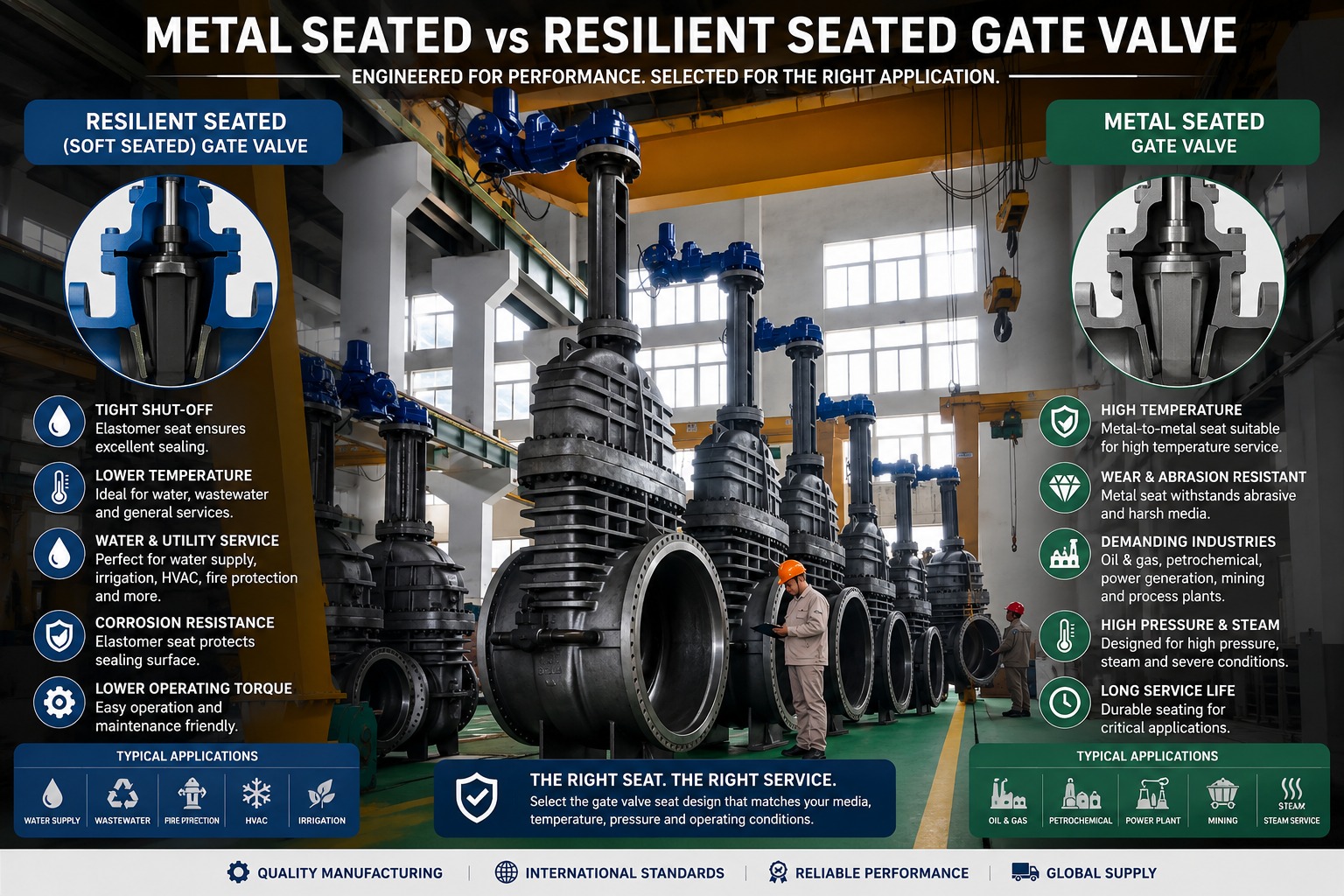
What Is a Metal Seated Gate Valve?
A metal seated gate valve uses metallic seating surfaces between the gate or wedge and the valve seat. Unlike a resilient seated design, the primary shutoff does not rely on an elastomer such as EPDM or NBR.
Metal seated gate valves are commonly considered for industrial applications where operating temperature, pressure, abrasive particles, or other process conditions may make an elastomeric seating system unsuitable.
Depending on the valve construction and application, the seating surfaces may incorporate stainless steel, alloy materials, or engineered hardfacing to improve resistance to wear.
How Does a Metal Seated Gate Valve Work?
When the valve is opened, the gate or wedge moves away from the seating surfaces, creating a flow passage.
When the valve is closed, the gate moves into the seating area and the metallic seating surfaces engage to restrict or stop flow.
Because the primary seating surfaces are metallic, this type of construction can be suitable for services where temperatures exceed the practical limits of common elastomeric materials.
However, metal-to-metal seating requires appropriate manufacturing tolerances, machining, alignment and surface condition. Shutoff performance depends on the complete valve design and service conditions.
Advantages of Metal Seated Gate Valves
Metal seated designs may be considered when an application requires:
- Higher temperature capability than a selected elastomer can provide
- Durable metallic seating surfaces
- Resistance to wear in selected demanding services
- Compatibility with certain industrial process conditions
- High-pressure service capability when supported by the valve design
- Long-term performance under demanding operating conditions
They are commonly encountered in applications across oil and gas, petrochemical processing, power generation, chemical processing, mining and other heavy industries.
Limitations of Metal Seated Gate Valves
Metal seating is not automatically the best solution for every application.
For clean water service, a resilient seated gate valve may provide very tight shutoff and may be more appropriate depending on the specification.
Metal seating can also be affected by particles entering the seating area. Wear, corrosion, surface damage, or poor alignment may affect sealing performance.
For this reason, the seat should be selected according to the actual fluid and operating conditions rather than simply choosing a metal seat because it is perceived as more durable.
What Is a Resilient Seated Gate Valve?
A resilient seated gate valve uses a resilient or elastomeric material as part of its sealing system.
In many water-service designs, the gate or wedge is coated or fitted with a resilient material that forms a tight seal against the valve body or seating area when the valve is closed.
Resilient seated gate valves are widely used in:
- Water supply systems
- Drinking water systems
- Wastewater treatment
- Irrigation
- Fire-water systems
- Utility pipelines
- HVAC water systems
- Municipal infrastructure
They are particularly common where dependable shutoff is required and the operating temperature and chemical conditions are compatible with the selected elastomer.
Is a Resilient Seated Gate Valve the Same as a Soft Seated Gate Valve?
In common valve-industry usage, resilient seated gate valve and soft seated gate valve generally describe gate valve designs that use a resilient or elastomeric sealing material rather than relying solely on metal-to-metal seating.
You may also see:
- Resilient seat gate valve
- Soft seat gate valve
- Soft seated gate valve
- Resilient wedge gate valve
- Resilient seated wedge gate valve
The exact construction and seat material should always be confirmed against the manufacturer’s technical specification.
Common resilient materials include EPDM and NBR, although the appropriate material depends on the fluid, temperature and service conditions.
Metal Seated vs Resilient Seated Gate Valve: Key Differences
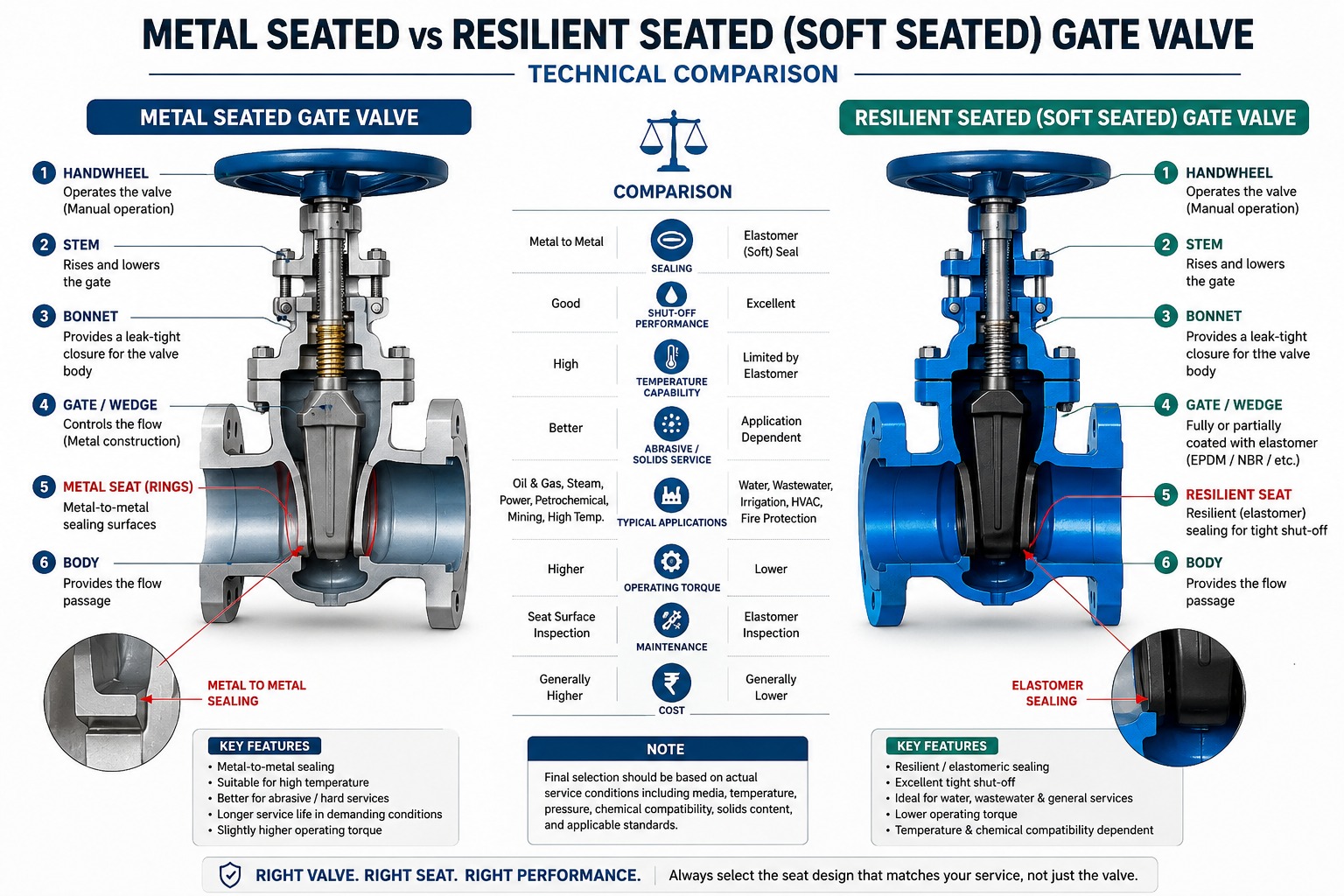
The biggest difference is the material and design of the sealing surfaces.
| Seat / Feature | Metal Seated Gate Valve | Resilient Seated Gate Valve |
| Seat / sealing surface | Metal | Resilient / elastomeric material |
| Common alternative term | Metal seat gate valve | Soft seated gate valve |
| Typical water service | Suitable, application dependent | Excellent and widely used |
| Tight shutoff | Depends on design and service condition | Generally excellent for suitable services |
| High-temperature service | Generally better suited | Limited by elastomer temperature rating |
| Abrasive service | Can be advantageous | Application dependent |
| Elastomer compatibility | Not applicable to primary metal seat | Important |
| Typical industries | Oil & gas, power, petrochemical, mining | Water, wastewater, utilities |
| Maintenance considerations | Seat wear and surface condition | Elastomer condition and compatibility |
| Best selection approach | Demanding industrial service | Water and compatible utility service |
There is no universal winner.The correct choice depends on the application.Metal Seated vs Soft Seated Gate ValveThe terms metal seated gate valve and soft seated gate valve describe two different approaches to valve sealing.A metal seated valve relies primarily on metal seating surfaces.A soft seated or resilient seated gate valve uses a resilient material to achieve the sealing effect.For many water applications, the resilient or soft seat provides excellent shutoff performance.For high-temperature applications, however, the temperature limitations of elastomers may make a metal seated valve the better choice.This is why valve selection should start with the service conditions rather than with the valve name.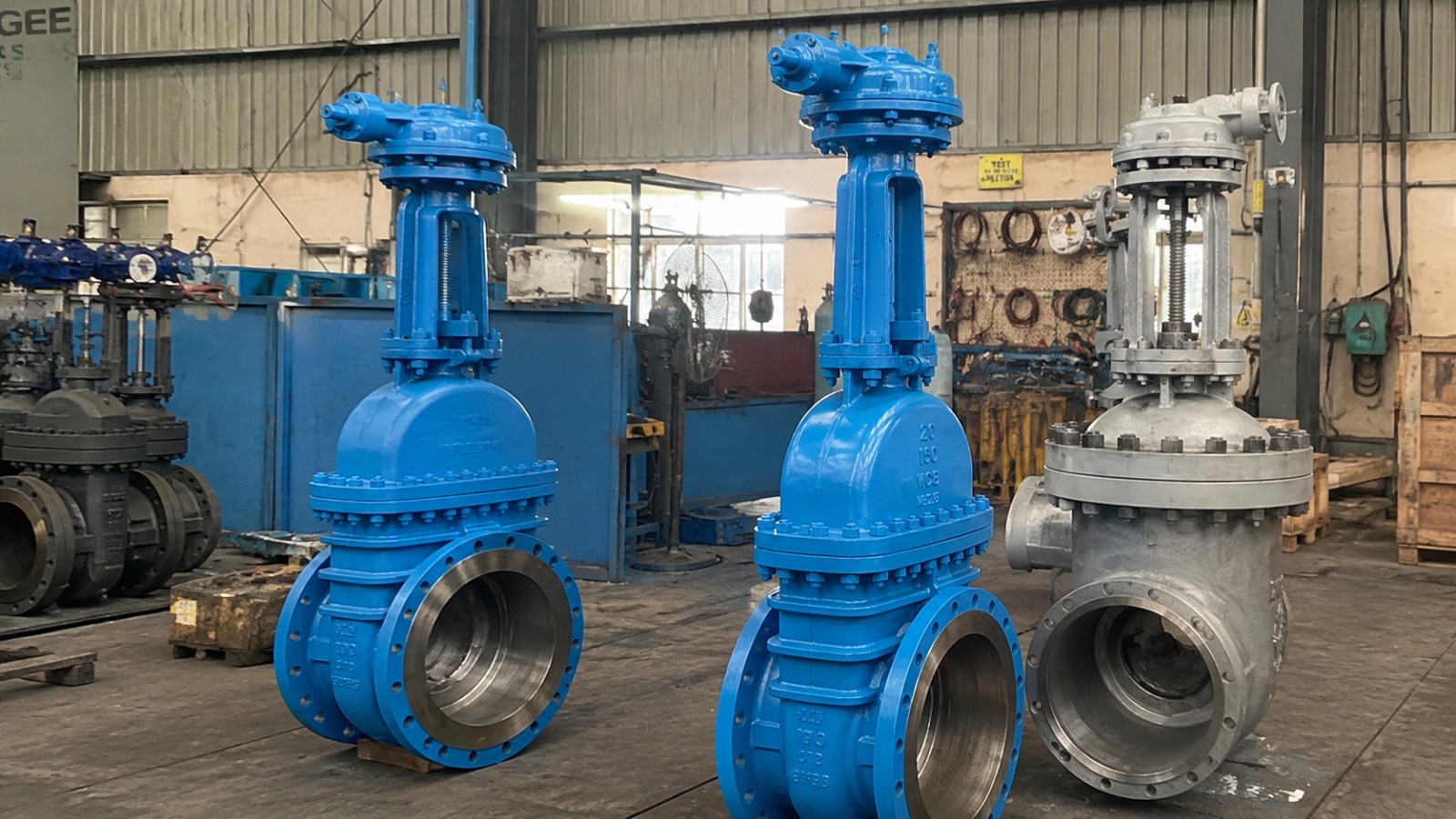
Buyer’s Guide: Which Gate Valve Seat Is Right for Your Application?
The following table provides a practical starting point for engineers, procurement teams and plant operators.
| Application / Industry | Recommended Seat | Why It Is Recommended | Key Considerations |
|---|---|---|---|
| Municipal water supply | Resilient / Soft Seat | Reliable tight shutoff and widely used in water distribution | Seat material, pressure and applicable certifications |
| Drinking / potable water | Resilient / Soft Seat | Excellent sealing for clean-water service | Appropriate potable-water certification where required |
| Wastewater treatment | Resilient / Soft Seat | Good shutoff for many water and wastewater services | Chemical compatibility and solids content |
| Irrigation | Resilient / Soft Seat | Economical and effective for typical irrigation systems | Water quality and temperature |
| Fire water | Resilient / Soft Seat | Reliable shutoff in water-based systems | Required fire protection approvals |
| HVAC / chilled water | Resilient / Soft Seat | Well suited to many clean-water isolation applications | Temperature and water-treatment chemistry |
| General utility water | Resilient / Soft Seat | Good sealing and economical operation | Water chemistry and operating temperature |
| Oil & gas pipelines | Metal or Resilient Seat | Selection depends on the actual pipeline service | Pressure, temperature, media and project specification |
| Crude oil | Metal or Resilient Seat | Both designs may be used depending on service | Fluid composition, temperature and pressure |
| Natural gas | Metal or Resilient Seat* | Depends on pipeline design and operating conditions | Gas compatibility and applicable standards |
| Petrochemical plants | Metal Seat | Often preferred for demanding process conditions | Temperature, pressure and chemical compatibility |
| Chemical processing | Metal or Resilient Seat | Depends on the chemical and operating conditions | Confirm exact seat material compatibility |
| High-temperature steam | Metal Seat | Better suited where temperatures exceed elastomer limitations | Temperature and pressure |
| Power generation | Metal Seat | Suitable for demanding high-temperature/high-pressure service | Steam conditions and applicable standards |
| Boiler feedwater | Metal Seat | Suitable for demanding service depending on design | Temperature, pressure and water chemistry |
| Cooling water | Resilient / Soft Seat | Good shutoff for many standard cooling-water systems | Temperature and treatment chemicals |
| Mining | Metal Seat | Can provide better resistance in certain demanding services | Abrasion, solids and erosion |
| Slurry | Metal Seat / Specialized Design | Metal seating may be advantageous in certain services | Valve must be specifically suitable for slurry |
| Marine / seawater | Application Specific | Selection depends on seawater chemistry and construction | Corrosion resistance and seat compatibility |
| Desalination | Application Specific | Depends on seawater, brine and process conditions | Chlorides, corrosion, temperature and pressure |
| Fertilizer plants | Metal or Resilient Seat* | Depends on process medium | Chemical compatibility and temperature |
| Cement plants | Metal Seat* | Suitable for certain abrasive and demanding services | Abrasion and operating temperature |
Important: The recommended seat in this table is a starting point, not a substitute for engineering review.
Final selection should consider fluid/media, temperature, pressure, solids content, chemical compatibility, required leakage performance, valve design and applicable standards.
For example, “oil and gas” does not automatically mean metal seated. Both metal and resilient seated valves are used in the industry, depending on the specific service.
Quick Gate Valve Seat Selection Guide
If you are purchasing a gate valve and need a quick starting point, this checklist can help:
| If Your Main Requirement Is… | Consider |
|---|---|
| Tight shutoff in clean water | Resilient / Soft Seat |
| Municipal water distribution | Resilient / Soft Seat |
| Wastewater service | Resilient / Soft Seat, subject to compatibility |
| Potable water | Resilient / Soft Seat with appropriate certification |
| High-temperature service | Metal Seat |
| High-temperature steam | Metal Seat |
| Certain abrasive services | Metal Seat / Specialized Valve Design |
| General water isolation | Resilient / Soft Seat |
| Demanding industrial process service | Metal Seat or Application-Specific Selection |
| High temperature + high pressure | Metal Seat, subject to valve design |
| Chemical service | Check exact seat material compatibility |
| Seawater | Application-specific selection |
Resilient Seated Gate Valve Applications
Resilient seated gate valves are especially common in water-related infrastructure.
Water Supply
Water distribution networks require dependable isolation valves that can remain closed for long periods and provide reliable shutoff when needed.
Resilient seated gate valves are widely used in this type of service because their sealing design is well suited to water applications.
Wastewater
Wastewater can contain suspended solids, chemicals and other contaminants. A resilient seated gate valve can be suitable for many wastewater applications, but the actual composition of the wastewater should be reviewed before selecting the seat material.
Irrigation
Agricultural and landscaping irrigation systems commonly use resilient seated gate valves for pipeline isolation.
The relatively simple operating principle and good shutoff performance make them practical for many irrigation systems.
Fire Protection
Water-based fire protection systems require reliable isolation valves. Resilient seated gate valves are commonly used in suitable fire-water applications, provided the valve meets the required project and approval requirements.
Metal Seated Gate Valve Applications
Metal seated gate valves are more commonly considered when operating conditions become more demanding.
High-Temperature Service
Temperature is one of the most important factors in deciding between metal and resilient seating.
Elastomers have defined temperature limits. When operating temperatures exceed those limits, a metal seated design may be more appropriate.
Oil & Gas
Metal seated and resilient seated gate valves are both used in oil and gas applications.
The correct selection depends on:
- Hydrocarbon properties
- Operating pressure
- Operating temperature
- Pipeline specification
- Leakage requirements
- Applicable standards
- Valve design
For critical pipeline applications, the complete valve specification should be reviewed rather than selecting the seat based only on the industry name.
Petrochemical and Chemical Processing
Chemical service requires careful consideration of material compatibility.
A resilient seat may be suitable for some chemicals and completely unsuitable for others. Similarly, metal materials can be affected by corrosion depending on the process medium.
The correct seat material should therefore be confirmed against the actual chemical composition and operating conditions.
Power Generation
Steam and other high-temperature services often require valve designs capable of handling temperatures that are beyond the practical range of common elastomers.
Metal seated gate valves are therefore commonly considered for demanding power-generation applications.
Mining and Abrasive Service
Mining applications can expose valves to abrasive particles and difficult operating conditions.
A metal seated or specialized valve design may be preferable in certain services, but a standard gate valve should not automatically be considered suitable for slurry simply because it has a metal seat.
The particle size, concentration, velocity and valve design all matter.
How to Select the Right Gate Valve Seat
Before placing an order, buyers should consider more than valve size and pressure rating.
1. Identify the Fluid or Media
Start with the basics: What will flow through the valve?
Is it:
- Water?
- Wastewater?
- Steam?
- Oil?
- Gas?
- Chemicals?
- Slurry?
- Seawater?
The answer immediately narrows the possible seat materials.
2. Check Operating Temperature
Temperature can be the deciding factor.
A resilient seat may perform extremely well in water at moderate temperatures, but the same elastomer may not be suitable for high-temperature steam.
Always check the actual operating and design temperature against the manufacturer’s seat-material rating.
3. Check Operating Pressure
Pressure rating is not determined by seat material alone.
The complete valve—including body, bonnet, wedge, stem, pressure boundary and design—must be suitable for the required pressure class or PN rating.
4. Consider Abrasive Solids
If the fluid contains sand, particles or other abrasive material, seat wear becomes an important consideration.
Metal seating may be advantageous in some abrasive services, but the entire valve design must be evaluated.
5. Check Chemical Compatibility
Never select EPDM, NBR or another elastomer simply because it is commonly used.
The seat material must be compatible with the actual fluid.
Chemical concentration, temperature and exposure time can all affect elastomer performance.
6. Consider the Required Shutoff Performance
If tight shutoff is a major requirement, resilient seating can be attractive for compatible services.
However, the required leakage criteria and applicable valve standard should always be considered.
7. Check Applicable Standards
Depending on the valve design and application, relevant standards may include:
- API 600
- API 602
- API 6D
- ASME B16.34
- API 598
- ISO 5208
- EN 1074
- AWWA standards
- Applicable DIN or EN standards
The exact standard should be selected according to the valve type, service and project specification.
What Seat Material Is Used in a Soft Seated Gate Valve?
Common resilient seat materials include:
EPDM
EPDM is widely used in water-related applications because of its suitability for many water services.
NBR
NBR can be suitable for certain oil and hydrocarbon-related applications, depending on the specific fluid and operating conditions.
Other Elastomers
Other resilient materials may be used depending on temperature, chemical exposure and application requirements.
The important point is that “soft seated” does not mean one universal material.
When ordering a soft seated or resilient seated gate valve, always specify the required seat material rather than relying only on the words “soft seat.”
Metal Seated vs Resilient Seated Gate Valve: Pros and Cons
| Valve Type | Main Advantages | Main Limitations |
|---|---|---|
| Metal Seated Gate Valve | Higher temperature capability, durable metallic seating, suitable for demanding services | May require more precise seating surfaces; performance depends on service and design |
| Resilient / Soft Seated Gate Valve | Excellent shutoff, widely used for water, practical and economical for many utility applications | Elastomer has temperature and chemical compatibility limitations |
Are Resilient Seated Gate Valves Better for Water?
In many standard water applications, yes, resilient seated gate valves are a very common choice.
Their sealing design provides reliable shutoff and works well within the temperature and pressure conditions normally encountered in water distribution systems.
However, “better” still depends on the application.
For example, water temperature, treatment chemicals, pressure, potable-water requirements and applicable certifications should all be checked before final selection.
Are Metal Seated Gate Valves Better for High Temperature?
Generally, metal seating is the more appropriate choice when the operating temperature exceeds the practical limit of the selected elastomer.
However, the complete valve design must be suitable for the temperature and pressure. Seat material alone does not determine the valve’s temperature rating.
For high-temperature applications such as steam and certain power-generation services, engineers should review the complete valve specification.
Common Buyer Mistakes When Selecting Gate Valve Seats
A few mistakes appear again and again in valve purchasing.
Choosing the cheapest valve
A lower purchase price does not necessarily mean a lower total cost.
A valve with an unsuitable seat can lead to leakage, premature wear and replacement costs.
Specifying only “soft seat”
If the application requires EPDM, NBR or another specific elastomer, state it clearly in the purchase specification.
Ignoring temperature
This is particularly important when selecting resilient seated valves.
Selecting by industry alone
“Oil & gas,” “water” or “chemical” is not enough information to select the seat.
The actual process conditions matter.
Not checking certifications
For potable water, fire protection and other regulated applications, the required approvals or certifications should be confirmed before ordering.
For a technical recommendation or quotation, provide the following information:
- Valve size
- Pressure class / PN rating
- Fluid or media
- Operating and design temperature
- Body and trim material, if specified
- Seat requirement
- End connection
- Applicable standard
- Quantity
- Destination
Final Takeaway: Metal Seat or Resilient Seat?
There is no single gate valve seat that is right for every pipeline.
A resilient seated gate valve, also commonly called a soft seated gate valve, is an excellent choice for many water, wastewater, irrigation and utility applications where tight shutoff and elastomer compatibility are priorities.
A metal seated gate valve becomes more attractive when the service involves higher temperatures, demanding industrial conditions, certain abrasive media or other requirements that may exceed the capabilities of resilient materials.
The best approach is to select the valve based on the actual service conditions, not simply on the industry or the valve price.
At C-Way Engineering Exports, gate valves can be specified according to application, pressure class, size, body and trim materials, seat configuration, end connection and applicable international standards.
Need help selecting the right gate valve? Share your valve size, pressure rating, media, operating temperature and end connection requirements with our team, and we can help you identify the appropriate gate valve configuration for your application.
Our engineering sales team can review the project requirements and help identify an appropriate valve configuration. Request a technical quotation from C-Way Engineering Exports for metal seated, resilient seated and other industrial gate valve requirements.C-Way Engineering Exports – Industrial Valves, Pipe Fittings, Flanges & Pipes for Global Applications.


