


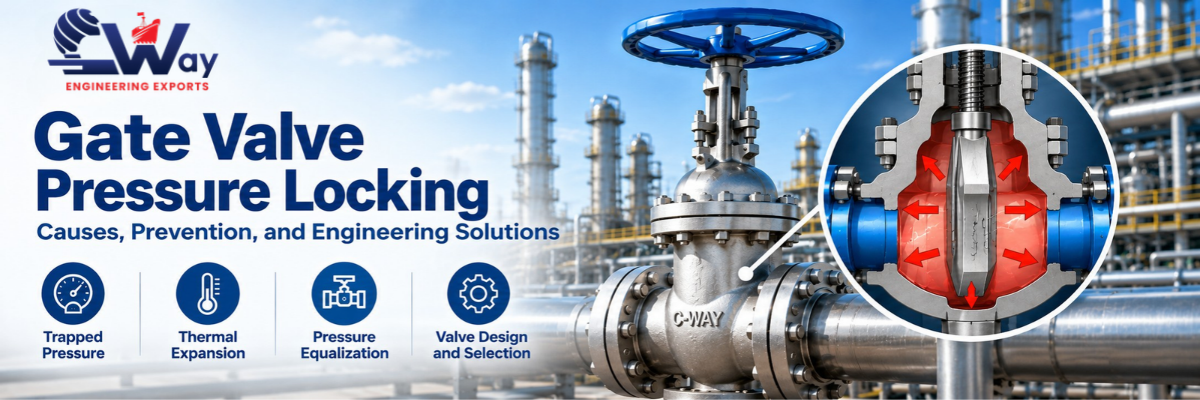
Understanding Gate Valve Pressure Locking
Gate valve pressure locking is an important operational concern in industrial piping systems, particularly in high-pressure, high-temperature, and steam applications. When pressure becomes trapped inside a valve body cavity, the resulting pressure imbalance can make the gate difficult to open and increase the operating force required.
This problem can affect valve reliability in power plants, oil and gas facilities, refineries, petrochemical plants, and other industrial installations.
Understanding the causes of pressure locking in gate valves helps maintenance engineers, reliability teams, and procurement professionals make informed decisions about valve selection, pressure management, and preventive maintenance.
In this guide, we explain how gate valve pressure locking occurs, how it differs from thermal binding, and which engineering solutions can help reduce the risk.
1. What Is Pressure Locking in a Gate Valve?
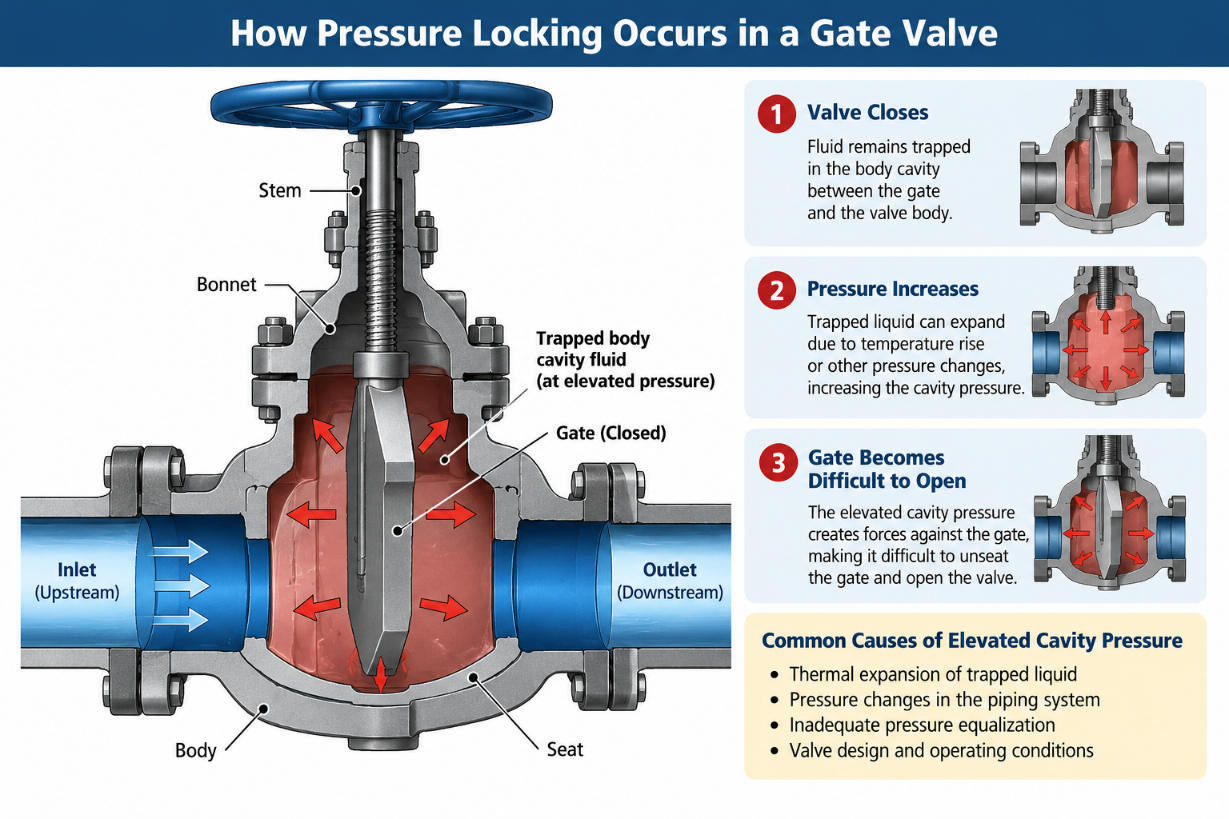
Pressure locking occurs when pressure trapped inside a gate valve body cavity creates unfavorable forces that prevent the valve from opening normally.
When a gate valve closes, fluid may become trapped in the cavity between the gate and the valve body. If the pressure inside this cavity rises or differs significantly from the pressure acting on the other surfaces of the gate, the resulting forces can increase the force required to unseat the gate.
As a result, the valve may become difficult to operate even when its stem, actuator, and other components appear to be functioning normally.
Common Symptoms of Gate Valve Pressure Locking
Typical warning signs include:
- The valve becomes difficult to open after remaining closed.
- Operating torque or stem thrust increases unexpectedly.
- The valve becomes difficult to operate after a change in pressure or temperature.
- An actuator cannot move the gate under expected operating conditions.
- The valve fails to open despite following the normal operating procedure.
These symptoms do not necessarily confirm pressure locking. Mechanical damage, corrosion, deposits, actuator problems, and thermal binding can produce similar symptoms. Proper investigation is necessary to identify the root cause.
2. What Causes Pressure Locking in Gate Valves?
Several factors can contribute to gate valve pressure locking. The actual mechanism depends on the valve design, process fluid, pressure conditions, and operating sequence.
Trapped Pressure in the Body Cavity
When a gate valve is closed, fluid may become trapped inside the body cavity. If the cavity is isolated from the surrounding piping, its pressure may differ from the upstream and downstream pressures.
This pressure imbalance can create additional forces on the gate, increasing the force required to open the valve.
Thermal Expansion of Trapped Liquid
Thermal expansion is a significant concern when liquid becomes trapped in a confined space.
If the temperature of the trapped liquid increases, the liquid expands. Because the cavity offers limited space for expansion, its pressure can rise substantially.
For example, a closed gate valve in a hot-water or steam-related system may contain trapped liquid that heats up during operation. Depending on the valve design and operating conditions, this can create excessive body cavity pressure and increase the difficulty of opening the valve.
Trapped-liquid expansion can also create a serious overpressure hazard. It must be considered during system design and valve selection.
Pressure Differences Across the Gate
Pressure differences between the body cavity and adjacent piping can create forces that resist gate movement.
The effect depends on the effective pressure areas, gate geometry, and pressure conditions on each side of the closure element.
When these forces exceed the normal operating requirements, the valve or actuator may be unable to open the gate as intended.
Inadequate Pressure Equalization
Pressure locking risks can increase when a valve design or piping arrangement does not adequately manage pressure trapped in the body cavity.
The appropriate solution may involve a manufacturer-approved cavity pressure-relief feature, a suitable pressure-relief device, or another engineered arrangement.
An external bypass may help equalize pressure across the main valve, but it does not automatically relieve pressure trapped inside the valve body.
3. Pressure Locking vs. Thermal Binding in Gate Valves
For a deeper understanding of temperature-related valve operating problems, read our guide to gate valve thermal binding in high-temperature steam service, including its causes, prevention methods, and wedge selection considerations.
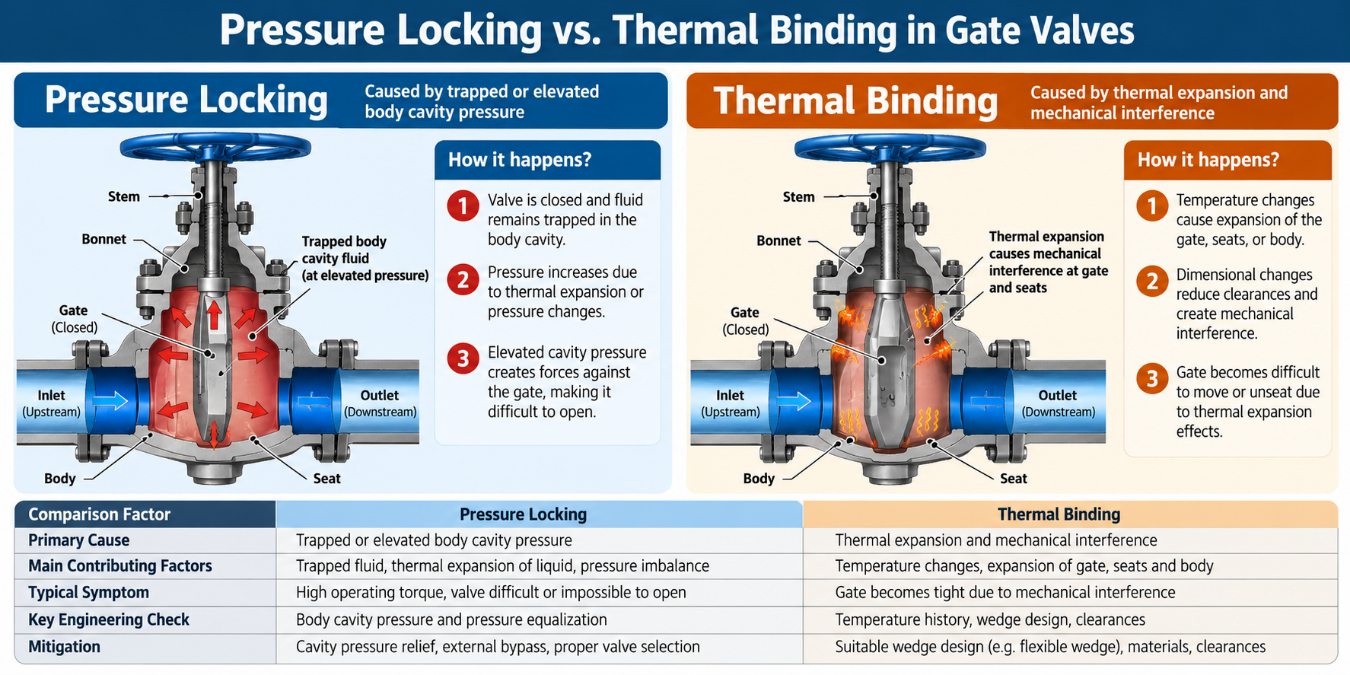
Pressure locking and thermal binding can produce similar symptoms, but they are different operating problems.
| Factor | Pressure Locking | Thermal Binding |
|---|---|---|
| Primary mechanism | Trapped or elevated cavity pressure creates unfavorable forces | Temperature-related dimensional changes cause mechanical interference |
| Contributing factors | Trapped fluid, pressure imbalance, thermal expansion of liquid | Thermal expansion of the gate, seats and related components |
| Investigation focus | Cavity pressure and pressure-management provisions | Temperature history, wedge geometry, clearances and seat contact |
| Potential mitigation | Engineered cavity pressure relief or equalization where appropriate | Suitable wedge design, materials, clearances and procedures |
| Can both occur? | Yes. Both may occur in the same valve, particularly with significant temperature and pressure changes. | |
Both conditions can occur in the same valve, particularly in applications involving significant temperature changes.
The distinction matters because a solution that addresses thermal binding may not resolve pressure locking, and vice versa.
For more information, see our related article on gate valve thermal binding: causes, prevention, and solutions.
4. How to Prevent Pressure Locking in Gate Valves
Preventing pressure locking begins with understanding the operating conditions and identifying whether the valve can trap fluid under pressure.
Select the Appropriate Gate Valve Design
Gate valves are available in several configurations, including solid wedge, flexible wedge, and parallel slide designs.
When selecting a valve for demanding service, engineers should consider:
- Nominal size and pressure rating.
- Operating and design temperatures.
- Process fluid and its thermal expansion characteristics.
- Body cavity configuration.
- Potential for trapped liquid.
- Pressure-relief and equalization requirements.
- Operating torque or stem thrust.
- Manufacturer-specific installation and operating requirements.
Valve selection should be based on the complete service conditions rather than pressure class or nominal size alone.
Choosing the right gate valve configuration requires an understanding of its construction, operating mechanism, and service requirements. Explore our wedge gate valve types, operation, and selection guide for more information.
Evaluate Body Cavity Pressure
Engineers should determine whether the closed valve can trap fluid and whether subsequent pressure or temperature changes could increase cavity pressure.
The assessment should cover normal operation, startup, shutdown, isolation, and maintenance conditions.
Where trapped-fluid expansion or cavity pressurization presents a credible risk, an appropriate pressure-management arrangement may be required.
Review Operating Procedures
Valve operating sequences can affect the pressure conditions inside the body cavity.
Approved procedures should address pressure equalization, isolation, and changes in operating conditions where relevant.
Operators should never attempt to overcome suspected pressure locking by applying excessive force or using an improvised pressure-release method.
Verify Actuator Sizing
An undersized actuator can contribute to valve opening problems. However, installing a larger actuator is not a universal solution to pressure locking.
Excessive cavity pressure may remain unresolved and can impose abnormal loads on the stem, gate, seats, and other components.
Actuator sizing should account for the manufacturer’s operating requirements and credible pressure-related loads.
5. External Bypass vs. Body Cavity Pressure Relief
External bypass arrangements and body cavity pressure-relief features can both be relevant to pressure management, but they serve different purposes.
External Bypass for Gate Valve Pressure Equalization
An external bypass typically provides an alternate flow path between the upstream and downstream sides of the main valve.
When appropriately designed and operated, it can help reduce the differential pressure across the closed gate valve before opening.
This can be useful in applications where differential pressure makes valve operation difficult.
However, an external bypass does not necessarily relieve pressure trapped inside the valve body cavity.
Body Cavity Pressure Relief
A cavity pressure-relief arrangement is intended to manage pressure trapped within the valve body cavity.
Depending on the valve design and service conditions, this may involve a manufacturer-engineered relief passage or a suitable pressure-relief device.
The arrangement must account for relief direction, process fluid, pressure limits, installation requirements, and the safe destination of the relieved fluid.
| Feature | External Bypass | Body Cavity Pressure Relief |
|---|---|---|
| Primary purpose | Reduce pressure difference across the main valve | Manage pressure trapped inside the valve cavity |
| Typical arrangement | Separate piping and a bypass valve | Engineered cavity-relief feature or pressure-relief device |
| Main consideration | Upstream and downstream pressure conditions | Cavity pressure and safe relief routing |
| Key limitation | May not relieve trapped cavity pressure | Must be engineered for the valve and application |
The correct solution depends on the actual source of the pressure imbalance. Neither arrangement should be selected without reviewing the valve design and operating conditions.
6. Solid Wedge vs. Flexible Wedge vs. Parallel Slide Gate Valves
Gate valve design can influence operating behavior, but no design should automatically be considered immune to pressure locking.
Solid Wedge Gate Valve
A solid wedge gate valve uses a relatively rigid wedge to provide shutoff against the seats.
Its suitability depends on the pressure and temperature conditions, materials, wedge geometry, and potential for thermal distortion or mechanical interference.
Flexible Wedge Gate Valve
A flexible wedge gate valve incorporates a designed degree of flexibility that can accommodate certain thermal and mechanical effects.
This can help reduce some thermal binding concerns in appropriate applications.
However, flexible wedge construction does not automatically prevent pressure locking. Body cavity pressure and pressure-management provisions must be evaluated separately.
Parallel Slide Gate Valve
A parallel slide gate valve uses parallel seating surfaces rather than a conventional wedge-shaped closure element.
Its operating characteristics and pressure-locking risk depend on the specific design, cavity configuration, and operating conditions.
Comparison of Gate Valve Designs
| Factor | Solid Wedge | Flexible Wedge | Parallel Slide |
|---|---|---|---|
| Closure design | Relatively rigid wedge | Wedge with designed flexibility | Parallel seating arrangement |
| Thermal accommodation | Depends on design and service | Can accommodate certain thermal effects | Depends on the specific configuration |
| Pressure-locking risk | Possible | Also possible | Design- and service-dependent |
| Selection priority | Process conditions, pressure, temperature, cavity configuration, manufacturer design and project requirements | ||
The best choice depends on the process requirements and manufacturer’s design documentation. Engineers should evaluate thermal binding and pressure locking as separate, although potentially related, concerns.
To compare wedge configurations in greater detail, read our guide to solid wedge, flexible wedge, and split wedge gate valves, including their construction, advantages, and selection considerations.
7. Gate Valve Pressure Locking: Troubleshooting and Selection Checklist
When a gate valve becomes difficult to open, maintenance teams should investigate the underlying cause before deciding on corrective action.
Use the following checklist to support the investigation.
| Inspection Area | What to Check |
|---|---|
| Operating history | Did the problem occur after heating, cooling, shutdown or a pressure change? |
| Pressure conditions | What are upstream and downstream pressures, and what is known about cavity pressure? |
| Body cavity | Can fluid become trapped inside the valve? |
| Temperature conditions | Could trapped liquid have experienced thermal expansion? |
| Valve design | Are cavity pressure-relief or equalization provisions required? |
| Operating mechanism | Could stem damage or actuator malfunction be involved? |
| Valve condition | Are corrosion, deposits or seat damage contributing? |
| Documentation | Are manufacturer operating instructions and design details available? |
If pressure locking is suspected, do not force the valve open or loosen pressure-retaining components to release trapped pressure. Follow the facility’s approved isolation, depressurization, and safety procedures.
Safety warning: If pressure locking is suspected, do not force the valve open or loosen pressure-retaining components to release trapped pressure. Follow the facility’s approved isolation, depressurization and safety procedures, and consult the valve manufacturer or responsible engineering team.
Gate Valve Selection for High-Pressure and High-Temperature Applications
Selecting a gate valve for demanding industrial service requires more than matching the nominal pipe size and pressure class.
Information Required When Selecting a Gate Valve
When requesting a quotation for a gate valve intended for demanding service, provide the following information:
- Valve type and nominal size.
- Pressure class or PN rating.
- Body, bonnet, gate, and stem materials.
- Process fluid and operating temperature.
- Design pressure and operating pressure.
- Potential for trapped liquid and thermal expansion.
- Required cavity pressure-management provisions.
- Applicable design, testing, and documentation requirements.
Depending on the valve type and project specification, relevant standards may include API 600, API 602, ASME B16.34, API 598, and ASME B16.10. The applicable standards should be verified for the selected valve.
Providing complete technical details helps manufacturers and suppliers assess the application and identify a suitable configuration.
Explore C-Way Engineering Exports’ industrial gate valves to review available valve configurations, materials, pressure ratings, and application options.
Industries Where Gate Valve Pressure Locking Requires Attention
Gate valve pressure locking can affect industrial systems where fluid becomes trapped inside the valve body cavity, particularly under changing pressure and temperature conditions.
- Oil and Gas:Pressure variations and demanding isolation requirements make proper gate valve selection essential across upstream, midstream, and downstream operations.
- Power Generation:Steam and high-temperature water systems require attention to trapped-fluid pressure and thermal binding during startup, shutdown, and operation.
- Chemical and Petrochemical:Valve materials and pressure-relief arrangements must suit the process fluid, operating conditions, and safety requirements.
- Refining:High-pressure and high-temperature applications require careful evaluation of body cavity pressure and valve operating conditions.
- Water and Industrial Utilities:Trapped liquid can expand as temperatures rise, potentially increasing body cavity pressure.
Across all these industries, appropriate valve selection and pressure management help reduce pressure-locking risks and improve operational reliability.
Frequently Asked Questions About Gate Valve Pressure Locking
What causes pressure locking in gate valves?
Pressure locking can occur when trapped or elevated body cavity pressure creates unfavorable forces on the gate. Trapped-liquid thermal expansion and pressure differences can contribute.
How can you prevent pressure locking in a gate valve?
Prevention may involve appropriate valve selection, evaluation of body cavity pressure, engineered pressure-relief or equalization provisions, and approved operating procedures. The solution should be based on the specific valve design and service conditions.
Can an external bypass prevent gate valve pressure locking?
An external bypass can help equalize pressure across the main valve, but it does not necessarily relieve pressure trapped inside the body cavity. Identify the actual pressure imbalance before selecting a solution.
Do flexible wedge gate valves prevent pressure locking?
No. Flexible wedge construction can accommodate certain thermal and mechanical effects, but it does not automatically eliminate pressure locking. Cavity pressure and pressure-management provisions must be assessed separately.
What is the purpose of a gate valve pressure-relief hole?
In certain designs, a pressure-relief hole or passage provides a route for cavity pressure equalization in a defined direction. Its suitability depends on the valve configuration, flow direction, process fluid and operating conditions. Confirm the design with the manufacturer.
What is the difference between pressure locking and thermal binding?
Pressure locking involves unfavorable pressure forces associated with trapped or elevated cavity pressure. Thermal binding involves mechanical interference caused by temperature-related dimensional changes. Both conditions can occur in the same valve.
Conclusion
Gate valve pressure locking can interfere with normal valve operation and create reliability and safety concerns in industrial piping systems.
The key to prevention is understanding how pressure can become trapped inside the valve body cavity and evaluating the effects of pressure differentials, thermal expansion, valve design, and operating procedures.
External bypasses, cavity pressure-relief arrangements, and different gate valve configurations can all be relevant, but their suitability depends on the actual application.
By assessing these factors during valve selection and system design, engineers can reduce the risk of pressure-related operating problems and make better-informed equipment decisions.
Looking for Industrial Gate Valves for Your Application?
C-Way Engineering Exports supplies industrial valves, pipe fittings, flanges and related piping products for customers across oil and gas, chemical processing, power generation, water treatment and other industrial sectors.
Share your valve size, pressure class, material requirements, process conditions and applicable standards with our team to discuss your requirements.
Explore industrial gate valve options
or
contact C-Way Engineering Exports
for product inquiries and technical specifications.


